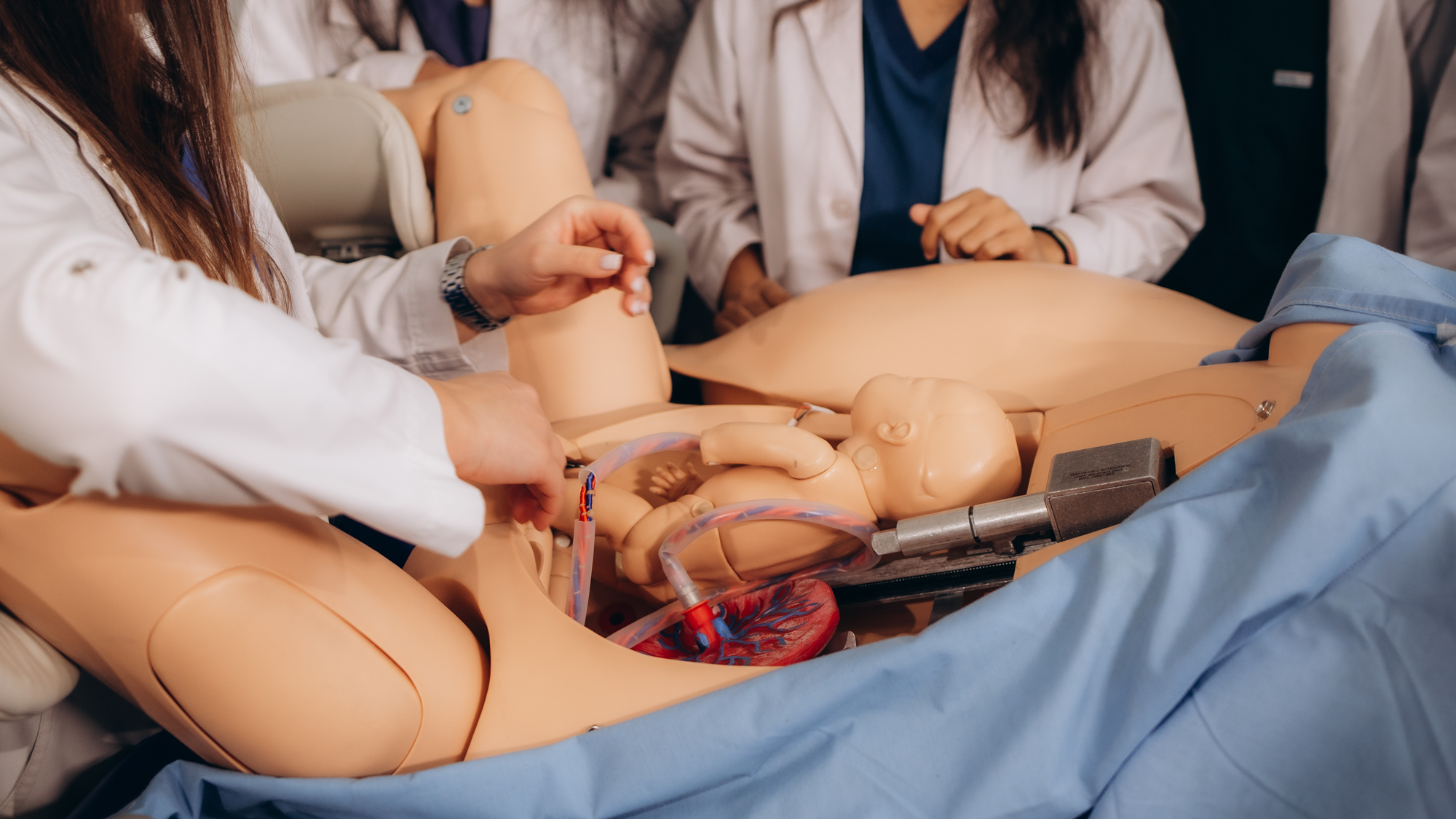

Have you ever considered simulation beyond its use for education? Many of us may have triggering memories from nursing school or annual unit-based trainings with the mention of simulation. However, simulation is also a powerful tool for systems assessment and improvement that many healthcare organizations are dramatically underutilizing. For nurses, this represents both an opportunity and a call to action.
According to a 2021 survey by Gilbert et al., 96% of hospitals use simulation primarily for education, while only 37% use it for systems integration and testing, 30% for error investigation, and 15% for research. Expanding simulation beyond training to include systems testing and integration can improve financial performance and maximize resources.
Brazil (2017) first defined the term “translational simulation” to describe this subset of simulation activities, “as a functional term for how simulation may be connected directly with health service priorities and patient outcomes, through interventional and diagnostic functions” (p. 1). This represents a paradigm shift from education alone to healthcare system improvement and patient safety. While many associate this with in situ simulation, or simulation delivered within the clinical setting, it’s more about the purpose – the ‘why’ – than the location (Brazil, 2017; Brazil & Reedy, 2024). It serves two critical functions: (1) diagnosis – using simulation to “explore healthcare work environments and teams,” (2) intervention – using simulation to “improve healthcare teams and systems” through testing and implementation, or both (Brazil & Reedy, 2024, p. 7). However, education remains a hallmark of simulation as knowledge, skills, and changing attitudes contribute heavily to quality and safety outcomes within a team or system.
Building on quality improvement principals, Brazil and Reedy (2024) identify three core concepts essential to translational simulation: (1) clear identification of the purpose of the simulation – exploration, improvement, or both; (2) articulation of the simulation process combining quality improvement and simulation methods; (3) intersections with conceptual foundations – considering interprofessional and interdisciplinary theoretical/conceptual approaches.
In practice, translational simulation has been successfully used for COVID-19 pandemic response systems, physical space and clinical process design, teamwork and culture change, and healthcare systems integration (Brazil & Reedy, 2024). However, it is not without challenges or barriers, such as a lack of standardized definitions and measures, a need for interdisciplinary integration, and external factors such as organizational support (Paganotti et al., 2024). Translational simulation also requires a different set of skills than educational simulation, including knowledge in quality improvement, safety, systems thinking, and specific data measurement (Brazil & Reedy, 2024; Paganotti et al., 2024).
Nurses are uniquely positioned at the bedside with assessment and problem-solving skills to identify systems problems and ideas. Translational simulation can validate nursing observations and drive change, providing data to support improvements and innovations while engaging interprofessional and interdisciplinary teams to create safer systems for both patients and staff.
Sarah L. Beebe orcid.org/0000-0002-4679-4008
Dr. Sarah Beebe is the founder of Two Bees Consulting, LLC, specializing in translational simulation, healthcare quality improvement, and simulation center accreditation. With a PhD in Nursing Science from George Washington University and certifications as a Healthcare Simulation Educator (CHSE) and Lean Six Sigma Green Belt (CLSSGB), Dr. Beebe brings over a decade of experience in simulation-based education and system transformation. She successfully established a 10,000 sq. ft. hospital-based simulation center that achieved full accreditation in under three years. Two Bees Consulting offers services in simulation program development, accreditation preparation, faculty development, and translational simulation implementation. Learn more at twobeesconsulting.com/ or contact Dr. Beebe at twobeesconsultingllc@gmail.com.
Conflict of Interest: I am the sole proprietor of Two Bees Consulting, LLC, where I provide consulting services for a fee for translational simulation.
Correspondence concerning the article should be addressed to Sarah L. Beebe, Two Bees Consulting, LLC, 5 Liszar Drive, Lewes, DE 19958.
References
Berwick D. M. (1996). A primer on leading the improvement of systems. BMJ (Clinical research ed.), 312(7031), 619–622. https://doi.org/10.1136/bmj.312.7031.619
Brazil V. (2017). Translational simulation: not ‘where?’ but ‘why?’ A functional view of in situ simulation. Advances in simulation (London, England), 2, 20. https://doi.org/10.1186/s41077-017-0052-3
Brazil, V., & Reedy, G. (2024). Translational simulation revisited: an evolving conceptual model for the contribution of simulation to healthcare quality and safety. Advances in simulation (London, England), 9(1), 16. https://doi.org/10.1186/s41077-024-00291-6
Gilbert, M., Waxman, K. T., Gilbert, G. E., & Congenie, K. (2021). The Scope of Hospital-Based Simulation. The Journal of nursing administration, 51(2), 74–80. https://doi.org/10.1097/NNA.0000000000000973
Paganotti, L. A., Shope, R., Calhoun, A., & McDonald, P. L. (2024). Barriers and Facilitators to Implementing Simulation-Based Translational Research: A Qualitative Study. Simulation in healthcare : journal of the Society for Simulation in Healthcare, 19(4), 220–227. https://journals.lww.com/simulationinhealthcare/abstract/2024/08000/barriers_and_facilitators_to_implementing.3.aspx