
 As thoughts about this column started to swirl about in my head in November 2025, I was watching Ken Burns’ documentary, The American Revolution. You are reading this column in March of 2026 and have experienced the move into 2026, Black History Month and are now in Women’s History Month. So, it is a perfect time to look at some women who have made an impact on nursing.
Meet Mary Bailey!
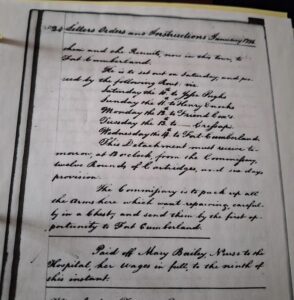
While completing my studies at CSUSB and conducting research for my Senior Honor’s Project (2005) about Nurses in the Military, I found the following written in George Washington’s hand: “Letters Orders and Instructions January 1756: Paid off Mary Bailey, Nurse to the Hospital, her wages in full, to the ninth of this instant.”[i] What is interesting about Washington’s entry is that while he was of the opinion that women didn’t belong in camp with the soldiers – a view he had during the French & Indian War and carried through during the American Revolution – he also recognized that his soldiers needed care when wounded, food (if it could be found) to nourish their bodies, and men to stay at the front. If the men were worried about their families, they would leave at the end of their conscription or they would be AWOL. Hence, by the time of the American Revolution, Washington realized that women were a necessity to the men and the women knew that in many cases, they were safer with their men on the front than in their homes awaiting raids by the British. Of note is that her name surfaced in the pages of Richard Berleth book Bloody Mohawk: The French and Indian War & American Revolution on New York’s Frontier (2009).
Now let’s enter the 19th Century and meet two amazing nurses on opposite sides of the Atlantic.
Meet Mrs. Mary Seacole!
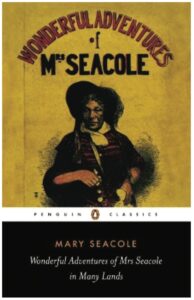
Some of you may be familiar with Mary Seacole and others may not so let me introduce you. Mary Jane Grant was born in 1805 in Kingston, Jamaica. Her mother was Creole and her father was a Scots and when she was 2 years of age, Jamaica abolished the Slave Trade Act, but slavery was still an institution until 1838 when Britain fully emancipated all colonies of its empire.
At the age of 12, she started to learn nursing by aiding her mother and other elder women who cared for British officers and their wives stationed in Jamaica. By the time of her marriage to Mr. Seacole in 1836, she was a “doctress” who knew the importance of herbs and how to create remedies from them to heal the sick. Following personal tragedies of widowhood, death of her mother and loss of her home, she returned to being a nurse and doctress to the British military. In her book, she writes about her life and world adventures and her years in the Crimea. She was a contemporary of Florence Nightingale although not a person Nightingale would describe as a friend.
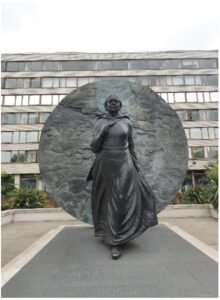
Mrs. Seacole served caring for the wounded and establishing a residence where they could come to recover and heal. She later moved to England and made an impact on health care in Britain. She was recognized by Queen Victoria and other members of the royal family.
In 2016, this statue to Mrs. Mary Seacole was unveiled in front of St. Thomas Hospital – a place where two great women of nursing history finally stand together.[ii]
Now to our side of the Atlantic.
Meet Emma E. Edmonds!
As nurses, we are privileged to be with people during times when they are most vulnerable or to step into the role of a confidant when people feel they can share secrets or deep feelings they may not be able to share with their family. But did you ever think that nurses could be spies?
Emma E. Edmonds did! In fact, she volunteered for the role!
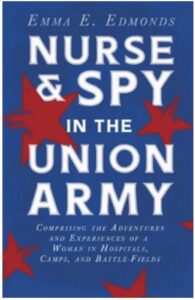
As a nurse in the Union Army, Miss Edmonds recorded all the awful wounds she saw, how the soldiers handled their wounds, their worries for their families that they knew they would never see again, letters that Edmonds wrote home on behalf of these boys, and many other experiences with a clergy family ministering to the soldiers and camp followers.
Then, when life in the military camps and on the battlefields were not going to well for the Union, she volunteered to serve as a spy. She was of small stature, and her visage was not completely feminine so with these attributes and her imagination and cunning, she was able to adapt, listen, and report back to help the Union Army and others.
That’s it for this issue. Check out these books from your library and enjoy the readings.
Until next time,
Trudy
Washington, George. George Washington Papers at the Library of Congress 1741-1799: Series 2 Letterbooks, page 24 image 27, https://www.loc.gov/collections/ cited in Matheke, T., (2005) Nursing in Combat: Oral History Project, unpublished Senior Honors Project, History 597, CSUSB.
Image of Mary Seacole Statue, https://www.maryseacoletrust.org.uk/mary-seacole-statue/
Book Cover of Emma E. Edmonds, https://www.perlego.com/book/2699502/nurse-and-spy-in-the-union-army-comprising-the-adventures-and-experiences-of-a-woman-in-hospitals-camps-and-battlefields-with-the-introductory-chapter-the-ethos-of-the-spy-pdf