
The New Jersey Collaborating Center for Nursing (NJCCN) launched a Nurse Residency Collaborative in 2020 utilizing the Vizient/American Association of Colleges of Nursing (AACN) Nurse Residency Program (NRP)™. The Vizient/AACN NRP includes an evidence-based curriculum and resources, a platform for nurse resident data including formative and summative surveys, networking, and support.

As shown in Figure 1, there are currently 22 hospitals across the state participating in the collaborative, and 64% of them receive partial funding from a grant coordinated by NJCCN from the NJ Department of Labor and Workforce Development. This grant requires hospitals to follow an apprenticeship model where nurse residents are paired with a preceptor for 2,000 clinical hours and complete 144 or more content hours during their first year on the job. NJCCN is currently in the sixth cycle of this grant and has enrolled more than 3,000 full-time nurse residents to date.
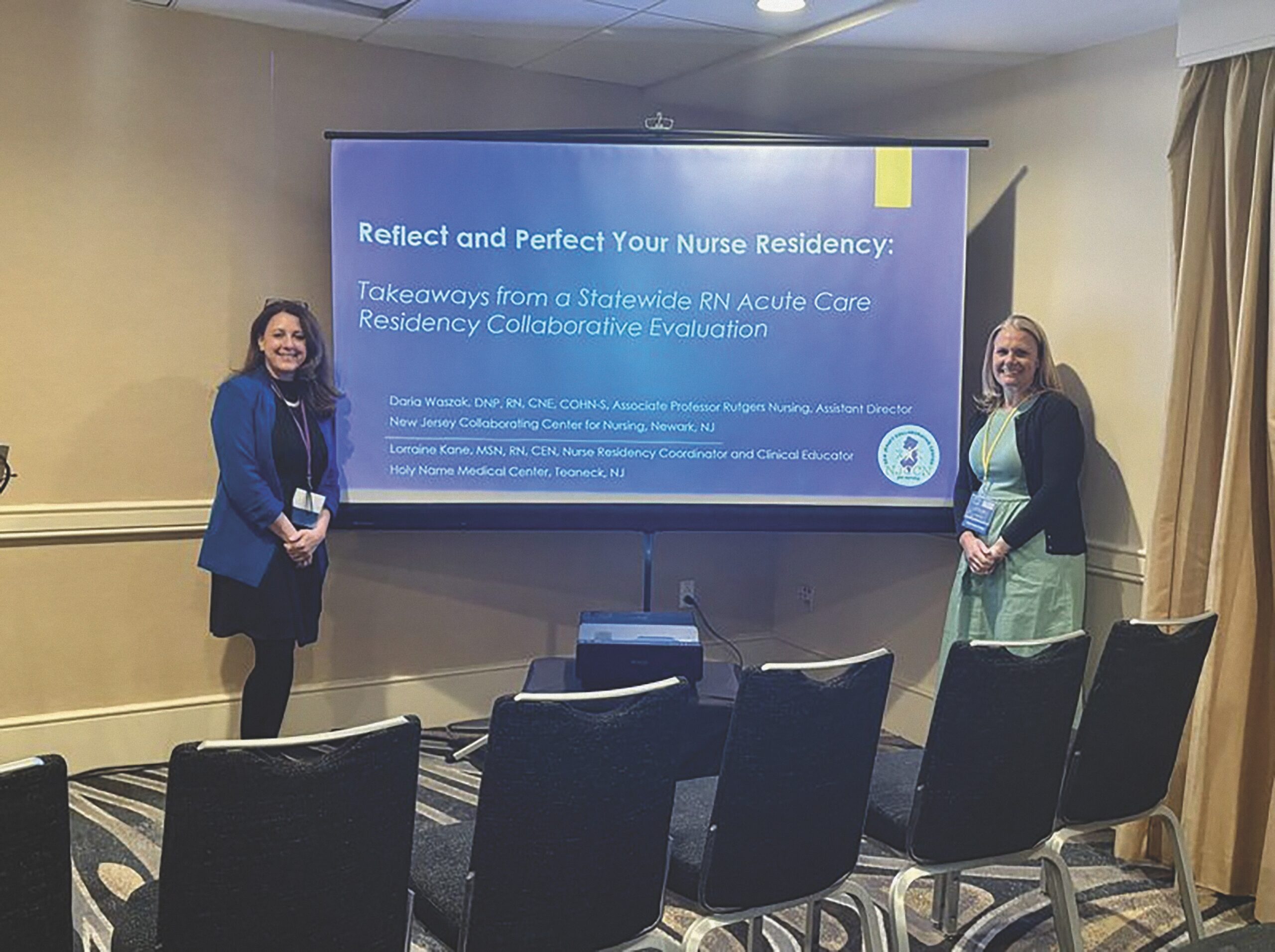
An evaluation of the 2022-2023 cohorts in the Nurse Residency Collaborative showed outcomes that aligned well with Vizient’s national benchmarks for competency and confidence, with a retention rate of 89-90%. This is about 12% higher than the average first-year RN retention rate in 2023 (NSI Nursing Solutions, 2024). Additionally, hospitals participating in the grant-funded apprenticeship had a slightly higher retention rate than the other hospitals in NJCCN’s Nurse Residency Collaborative. These findings were published in the Journal of Continuing Education in Nursing and were consistent with previous cohort outcomes (Cadmus & Roberts, 2022; Waszak et al., 2025). Dr. Daria Waszak, Executive Director of NJCCN, presented an overview of these findings at the National Forum of State Nursing Workforce Centers Conference in Philadelphia in June 2025, along with Lorraine Kane, Nurse Residency Coordinator/Clinical Educator at Holy Name Medical Center. As explained by Kane, “Nurse residency programs offer several benefits to new nurses. These programs offer coaching, peer support and help new nurses build clinical skills, critical thinking, and decision-making abilities faster. Also, when nurses feel supported, they tend to feel a greater sense of accomplishment which leads to less stress and burnout. Holy Name’s nurse residency program is very fortunate to have the support of Vizient which provides essential learning materials we often use throughout our topical sessions.”
Several hospitals in the Nurse Residency Collaborative, including Holy Name Medical Center, earned ANCC Practice Transition Accreditation Program® (PTAP) designation for their NRPs. Other hospitals in the Nurse Residency Collaborative with PTAP designation include Capital Health Medical Center, Englewood Hospital, University Hospital, and most recently, Inspira Health’s Elmer, Vineland, and Mullica Hill hospitals.
Other transition to practice programs currently coordinated by NJCCN are in the sectors of School Nursing, Long Term Care, and Advanced Practice (in a variety of specialties). For more information on these programs, visit the NJCCN website at https://www.njccn.org. Reach out to Dr. Waszak at daria.waszak@rutgers.edu if you are interested in having your organization join one of these transition-to-practice program collaboratives. n
References
Cadmus, E. & Roberts, M.L. (2022). First year outcomes: Program evaluation of a statewide nurse residency program. J Nurse Adm, 52(12), 672–678. https://doi.org/10.1097/NNA.0000000000001230
Nursing Solutions, Inc. (2024). NSI National Health Care Retention and RN Staffing Report.NSI; https://www.nsinursingsolutions.com/Documents/Library/NSI_National_Health_Care_Retention_Report.pdf
Waszak, D.L., Cadmus, E., & Roberts, M.L. (2025, Aug). Evaluation of a Statewide Registered Nurse Residency Collaborative: An Apprenticeship Model in Acute Care, The Journal of Continuing Education in Nursing, 56(8), 337-343 https://doi.org/10.3928/00220124-20250717-01