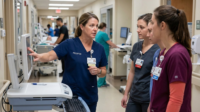


The computer screen flickered in the pre-dawn darkness as she reviewed lab results that arrived overnight. Alone in the clinic, the nurse practitioner made decisions that once required a team of physicians. Adjust the diabetes medication. Order the cardiac workup. Schedule the psychiatric consultation. The waiting room would soon fill with 40 patients scheduled for 15-minute slots that invariably stretched longer.
This is rural healthcare in the 21st century: nurses practicing at the full scope of their training, their contributions often undercompensated despite their central role. This daily reality reflects decades of systemic change.
Grant County’s physician shortage, which began reaching critical levels in the 1990s, has only worsened. Dr. Twana Sparks observed the impact firsthand, “In the evolution of medicine, particularly for rural areas. . . now we have almost no doctors in town. We have nurse practitioners and physicians’ assistants that are essentially running medical care here, and most of them are women.”
The State of New Mexico allows nurse practitioners independent practice authority. In Grant County, this autonomy proves essential. Nurse practitioners and physician assistants didn’t just fill gaps—they became the healthcare system itself. But assuming physicians’ responsibilities didn’t translate to physicians’ recognition.
In 2010, female surgical staff at the hospital discovered the men’s locker room was twice the size of the women’s, despite serving only 5 men compared to 40 women. When one surgeon suggested switching rooms, the response was fierce. “I never heard such a surprising hue and cry about how unfair it was for those men to give up their dressing room,” she recalled. The hospital required a formal study counting square footage per person before making the switch. The episode revealed how inequity adapts rather than disappears, manifesting in space allocation and institutional response rather than outright exclusion.
Still, women found ways to create change within these constraints. In 2015, nurses at what is now Gila Regional Medical Center aided in securing the Baby-Friendly designation. According to Dr. Barbara Mora, the initiative emerged when “50% of mothers presenting to labor and delivery [were] coming with no prenatal care.” They secured grants ensuring pregnancy-based Medicaid eligibility could begin during pregnancy. “The nurses there took leadership way back. . . they were the leaders to get this grant,” Mora noted. “Most people don’t know that.”
Beyond institutional achievements, a quieter revolution was occurring in examination rooms across Grant County. Traditional healing practices, marginalized for decades, found renewed relevance. Dr. Marie Weil, a psychologist, described a telling encounter: “A woman very softly asked me if I would do a blessing. I asked her if she could tell me more about what she meant by a blessing, and essentially what she was talking about was a limpia. But she was afraid to say it because she felt that people thought she was crazy.”
These gradual shifts in professional acceptance would soon face their greatest test. March 2020 arrived with familiar echoes of historical pandemics. New Mexico declared a public health emergency on March 11. Governor Michelle Lujan Grisham announced restrictions on March 24, closing non-essential businesses—policies that were both praised and criticized heavily.
The pandemic forced rapid changes, particularly in telehealth. Previously restricted by regulations, virtual visits became essential overnight. But COVID merely amplified existing fractures in rural healthcare access.
Underlying challenges persisted throughout. Psychiatrist Dr. Teresa Arizaga explained, “Access for people receiving services is limited by lack of transportation, not having a stable house to live in, and not having food security. When people have those challenges, they’re not thinking about, ‘Oh, I need to go get my annual exam done.’ When mental health isn’t treated, physical health usually goes untreated. The two go hand in hand.”
School-based clinics emerged as one adaptation. “Their no-show rate goes up during the summer months because they’re dependent on other people to bring them to the appointment,” Arizaga noted. “When they’re at school, the clinic is right there.”
Some areas of women’s healthcare leadership have evolved by returning to their roots. Contemporary midwifery exemplifies this pattern. Today, 30% of deliveries in New Mexico are attended by midwives—triple the national average. This reflects the enduring influence of curandera-parteras who served as the primary maternity caregivers throughout New Mexico’s rural villages for over a century. Modern certified nurse-midwives practice in hospitals, birth centers, and homes, integrating evidence-based practice with cultural understanding and adapting traditional wisdom to contemporary standards.
Yet even these successes occur against a backdrop of mounting challenges. Grant County’s demographics compound every challenge. With 38% of residents over 65, the need for healthcare intensifies as the workforce shrinks. “When you work in a place like Silver City, you aren’t attached to one of the big universities, you can’t just walk across the hall and talk to the specialists,” Dr. Mora explained. “A lot of the time, you’re it.”
Women healthcare providers now hold positions their predecessors couldn’t have imagined—nurse practitioners with prescriptive authority, behavioral health specialists integrating traditional and clinical approaches, certified nurse-midwives practicing independently. Yet they face similar obstacles: geographic isolation, limited resources, and institutional systems that depend on their labor while questioning their leadership.
The fundamental equation remains unchanged: rural areas face challenges in attracting and retaining medical professionals. Solutions, however, are on the horizon. For example, medical school-based telehealth services are expanding across rural New Mexico. WNMU’s nursing program continues to produce graduates who remain when others leave. Women continue transforming rural healthcare through necessity and innovation.
As Grant County faces its future, the question isn’t whether women will continue leading healthcare. The question is whether systems will finally value what they’ve always depended on: women’s expertise, persistence, and refusal to accept that geography should determine health outcomes.
The names change. The challenges persist. The work continues.
The Silver City Museum is actively collecting stories of nurses and healthcare workers from our community. Too often, as even this article demonstrates, nursing stories are told through others’ voices. If you served in any healthcare capacity—or if your mother, grandmother, or aunt did—please contact us at curator@silvercitymuseum.org so these names, stories, and contributions can be documented firsthand and preserved with the authority they deserve.