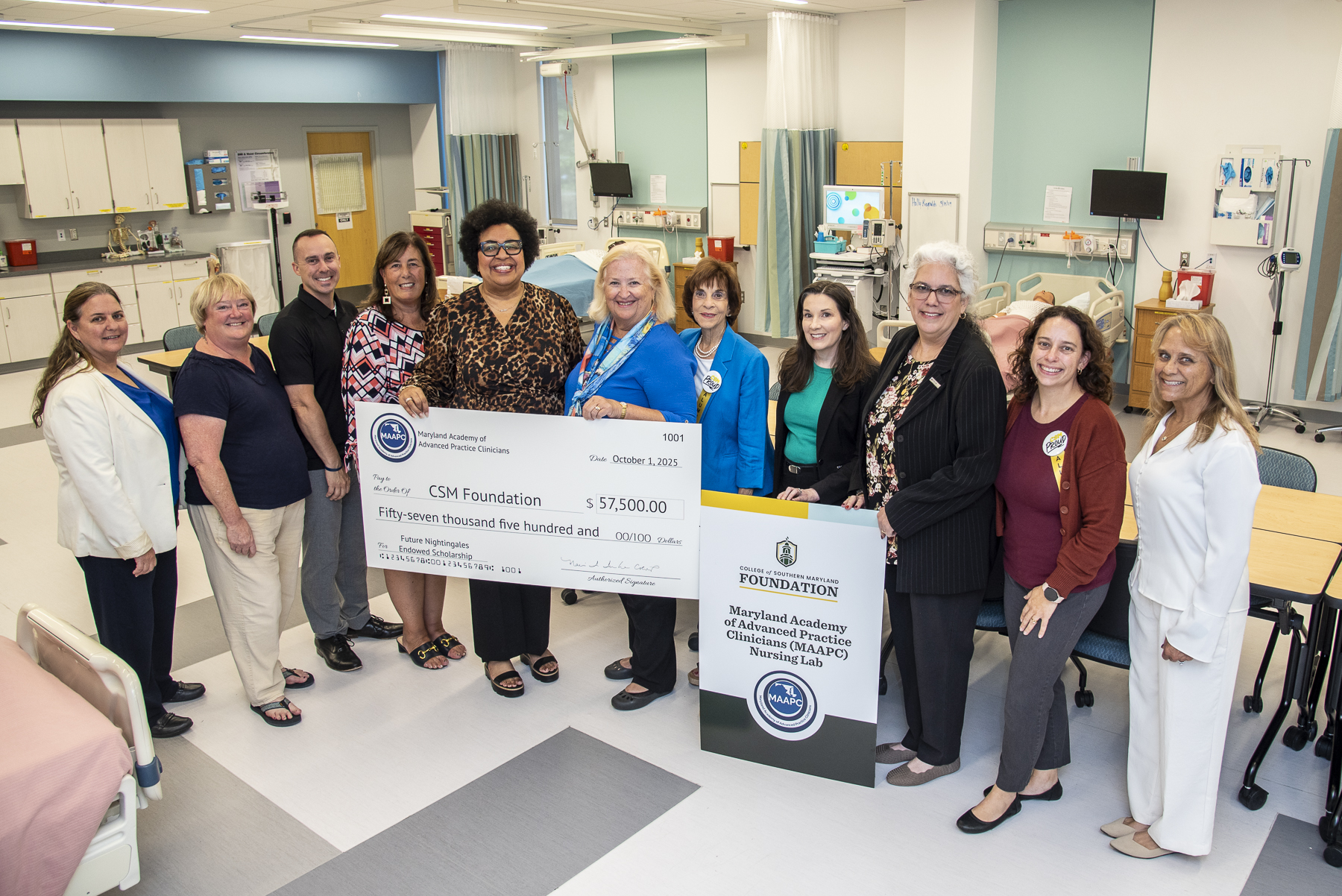

The Maryland Academy of Advanced Practice Clinicians (MAAPC) is proud to announce the establishment of The Future Nightingales Endowed Scholarship in support of full-time first- or second-year associate degree nursing (ADN) students enrolled at the College of Southern Maryland (CSM) with demonstrated financial need. MAAPC Board of Directors and members of Maryland Nurses Association (MNA) District Nine celebrated with CSM faculty and staff at a ceremony on October 1, 2025. This initiative holds special meaning, honoring the organization’s founding leaders who launched their nursing careers from the region. From its inception, MAAPC has been committed to advancing and supporting nursing education through innovative continuing education programs which focus on clinical practice, pharmacology, and leadership development. By establishing this scholarship, MAAPC honors its roots in Southern Maryland while investing in the next generation of nursing professionals.
Evidence Supporting Scholarships
The literature provides compelling evidence that scholarships for entry-to-practice ADN programs effectively address both individual poverty and critical registered nurse (RN) workforce shortages. ADN programs serve as crucial pipelines for economically disadvantaged communities to access stable, well-compensated healthcare careers. Research consistently shows that nursing education provides one of the most reliable pathways out of poverty, offering stable employment, competitive wages, and meaningful work that strengthens entire communities (Association of Women’s Health Obstetric and Neonatal Nurses (AWHONN), 2023; Brownie et al., 2018; Kennison et al., 2024). The accessibility of ADN programs makes them particularly effective for poverty reduction among vulnerable populations. Students attending ADN programs are more likely to come from communities that are economically disadvantaged and are disproportionately Black, Indigenous, and People of Color, as well as first-generation college students and non-native English speakers (AWHONN, 2023; Dos Santos, 2020). These programs can be more cost-effective than traditional four-year baccalaureate programs and specifically serve economically disadvantaged students, non-traditional adult learners, career-changers, and individuals from underrepresented racial and ethnic backgrounds who often face financial constraints and exclusionary admission criteria in Bachelor of Science in Nursing programs (AWHONN, 2023).
Focused support for socioeconomically disadvantaged nursing students has demonstrated high completion rates and first-time NCLEX-RN passage rates, enabling successful workforce entry and economic status improvement (Craft-Blacksheare, 2018; Dos Santos, 2020; Kennison et al., 2024). The retention rates for scholarship recipients strengthens the argument for targeted financial support, with data showing 12-month educational program retention rates of 84% and 1-year workforce retention rates ranging from 83-92% particularly beneficial among non-traditional, adult, and career-changing students (AWHONN, 2023; Dos Santos, 2020; Toyinbo et al., 2023).
Scholarship Impact
Scholarships for ADN programs do more than transform individual lives—it strategically addresses critical nursing workforce shortages through expanding access to nursing education for populations that might otherwise be unable to pursue the profession. By targeting these populations, ADN scholarships help expand the RN workforce and address shortages in regions and communities with the greatest need. Rural and underserved areas in Southern Maryland’s Calvert, Charles, and St. Mary’s Counties desperately need healthcare professionals who understand their communities and are committed to staying local. The geographic retention patterns of ADN graduates prove particularly valuable as these nurses tend to remain in their local communities rather than migrating to urban areas (Kovner et al., 2011). In addition to increasing the overall supply of RNs, this approach ensures that the workforce reflects the populations served, which is essential for improving health equity. By supporting students from these very communities, we’re building a workforce pipeline that will serve families, neighbors, and future generations.
The dual impact of ADN scholarships creates an effect where individual economic advancement contributes to regional healthcare improvement, while addressing workforce shortages by providing pathways for socioeconomic mobility among disadvantaged populations. This dual benefit for individuals and society makes scholarships for entry-to-practice ADN programs a particularly effective intervention for addressing both poverty reduction and healthcare workforce challenges.
Scholarship Contributions
MAAPC recognizes that today’s associate degree nursing students represent the foundation of tomorrow’s healthcare workforce and potential future advanced practice clinicians who will continue MAAPC’s mission of expanding healthcare access and improving patient outcomes throughout Maryland. MAAPC’s endowed gift ensures support to students in perpetuity. CSM has created a QR code for tax deductible contributions directly to the Future Nightingales Endowed Scholarship. The contribution creates two powerful outcomes: immediate economic opportunity for deserving students and lasting healthcare access for communities. Every dollar contributed to the MAAPC Future Nightingales Endowed Scholarship removes a financial barrier standing between a motivated Maryland resident and a nursing career. The evidence is clear: nursing education elevates individuals and communities alike. The contribution to such scholarship ensures that financial circumstances don’t determine who can answer the call to heal. All donations are tax-deductible through the organization’s 501(c)(3) foundation partnership.
MAAPC remains an all-volunteer nonprofit organization with membership open to all Advanced Practice Clinicians including Nurse Practitioners, clinical nurse specialists, Nurse Midwifes, Nurse Anesthetists, and Physician Assistants. Join MAAPC for the annual Pharmacology Conference on April 18, 2026, in Annapolis, Maryland. For more information about MAAPC, membership benefits, conference details and registration, or scholarship donations, visit https://maapconline.enpnetwork.com or contact them at TheMAAPC@gmail.com
Author Note: I have no known conflict of interest to disclose. Correspondence concerning this article should be addressed to Sabrina Sepulveda at Sabrinacrnp@gmail.com
References
Association of Women’s Health, Obstetric and Neonatal Nurses (AWHONN) (2023). Nursing Workforce.04.004Diversity. Journal of obstetric, gynecologic, and neonatal nursing: (JOGGNN), 52(4), e5–e9. https://doi.org/10.1016/j.jogn.2023.04.004
Brownie, S., Wahedna, A. H., & Crisp, N. (2018). Nursing as a pathway to women’s empowerment and intergenerational mobility. Journal of clinical nursing, 27(21-22), 4050–4057. https://doi.org/10.1111/jocn.14540
Craft-Blacksheare M. (2018). New Careers in Nursing: An Effective Model for Increasing Nursing Workforce Diversity. The Journal of nursing education, 57(3), 178–183. https://pubmed.ncbi.nlm.nih.gov/29505079/
Dos Santos, L. M. (2020). I Want to Become a Registered Nurse as a Non-Traditional, Returning, Evening, and Adult Student in a Community College: A Study of Career-Changing Nursing Students. International Journal of Environmental Research and Public Health, 17(16), 5652. https://doi.org/10.3390/ijerph17165652
Kennison, M., Dzurec, L. C., & Smith, R. J. (2024). Diversifying the Workforce Through Focused Support of Nursing Students With Socioeconomic Challenges. The Journal of Nursing Education, 63(12), 844–849. https://doi.org/10.3928/01484834-20240730-01
Kovner, C. T., Corcoran, S. P., & Brewer, C. S. (2011). The Relative Geographic Immobility Of New Registered Nurses Calls For New Strategies To Augment That Workforce. Health Affairs, 30(12), 2293–2300. https://doi.org/10.1377/hlthaff.2011.0108
Toyinbo, P., Rugs, D., Nedd, N., Wang, X., Hall, K. S., Hyacinthe, M., & Cowan, L. (2023). Retention in nursing education and scholarship programs: Survival analysis of the Veterans Health Administration National Nursing Education Initiative Data. Journal of Advanced Nursing, 79(8), 3069–3081. https://pubmed.ncbi.nlm.nih.gov/36971284/