
Clinical sites are highly coveted and chosen carefully for their ability to meet course objectives and student learning needs1. Until recently, program historical site preferences have routinely been upheld, however the clinical placement process is becoming increasingly complex2 due to an influx of nursing programs, increasing demand for nurses due to workforce shortages3, and the need for practice readiness upon graduation4. Moving away from historical site preferences is necessary for equity among programs yet managing the uncertainty of securing placements rest heavily on faculty and clinical coordinators2.
The South Carolina Board of Nursing allows for up to 50% of course clinical hours to be simulation-based5. Balancing clinical experiences with simulation is a strategy to mitigate strain created when clinical site placements are challenging6. Ensuring that clinical replacement simulations maintain rigor, foster critical-thinking development, include client communication, and develop technical skills is paramount to practice readiness7.
This article reports how a medical-surgical course created a clinical replacement simulation using the International Nursing Association for Clinical Simulation and Learning (INACSL) Standards of Best Practice-Based (SoBP) to achieve course objectives, foster student demonstration of competency, and promote practice readiness.
Methods
INASCL SoBP provides a framework for achieving excellence in simulation-based learning7. The standard of design and the four cornerstones of SoBP (professional integrity, pre-briefing, facilitation, and debriefing)7, were utilized in this course’s simulation implementation.
Design
Criteria to meet this standard include basing simulations on pre-assigned objectives, matching learning modalities to those objectives, facilitate learning on the students’ knowledge, and creating a plausible scenario to guide simulation9. Choices made with design criteria in mind were:
- Selection of course and program objectives, focusing on crucial learning areas—those requiring mastery or ones infrequently seen but imperative to know. Based on this course’s content, intravenous fluid management and SBAR interdisciplinary communication were deemed mastery skills and “therefore,’” included in every scenario. Cardiopulmonary resuscitation, because not seen often, was included to infuse practice opportunity.
- Placing the simulation at the end of the semester “thus,” allowing students’ application of their knowledge obtained throughout the semester during the scenarios.
- Designing a simulated client who encompasses course content and developing scenarios for that client including health decompensation, client education, and interdisciplinary care coordination. As an example, the client designed for this course was an 82-year-old female client with a hip fracture requiring reparative surgery. Past medical history included diabetes, hypertension, and osteoporosis; health issues created were hypoglycemia, fluid volume deficiency, hyperkalemia, cardiac arrest, wound infection requiring dressing recommendations, and discharge education.
- Ensuring that all activities included within the simulation were previously introduced throughout the semester enhancing knowledge application rather than in-time learning.
Professional Integrity
Professional integrity within simulation include implementing evidence-based criteria throughout the experience, ensuring a psychologically safe environment, and maintaining confidentiality8. Choices supporting professional integrity were:
- Core faculty within the course attended training and professional development based on simulation SoBP.
- Providing students with logistical details and description of the simulation early in the course, allowing time for questions, discussions, and awareness to minimize stress.
Pre-Briefing
The purpose of pre-briefing is to provide transparency, establish a learning environment, and prepare students for engagement10. Decisions regarding pre-briefing were:
- Creating an electronic health record (EHR) of the simulated client for student review during the pre-simulation assignment and throughout simulation.
- Designing a pre-simulation assignment requiring student brainstorming of possible health complications the simulated client could experience based on the EHR data and course content provided throughout the semester.
- During the simulation orientation, reviewing course content and skills being applied while assuring any potential emotional responses that could arise are acceptable.
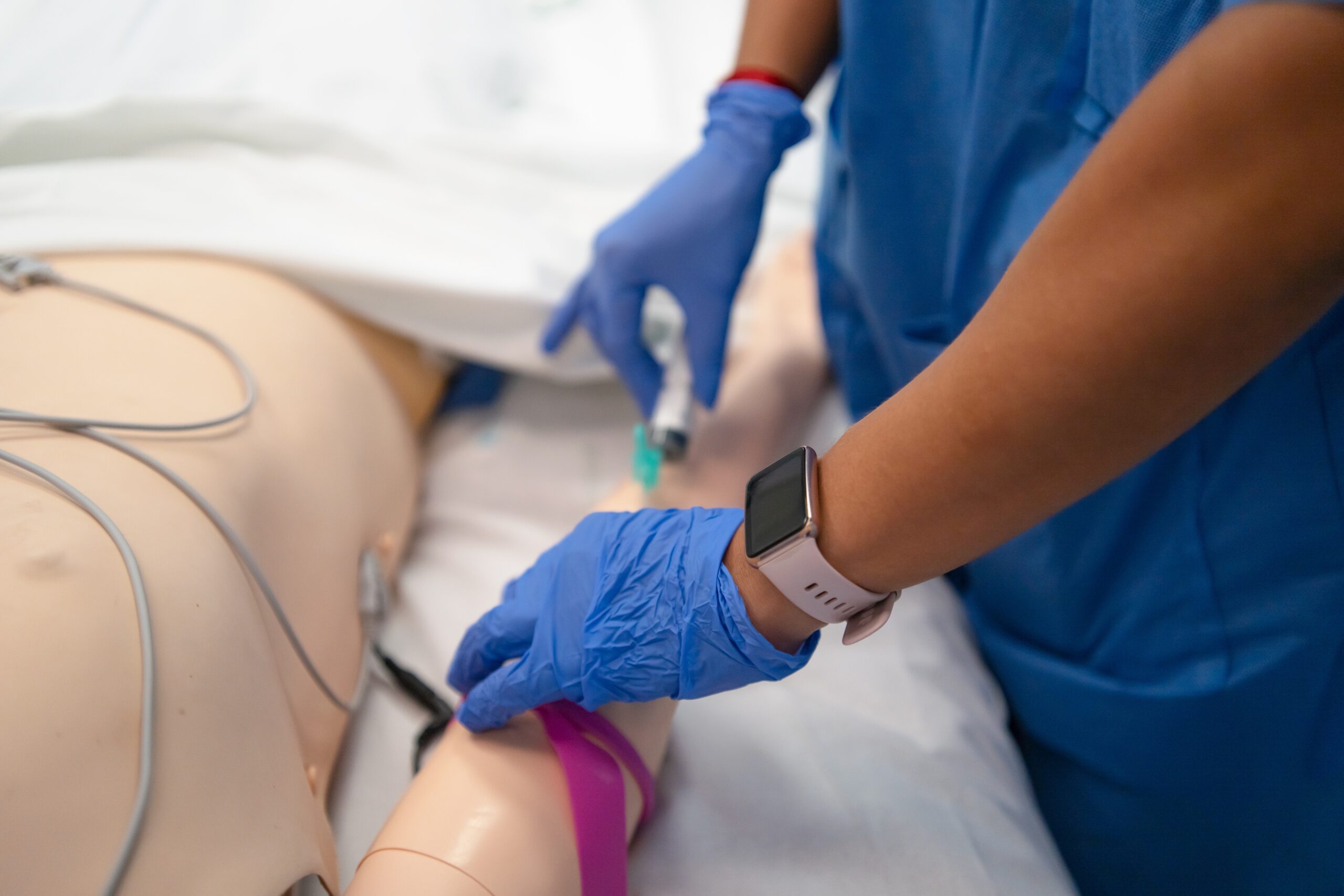
- Orienting students to the simulation facility and explaining functionality of the manikins, how to obtain needed diagnostics or supplies, and the role of the faculty facilitator.
- Reinforcing that questions can be asked throughout the experience without repercussion.
Facilitation
Faculty are the lynchpin to facilitation. They help students achieve the designed outcomes and ensure that learning occurred11. Because varying faculty participate in simulation for this course, the following choices were made to promote facilitation standardization:
- Creating scripts of each simulation scenario describing the expected flow and prompting opportunities to guide faculty toward the designed simulation objectives.
- Building time for individual debriefing to provide real-time feedback, fostering deeper understanding and guiding improvements for the next scenario. For this simulation, students rotated through five scenarios based on the same client experiencing a different decompensation each rotation. Every scenario was 20 minutes followed by a 10-minute debriefing.
- Providing the simulation facility staff with an overview of the simulation design including objectives, required space, supplies, and time.
Debriefing
Providing feedback, allowing for reflection, and guiding the connection between simulation and the practice environment are all key outcomes of a successful debriefing. Using a structured framework, maintaining psychological safety, and deliberate planning are all elements required to meet this standard12. Choices regarding debriefing were:
- Using Debriefing for Meaningful Learning13 as the theoretical framework.
- Providing a guided worksheet to students at the conclusion of rotations fostering self-reflection.
- Completing the day with group debriefing using Socratic questioning to enhance the group discussion.
Results
Based on completed student survey data, overarchingly, students’ perceptions of this simulation over five semesters of implementation have been positive. They expressed feeling prepared, having the needed knowledge and skills to be successful, and competent in applying their course content. Because this course does not grade simulation, and other course activities interweave with simulation, there are no direct measures of student learning; however, the careful selection of crucial learning activities included in simulation standardized student experience with those skills. Faculty facilitators could see each student perform in all crucial learning areas. Anecdotally, faculty consistently reported seeing students’ skill improvement.
Conclusion
Planning, time, effort, and coordination went into implementing this medical-surgical course’s simulation. Using the INACSL standards to provide direction and set benchmarks for success and receiving positive feedback from students and faculty alike increases confidence that this simulation has and will foster the skills, knowledge, and confidence students need as they move to practice environments.
References
Forber, J., DiGiacomo, M., Carter, B., Davidson, P., Phillips, J. & Jackson, D. (2016). In pursuit of an optimal model of undergraduate nurse clinical education: An integrative review. Nurse Education in Practice, 21, 83-92. https://www.sciencedirect.com/science/article/pii/S1471595316301007.
McCamey, D., Novak, K., Pasquale, C., Blount, T., Smetana, A., Kent, E., Reyes, I., & D’Aoust, R. (2025). The critical role of clinical placement professionals in academic-practice partnerships for nurse education. Journal of Professional Nursing, 60, 67-70. https://www.sciencedirect.com/science/article/pii/S8755722325001036.
Campbell, C. & Gaul, K. (2023). Unpacking HRSA’s registered nurse supply and demand projections for South Carolina, 2020-2035. South Carolina Office for Healthcare Workforce, South Carolina Area Health Education Consortium. https://www.scahec.net/scohw/data/reports/138-2022-HRSA-Nursing-Projections-Brief_2023-01-17.pdf
Kavanaugh, J.M. & Sharpnack, P.A. (2021). Crisis in competency: A defining moment in nursing education. The Online Journal of Issues in Nursing, 26 (1). https://doi.org/10.3912/OJIN.Vol26No01Man02.
South Carolina Board of Nursing. (2024). Position statement: Use of simulation in pre-licensure nursing programs. South Carolina Department of Labor, Licensing and Regulation. https://llr.sc.gov/nurse/PStatements/Simulation-Position-Paper.pdf.
Hayden, J.K., Smiley, R.A., Alexander, M., Kardong-Edgren, S. & Jeffries, P.R. (2024). The NCSBN national simulation study: A longitudinal, randomized, controlled study replacing clinical hours with simulation in prelicensure nursing education. Journal of Nursing Regulation, 5 (2), S3-S40. https://doi.org/10.1016/S2155-8256(15)30062-4.
INACSL standards committee, Persico, L., Wilson-Keates, B., DiGregorio, H., Decker, S. & Xavier, N. (2025). Preamble: Grounded in excellence: The cornerstone of healthcare simulation standards of best practice. Clinical Simulation in Nursing, 105. https://doi.org/10.1016/j.ecns.2025.101774.
INACSL standards committee, Xavier, N., Quinn, J., Amidon, B., Barnes, R., Bronson, S. & Dunning, L. (2025). Healthcare simulation standards of best practice professional integrity. Clinical Simulation in Nursing, 105. 10.1016/j.ecns.2025.101778.
INACSL Standards Committee, Watts, P.I., McDermott, D.S., Alinier, G., Charnetski, M., & Nawathe, P.A. (2021, September). Healthcare simulation standards of best practice TM simulation design. Clinical Simulation in Nursing, 58, 14-21. https://www.nursingsimulation.org/article/S1876-1399(21)00096-7/fulltext
INACSL Standards Committee, Persico, L., Ramakrishnan, S., Wilson-Keates, B., Catena, R., Charnetski, M., Fogg, N., Jones, M.C., Ludlow, J., MacLean, H., Simmons, V.C., Smeltzer, S. & Wilk, A. (2025). Healthcare simulation standard of best practice prebriefing: Preparation and briefing. Clinical Simulation in Nursing, 105. https://www.nursingsimulation.org/article/S1876-1399(25)00094-5/fulltext
INACSL Standards Committee, DiGregorio, H., Todd, A., Blackwell, B., Brennan, B.A., Repsha, C., Shelton, C.M., Vaughn, J., Wands, L., Wruble, E. & Yeager, C. (2025). Healthcare simulation standards of best practice facilitation. Clinical Simulation in Nursing, 105. https://www.nursingsimulation.org/article/S1876-1399(25)00093-3/fulltext
INACSL Standards Committee, Decker, S., Sapp, A., bibin, L., Chidume, T., Crawford, S.B., Fayyaz, J., Johnson, B.K. & Szydlowski, J. (2025). Healthcare simulation standards of best practice: The debriefing process. Clinical Simulation in Nursing, 105. https://www.nursingsimulation.org/article/S1876-1399(25)00092-1/fulltext
Dreifuerst, K. T. (2015). Getting started with debriefing for meaningful learning. Clinical Simulation in Nursing, 11 (5), 268-275. https://www.nursingsimulation.org/article/S1876-1399(15)00006-7/abstract