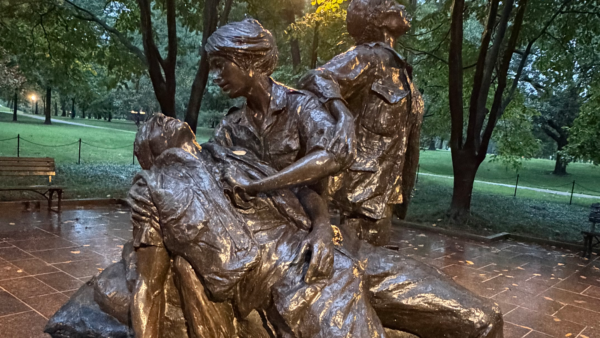

I am in Washington, D.C., for a nurse education conference. Before the seminars started, before the sun was even up, I went to the Vietnam Women’s Memorial.
It has been raining all week in D.C. This morning was cold and windy, with raindrops mixing with heavy drops of water falling from the trees. It was surprisingly quiet. The car dropped me at the Vietnam Veterans Memorial, the Wall a dark ribbon to my left as I walked into the park. Rounding a corner, with a soft light behind the trees to my right, I saw it.
In bronze, three women: one standing, searching the sky; one kneeling, observing the ground; and one comforting a wounded soldier. Between them sits a pile of sandbags, but the women seem oblivious to the possibility of seeking cover. Their attention is elsewhere.
Eight trees surround the monument, a living testament to the eight women whose names are inscribed on the Wall.
I had read that visitors sometimes leave hair ties at the memorial in solidarity with the women who served, although the National Park Service discourages leaving objects behind. As a nurse, I understand the symbolism. Sometimes that hair tie around your wrist—that half-second you take to pull your hair out of the way before diving back in—is a moment you have to center yourself before returning to the service of others.
I didn’t see any hair ties this morning.
But I did see a tiny, red rose tucked into one woman’s hand.
I wonder what the person who left it was thinking. What were they feeling? It is overwhelming, to stand here and take this in. It made me think of the deceptively simple question philosopher T. M. Scanlon asks:
“What do we owe each other?”
I think nurses may have some answers.
We owe one another dignity and respect. We owe one another service and gratitude. We owe one another community and care. Sometimes, we owe one another something of ourselves.
The women represented at this memorial answered that question under circumstances most of us will never experience. Thousands of women served in Vietnam, many of them nurses caring for the wounded and dying. Their service is part of our professional history, but it is also part of our collective history. To them, to all nurses and healthcare professionals who have served in our armed forces, to our veterans, and to the families who have carried the weight of that service, thank you.
But gratitude is not only something we feel. It can also ask something of us.
We live in communities with people whose experiences, needs, beliefs, and priorities may be very different from our own. As nurses, we understand this. We do not require agreement before offering dignity. We listen. We advocate. We care for the person in front of us.
Our civic lives also ask us to live in community with one another.
Election Day is approaching. Check your voter registration. Learn about the candidates and questions on your ballot. Seek reliable information. Make your own decisions.
And vote.
New Mexico voters can check their registration status and find official voting information through the New Mexico Secretary of State’s voter portal.
This morning, standing in the rain before three bronze women, I was reminded that “What do we owe each other?” is not merely a philosophical question.
It is one each generation must answer for itself.