
Overview
Health literacy is the ability to obtain, process, and understand basic health information needed to make appropriate health decisions (Coughlin et al., 2020). In 2020, the definition expanded to include both individual and organizational responsibility for effective communication (Centers for Disease Control and Prevention, 2024). This expanded definition highlights that effective communication is a shared responsibility between patients and healthcare providers. Low health literacy is associated with poorer health outcomes and less effective use of healthcare services and is a stronger predictor of health status than demographic factors such as income or education (Allen-Meares et al., 2020; Shahid et al., 2022).
Language barriers further complicate health literacy, limiting understanding of medical information and contributing to miscommunication and decreased adherence to treatment plans (Chen et al., 2024). Patients frequently struggle to recall or comprehend healthcare instructions (Casey & Sherman, 2025). As a result, important details discussed during healthcare visits may be misunderstood or forgotten after the encounter. The teach-back method, which asks patients to explain information in their own words, improves comprehension and self-care behaviors (Yen & Leasure, 2019; Talevski et al., 2020; Zangouei et al., 2024).
Individuals with low health literacy frequently struggle to maintain their follow-up appointments (Shahid et al., 2022). No-shows contribute to waitlist backlogs and are often linked to poorly managed chronic conditions (Ellis et al., 2022). If the instructions are complicated or unclear, they may not follow through. This lack of follow-through can delay care and create additional barriers to accessing the services needed. This can lead to gaps in care and a deterioration in health over time (Nguyen et al., 2011). Making information easier to comprehend and providing clear reminders can help more people receive the care they need on time.
Addressing modifiable factors, such as health literacy, is essential for improving outcomes. Improving understanding can empower patients to take a more active role in managing their health. People with low health literacy are less likely to effectively manage chronic conditions such as diabetes, which often require consistent self-monitoring, dietary changes, exercise, medication adherence, and regular follow-up visits (Salim et al., 2022). When patients do not fully understand their condition or treatment plan, they are at a higher risk of complications and hospitalization (Dhaliwal & Dang, 2024; Shahid et al., 2022). Incorporating evidence-based communication methods, such as the teach-back technique, into diabetes education can provide patients with the knowledge and confidence they need to actively participate in their care, ultimately helping to prevent complications and reduce the overall impact of the disease.
Local and Population Context
Good Samaritan Health Services (GSHS), a nonprofit mobile clinic serving uninsured individuals in Northeastern Oklahoma, identified missed appointments as a significant issue. Between January and July 2025, established patients missed 476 appointments. Patients commonly reported confusion about appointment details or the importance of follow-up care.
A health literacy screening conducted in October 2025 using the Single Item Literacy Screener (SILS) found that, among 40 patients surveyed, 92.5% (n = 37) scored above the cut-off, indicating limited health literacy. Additionally, 92.5% (n = 37) required a translator to understand the screening question, highlighting significant language and comprehension barriers.
These findings reflect broader trends. Oklahoma ranks 29th in adult literacy, with 20.1% of adults classified as having low literacy skills, and 47th in overall health outcomes (Barbara Bush Foundation for Family Literacy, n.d.; United Health Foundation, 2024). Nationally, 28% of adults demonstrate limited literacy skills, with higher rates among Hispanic populations (National Center for Education Statistics, 2023).
Purpose and Framework
This project aimed to evaluate best practices for improving diabetes-related health literacy among uninsured, non-English-speaking Hispanic patients.
Roy’s Adaptation Model guided the intervention by focusing on how patients adapt to chronic illness. The model emphasizes physiologic health, self-concept, role function, and the importance of patient–provider relationships, supporting culturally responsive education and communication.
Methods
This project used a pre–post educational intervention design implemented at a safety-net clinic in Oklahoma. The target population included adult Hispanic patients with limited English proficiency and uncontrolled type 2 diabetes. Participants were recruited from established clinic patients with hemoglobin A1C levels above 6.0 and invited to attend a series of diabetes education classes. A six-item screening tool was created to measure health literacy before and after the intervention, available in both English and Spanish, to evaluate changes resulting from the educational intervention.
Implementation
The intervention consisted of three 120-minute diabetes education classes delivered during routine clinic sessions. Education was provided by a nurse educator with support from a volunteer nurse, a Spanish-speaking translator, and the director of nursing.
Teaching strategies included:
- Plain language communication
- Culturally sensitive education
- Teach-back method to confirm understanding
- Spanish translation by a certified interpreter
Content focused on diabetes knowledge, blood glucose monitoring, medication management, lifestyle modification, and self-management behaviors. Participants who completed all sessions received a certificate of completion.
Results
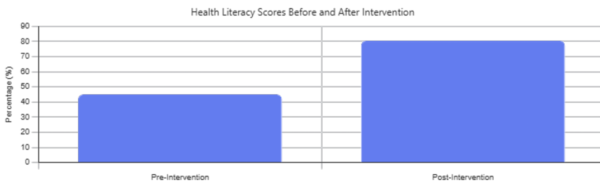
Fifteen patients participated in the project between January and March 2026. Pre-intervention assessments showed that participants answered an average of 45% of health literacy questions correctly. Following the intervention, post-test scores increased to 80.5%. These findings demonstrate a substantial improvement in diabetes-related health literacy after implementation of culturally adapted education using the teach-back method.
Implications for Nursing Practice
Findings demonstrate that culturally adapted education combined with the teach-back method can significantly improve health literacy. Assessing baseline knowledge and tailoring education to cultural and linguistic needs enhances patient understanding and engagement.
Routine health literacy screening can help identify knowledge gaps and guide targeted education. The teach-back method is an effective, practical strategy nurses can use to confirm comprehension, improve communication, and promote adherence.
For patients managing chronic conditions such as diabetes, improved understanding supports better self-management, reduces complications, and may decrease missed appointments and healthcare utilization.
Conclusion
Low health literacy remains a critical barrier to effective chronic disease management among uninsured Hispanic populations. This project highlights the value of culturally tailored education and the teach-back method in improving diabetes self-management knowledge. Integrating these strategies into routine practice can enhance patient engagement, reduce missed appointments, and ultimately improve health outcomes. n
References
Allen-Meares, P., Lowry, B., Estrella, M. L., & Mansuri, S. (2020). Health literacy barriers in the health care system: barriers and opportunities for the profession. Health & Social Work, 45(1), 62–64. https://doi.org/10.1093/hsw/hlz034
Barbara Bush Foundation for Family Literacy. (n.d.). Literacy gap snapshot: Oklahoma [PDF] Retrieved Sept 20, 2025, from https://map.barbarabush.org/assets/cards/BBFFL-Literacy-Card OK.pdf
Casey, E., & Sherman, J. (2025). Patient education in health care: Exploring strategies for effective comprehension, recall, and compliance. Journal of Prosthetics & Orthotics, 37(1), e18–e28. https://doi.org/10.1097/JPO.0000000000000542
Centers for Disease Control and Prevention. (2024, May 15). National Diabetes Statistics Report. Retrieved March 29, 2025, from https://www.cdc.gov/diabetes/php/dataresearch/index.html
Chen, W.-T., Sun, W., Huang, F., Shiu, C.-S., Kim, B., Candelario, J., Toma, L., Wu, G., & Ah-Yune, J. (2024). Lost in translation: Impact of language barriers and facilitators on the health care of Asian Americans living with HIV. Journal of Racial and Ethnic Health Disparities, 11(4), 2064–2072. https://doi.org/10.1007/s40615-023-01674-7
Coughlin, S. S., Vernon, M., Hatzigeorgiou, C., & George, V. (2020). Health literacy, social determinants of health, and disease prevention and control. Journal of Environment and Health Sciences, 6(1), 3061. https://pmc.ncbi.nlm.nih.gov/articles/PMC7889072
Dhaliwal, J. S., & Dang, A. K. (2024). Reducing hospital readmissions. In StatPearls. StatPearls Publishing. https://www.ncbi.nlm.nih.gov/books/NBK606114/
Ellis, D. A., Sanders, J. G., Jenkins, R., & McAuslan, L. (2022). A weekday intervention to reduce missed appointments. PloS one, 17(9), e0274670. https://doi.org/10.1371/journal.pone.0274670
National Center for Education Statistics. (2023). Highlights of U.S. national results (PIAAC). U.S. Department of Education. https://nces.ed.gov/surveys/piaac/2023/national_results.asp
Nguyen, D. L., Dejesus, R. S., & Wieland, M. L. (2011). Missed appointments in resident continuity clinic: patient characteristics and health care outcomes. Journal of graduate medical education, 3(3), 350–355. https://doi.org/10.4300/JGME-D-10-00199.1
Morris, N. S., MacLean, C. D., Chew, L. D., & Littenberg, B. (2006). The single item literacy screener: Evaluation of a brief instrument to identify limited reading ability. BMC Family Practice, 7(1), 21. https://doi.org/10.1186/1471-2296-7-21
Roy, C. (2009). The Roy adaptation model (3rd ed.). Pearson Prentice Hall.
Salim, H., Young, I., Lee, P. Y., Shariff, G. S., & Pinnock, H. (2022). Insights into how Malaysian adults with limited health literacy self‐manage and live with asthma: A photovoice qualitative study. Health Expectations, 25(1), 163–176. https://doi.org/10.1111/hex.13360
Shahid, R., Shoker, M., Chu, L., Frehlick, R., Ward, H., & Pahwa, P. (2022). Impact of low health literacy on patients’ health outcomes: a multicenter cohort study. BMC health services research, 22(1), 1148. https://doi.org/10.1186/s12913-022-08527-9.
Talevski, J., Wong Shee, A., Rasmussen, B., Kemp, G., & Beauchamp, A. (2020). Teach-back: A systematic review of implementation and impacts. PLOS ONE, 15(4), e0231350. https://doi.org/10.1371/journal.pone.0231350
United Health Foundation. (2024). America’s health rankings: Annual report 2024 – Oklahoma. https://www.americashealthrankings.org/explore/measures/Overall/OK
Yen, P. H., & Leasure, A. R. (2019). Use and effectiveness of the teach-back method in patient education and health outcomes. Federal Practitioner: For the Health Care Professionals of the VA, DoD, and PHS, 36(6), 284–289.
Zangouei, Z., Amouzeshi, Z., Mohsenizadeh, S. M., & Ayati, R. (2025). The impact of self-care training using the teach-back method with telephone follow-up on adherence to treatment in patients with hypothyroidism: A randomized controlled clinical trial. BMC Health Services Research, 25, 781. https://doi.org/10.1186/s12913-025-12962-9