
Identification of Problem:
Childhood vaccination rates have declined in recent years due to increasing vaccine hesitancy and limited access to reliable health education. As coverage decreases, outbreaks of preventable diseases have reemerged, increasing pediatric morbidity (Kiang et al, 2025). School nurses, who maintain contact with students and parents, are uniquely positioned to provide vaccine education, address concerns, and support immunization compliance within school settings. Our research question asks: How does providing vaccine education through school nurses affect childhood vaccination rates compared to children who do not receive regular primary care? The objective is to determine whether school-based vaccine education is more effective in increasing immunization rates and decreasing parental vaccine hesitancy. Identifying the most effective setting for parent-focused vaccine education is essential to improving public health outcomes and protecting children from transmissible diseases.
Review of Literature:
Literature was gathered from OVID, the OUHSC Bird Library, and Google Scholar. Keywords in the literature search included vaccine, school nurse, parent, vaccination rates, school-age, and United States. We reviewed a total of 12 articles, each published between 2020 and 2026. Most of the studies were nonexperimental (studies), but we also utilized randomized controlled trials (studies), quasi-experimental studies (studies), and expert opinion (source). Key findings of our research highlight the long-term consequences of declining vaccination rates and explore the attitudes towards vaccines across different demographics (Kiang et al, 2025; Suryadevara et al, 2025). Research indicates that targeted vaccine education delivered through school nurses can have a significant impact on vaccination compliance and overall immunization rates (Hoffman et al, 2024; Bethke et al, 2024). Research reviewed illustrates that vaccine education provided by school nurses to their students and parents increases the likelihood of the student receiving vaccines in the future (Wilson et al, 2023).
Recommendation Intervention or Protocol:
The research concludes that school nurses providing vaccine education increases childhood immunization rates and reduces vaccine hesitancy. Students’ accessibility to vaccines in schools could help them to build trusting relationships with nurses, providing school nurses an opportunity to provide useful health information to these families. It could also positively influence parental attitudes and increase the likelihood of children receiving recommended immunizations. Vaccine education and immunizations by school nurses reinforces the role of nurses in disease prevention and expands public health promotion. Ideally, training and resources for school nurses may enhance student and family vaccine compliance.
Suggestions for Further Study:
Future research should compare educational settings to determine the most effective environment for improving vaccination rates. Other ideas for future research include expanding studies to vaccine compliance of all ages, incorporating research on other healthcare professionals’ influence on vaccine compliance, and discussing what type of vaccine education is most effective.
Brief Biographies for Authors/Contributors:
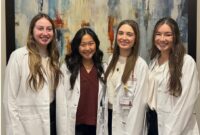
Leah North, Katelyn Quijano, Amanda Miller, and Hailey Ratlief graduated May 14, 2026, with Bachelor of Science in Nursing degrees from the Fran and Earl Ziegler College of Nursing at the University of Oklahoma Health Campus. The authors will be starting their nursing careers in Bone Marrow Transplant, Neonatal ICU, Labor and Delivery, and Orthopedics units. They chose to research vaccination rates because of the recent decline in childhood vaccine rates and discovered how influential school nurses can be in increasing these vaccine rates.
They would like to thank Dr. Laura Ables and Dr. Mark Fisher for their continued support and encouragement throughout nursing school. Laura Ables, PhD, RN is a Clinical Assistant Professor at the Fran and Earl Ziegler College of Nursing at the University of Oklahoma Health Campus. Mark J. Fisher PhD, RN, CNE is a professor at the Fran and Earl Ziegler College of Nursing at the University of Oklahoma Health Campus. n
References:
Alliance for a Healthier Generation. (2025, January 28). New school vaccine research reveals effective messaging approaches for parents and caregivers. https://www.healthiergeneration.org/articles/new-school-vaccine-research-reveals-effective-messaging-approaches-for-parents-and
Bethke, N., O’Sullivan, J. L., Keller, J., von Bernuth, H., Gellert, P., & Seybold, J. (2024). Increasing vaccinations through an on-site school-based education and vaccination program: A city-wide cluster randomized controlled trial. Applied Psychology: Health and Well-being, 16(3), 1326–1348. https://doi.org/10.1111/aphw.12528
Centers for Disease Control and Prevention. (n.d.). Parental attitudes and behaviors toward school and daycare vaccination requirements. https://www.cdc.gov/schoolvaxview/pubs-resources/parental-attitudes-toward-vaccination-requirements.html
Haber, J., & LoBiondo-Wood, G. (2021). Nursing Research (10th ed.). Elsevier-Evolve. https://pageburstls.elsevier.com/books/9780323762939
Hoffman, E., Kahan, T., Auerbach, E., Brody, H., Abramson, N. N., Haiken, S., Shields, D., Elyasi, A., Ifrah, S., Frenkel-Schick, A., Zyskind, I., Knoll, M., & Carmody, E. (2024). Peer education as a strategy to promote vaccine acceptance: A randomized controlled trial within New York community healthcare practices. Vaccine, 42(Suppl 5), 126028. https://doi.org/10.1016/j.vaccine.2024.05.076
Huber, D.L., & Joseph, M. L. (2022). Leadership and Nursing Care Management (7th ed.). Elsevier – Evolve.
Kiang, M. V., Bubar, K. M., & Mina, M. J. (2025). Modeling reemergence of vaccine-eliminated infectious diseases under declining vaccination in the US. JAMA, 333(24), 2176-2187. https://doi.org/10.1001/jama.2025.6495
McCartney, P. R. (2021) The translational science spectrum. Journal of Obstetric,Gynecologic & Neonatal Nursing, 50(6), 655-658. https://www.doi.org/10.1016/j.jogn.2021.09.007
Ravert, T.. (2026, January 28). The effectiveness of a school nurse managed VFC program in reducing school immunization exclusions. National Association of School Nurses, https://www.nasn.org/blogs/tracy-ravert-msn-rn-csn/2026/01/28/the-effectiveness-of-a-school-nurse-managed-vfc-pr
Roberts, W., White, S., Aguilar Perez, F., Eusuf, Q., Satherley, P., & Ramsey, R. (2024). Vaccination: School nurses’ and children’s attitudes and concerns. Pediatrics and Child Health, 120, 33-37. https://www.ovid.com/journals/nrtm/abstract/00006203-202408000-00016~vaccination-school-nurses-and-childrens-attitudes-and?redirectionsource=fulltextview
Seither, R., Yusuf, O. B., Dramann, D., et al. (2024). Coverage with selected vaccines and exemption rates among children in kindergarten — United States, 2023–24 school year. MMWR Morbidity and Mortality Weekly Report, 73, 925–932. https://doi.org/10.15585/mmwr.mm7341a3
Suryadevara, M. M., Wang, D. D., & Domachowske, J. J. (2025). Vaccine attitudes, practices, and literacy among New York State primary care providers and their office personnel. Human Vaccines & Immunotherapeutics, 21(1). https://doi.org/10.1080/21645515.2025.2529635
Tu, P., Smith, D., Parker, T., Pejavara, K., Michener, J. L., & Lin, C. (2023). Parent–child vaccination concordance and its relationship to child age, parent age and education, and perceived social norms. Vaccines, 11(7), 1210. https://doi.org/10.3390/vaccines11071210
Wilson, O. F., Mote, S. L., & Morse, B. L. (2023). Addressing vaccine hesitancy among students and families: Interventions for school nurses. NASN School Nurse, 38(3), 146–154. https://doi.org/10.1177/1942602X221106945