

Abstract

This study was conducted to determine whether a point-based head-to-toe assessment rubric would improve students’ formative and summative evaluations of the head-to-toe assessment and reduce instructor subjectivity. A survey was used to gather students’ and the instructor’s feedback on the ease of use and objectivity of the assessment tool. The post-survey indicated that the head-to-toe assessment rubric provided structure for both formative and summative evaluations for students and the instructor, reduced subjectivity, and enhanced objectivity for the instructor.
Keywords: assessment, rubrics in nursing education, rubrics in education, head-to-toe assessment, formative and summative evaluation.
A Point-based Head-to-Toe Assessment Rubric
Completing an accurate patient assessment is crucial. Instructors have used multiple approaches to help students become proficient in patie nt assessment (Huber & Epp, 2021). Being proficient in patient assessment enables a nurse to recognize subtle changes in a patient’s health (Fontenot et al., 2021). The ability to successfully execute an accurate patient assessment begins in nursing school. The possibility of the instructor’s subjectivity or the generality of the physical assessment tool may lead to a less-than-accurate assessment at the bedside.
Implications for Nursing
According to Sezer et al. (2025), rubrics reduce subjectivity and facilitate mutual understanding between students and instructors. Arrogante et al. (2021) found that students preferred formative evaluation in clinical simulations. A standardized head-to-toe assessment guideline would be beneficial for the formative and summative evaluation in the lab portion of the class and further guide students in the clinical arena. Ensuring that instructors equip nursing students with the tools to perform accurate physical assessments is essential to providing adequate patient care. (Toney-Butler & Unison-Pace, 2023).
Methods
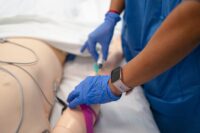
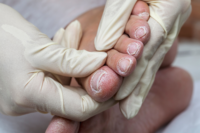
A point-based head-to-toe assessment rubric was developed, allowing points to be assigned to each section of the assessment, including the general assessment, HEENT, heart/lungs, abdomen, and upper and lower extremities. The assessment tool was used by second-semester Associate Degree in Nursing (ADN) students as a guide for conducting a head-to-toe assessment in the lab setting. The instructor used the same guide to direct both formative and summative evaluations of students’ ability to perform a concise, accurate patient assessment.
Before initiating the point-based assessment rubric, students and the instructor were given the option to not participate or withdraw from the study at any time. Consent for both the students and the instructor was administered on paper. A post-survey in paper form was completed by both the students and the instructor after the summative head-to-toe assessment. Both the consent and the survey were completed without the researcher’s involvement.
Analysis
The sections of the survey included Clarity and Design, Educational Value, Rubric Components, and Open-ended Feedback. The components of the survey were reviewed and analyzed by the researcher, utilizing both the students’ and the instructor’s feedback regarding qualitative and quantitative results.
Results. The results included both quantitative and qualitative feedback from the students and the instructor.
Quantitative Results. Quantitative results included information regarding clarity and design, educational value, and the overall components of the head-to-toe assessment rubric. For each section, additional subsections provided further clarity on the requested information. Section 1: Clarity and Design gathered information on the ease of understanding for both the student and the instructor, whether the layout was user-friendly, and whether the points assigned to each section were clearly explained.
Student Ratings. Students rated the Clarity and Design section of the rubric as follows: Ease of Understanding 100% strongly agree; Layout User-Friendly 100% strongly agree, and Points Clearly Explained 76% Strongly Agree/Agree, 18% Neutral, and 18% Disagreed. Section 2: Educational Value determined whether the rubric improved understanding and critical thinking, and whether the points assigned to each section were fair, and whether students would recommend the use of the rubric for evaluation purposes. Students rated Improved Understanding and Critical Thinking as Strongly Agree/Agree 88% and 76%, respectively. The components for Points Assignment Fair and Recommended Use as 75% and 88% for Strongly agree/Agree. Section 3: Rubric Components were rated 5 (Excellent) overall.
Instructor Ratings. Instructor ratings for Section 1: Clarity and Design and Section 2: Educational Value were rated as 100% Strongly Agree/Agree for all components of both sections. However, the overall rubric components were rated as 4 (Good).
Qualitative Results. Qualitative results indicated that the head-to-toe assessment rubric was organized, easy to follow, and less intimidating than other rubrics.
Discussion
The head-to-toe assessment rubric provided a structured, point-based framework for formative and summative evaluations. The system-enhanced objectivity, though requiring 100% summative success, was viewed as overly strict. A passing benchmark of 77% was suggested as a fairer measure of competency. Because of the rubric’s functionality, it can be modified for use in any course, skill level, and/or evaluation context.
Conclusion
The students’ and instructor’s feedback indicated strengths in the rubric’s clear and logical layout, comprehensive content, and well-organized instruction sections. The areas identified as needing improvement were in the scoring system. The study was limited to a small sample size and requires further research and/or a pilot study.
References
Arrogante, O., Gonzalez-Romero, G. M., Lopez-Torre, E. M., Carrion- Gracia, L., & Polo, A. (2021). Comparing formative and summative simulation-based assessment in undergraduate nursing students: Nursing competency acquisition and clinical simulation satisfaction. BMC Nursing 20 (92), 1-11. https://doi.org/10.1186/s12912-021-00614-2
Fotenot, N. M., Hamlin, S. K., Hooker, St. J., Vazquez, T., & Chen, H. M. (2022). Physical assessment competencies for nurses: A quality improvement initiative. Nursing Forum 57, 710-716. doi: 10.1111/nuf.12725
Huber, B. J., & Epp, S. M. (2022). Teaching & learning focused physical assessments: An innovative clinical support tool. Nurse Educ Pract 59 (103131). doi:10.1016/ j.nepr.2021.103131
Sezer, E., Celik, H. Y., Karabacak, U., Lasater, K. (2025). Lasater clinical judgment rubric in nursing education: a Turkish validity and reliability study. BMC Nursing 24 (70) https://doi.org/10.1186/s12912-024-02679-1
Toney-Butler, T. J., & Unison-Pace, w. J. (2023). Nursing admission assessment and examination. National Library of Medicine: National Center for Biotechnology Information. StatPearls [Intenet]. https://www.ncbi.nlm.nih.gov/books/NBK493211/