

The Maryland Nurse Association comprises members from a multitude of positions and specialties, each contributing in their own way to the nursing profession. This occasional column provides an opportunity to highlight those contributions and for readers to learn more about their nursing colleagues.
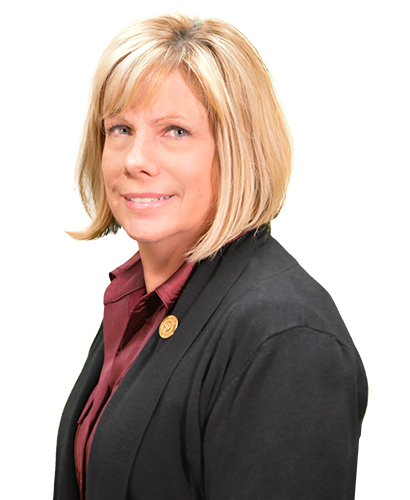
Recently, I spoke with Christine Frost, RN, DNP, MBA, NEA-BC, vice president and chief nursing officer at Luminis Health Anne Arundel Medical Center, in Annapolis, Maryland, where she oversees about 1,200 nurses. The medical center is a third time designated American Nurses Credentialing Center Magnet® organization and prides itself on its close ties with the community.
Frost has a long history with Luminis Health Anne Arundel Medical Center. She began her nursing career there in oncology and returned to work as a nursing director and senior director. Her current CNO role marks her third stint with the organization. Frost also gave birth to her two children at the medical center. She has held positions at the University of Maryland Medical System and the University of Maryland Baltimore Washington Medical Center. Frost received her bachelor’s degree from Georgetown University School of Nursing and holds a master of science in nursing and master of business administration from the University of Maryland School of Nursing and the University of Baltimore. More recently, Frost obtained a doctor of nursing practice, also from the University of Maryland School of Nursing.
Cynthia Saver: Tell me about how you came to nursing and what drew you to leadership.
Christine Frost: Like many other nurses, I entered nursing to make a difference in the lives of patients and families. I worked as a candy striper in high school and fell in love with nursing. I launched my career at Anne Arundel Medical Center as a new nurse in oncology, and began taking on leadership roles such as being a shift charge nurse. I really enjoyed coming into a chaotic shift and organizing the people and the patients to be sure everyone on the team had what they needed to take excellent care of their patients. That grew into being responsible for a unit and then onto other leadership roles.
I realized early on that leadership provided an opportunity to extend my impact beyond the bedside. With my leadership team, I could help create and shape an environment to ensure that nurses had the resources and support needed to deliver exceptional care. I believe the ability to influence outcomes, to influence the work environment, and to influence patient experience on a larger scale is what really drew me to leadership.
Saver: How would you describe your leadership philosophy?
Frost: I am a servant leader. I focus on being an authentic leader and an authentic person who can be trusted and is committed to high standards — the focus every day is that we deliver the highest quality care to our patients in our community. I also believe it’s important to listen to the voice of all staff members. We need to hear what the caregivers who are closest to the work are saying and take into account their recommendations and their solutions. I strive to make sure that nurses feel heard, valued, and empowered.
Saver: What do you see as the main challenges for Maryland’s nurse leaders in today’s healthcare environment?
Frost: Healthcare continues to move at a rapid pace, and our patients’ needs are increasingly complex, with many having both medical and psychosocial diagnoses. Healthcare organizations need to identify and help address social determinants of health and help eliminate barriers for our patients to receive care. We also need to support our more complex patients in living their best, healthiest lives outside the hospital, in the community.
All this makes workforce recruitment and retention a priority, particularly because we are in a nursing shortage in Maryland and across the nation. It is critical that nursing leaders, our talent acquisition teams, and academic partners in the area collaborate on how we can best create smooth and successful transitions from academia to practice. We also need to create and foster work environments that are attractive as we recruit and retain staff. Our employees are the most precious resource that we have; they are the ones taking care of patients around the clock.
Artificial Intelligence (AI) and its impact on hospitals, clinicians, and patients is on all our minds. How do we make sure we are effectively assessing the AI tools that are available to us by incorporating the voice of the people who are taking care of the patients? We need to know if the technology is going to be helpful to caregivers at the bedside, so we absolutely must engage them in the process. I think AI is going to be a game changer in healthcare, for nurses and patients alike, in the next three to five years, if not sooner.
Saver: What advice do you have for a nurse who may be interested in pursuing leadership or who may be unsure if it’s a path they want to take?
Frost: A good place to start is to become a really strong clinician, and then start exposing yourself to leadership opportunities such as serving on committees, leading projects, and participating in shared governance. It’s also very important to find a mentor you can talk with about your goals and who will both challenge and support you as they guide you along the way. Your mentor can be anyone on your unit, it can be your leader, it can be your chief nurse, or it can be a friend or a family member.
I’d also say, don’t be afraid to step out of your comfort zone. If somebody taps you on the shoulder and says, “You know what, I think you would be really great leader,” they’re seeing your ability to lead, to problem solve, and to get the team rowing in the same direction at the same time. Trust yourself and take that next step.
That advice come from my own experience. Three or four years into my career, my supervisor told me I was ready to be in charge of the unit. My immediate reaction was along the lines of “You can’t be serious, I’m not ready for that.” My leader did not give into my reluctance, but rather said, “We’re going to support you, we’re going to guide you, and you’re going to be great.” That job kicked off my love for leadership, and even further enhanced my joy and absolute respect for the career of nursing.
Remember that as a leader, you’re never alone. You can always ask questions. Leadership isn’t about having all the answers; it’s about creating connections and relationships with people. It’s important to establish bidirectional communication where leaders share information with staff who share information with leaders. I rely on my excellent leadership team, who then rely on the frontline staff to pass along information and make recommendations based on their experience in the work environment. The communication helps with making decisions not based on the individual leader’s perception and perspective, but from the perspective of the people who are taking care of the patients.
My advice: I would say trust yourself, be curious, stay open to learning, and don’t be afraid to step out of your comfort zone.
Saver: What is the value of belonging to the Maryland Nurses Association (MNA)?
Frost: I believe that it is really important for nurses and nurse leaders to be members of professional associations. Membership gives me the opportunity to connect with colleagues across the state. We’re able to share ideas, which was particularly helpful during the COVID pandemic, when we were living a shared experience. The ability to share ideas and collaborate on issues that affect both nurses and patients is critical.
MNA supports nursing by playing an important role in advancing nursing practice and advocating for healthcare policy. I have learned from MNA how to get involved in advocacy, which contributes to the future of nursing in Maryland.
MNA also supports professional development. I’ve gained both colleagues and knowledge. I believe it is important that we communicate to our nursing leaders and our nursing team at the bedside the importance of joining organizations such as MNA. Membership affords us all of the things I mentioned, and I think those are definitely important for professional growth and advocacy within the nursing field.
Saver: Being a CNO is stressful in today’s environment. How do you maintain work-life balance and what do you do for fun?
Frost: Sometimes I do well in with work-life balance and sometimes I have to remind myself of its importance. I tell my team that my expectation for them is to disconnect as much as possible on the weekends, for example, staying off email, so I try to do the same and lead by example.
As far as fun, I like to spend time with my family and friends. We have a boat, so enjoy going out on the bay. We also have a dog, so we take the dog for walks. I really enjoy the state of Maryland. I think it has a lot to offer from outdoor and cultural perspectives, and being close to Washington, DC, and Baltimore provides a lot of opportunities to explore.
Work-life balance is a commitment that we need to make to ourselves, maintain it, and hold ourselves accountable; it’s important so we can be successful in our roles, both at home and at work.