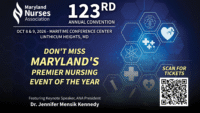


I write this having just returned from a nursing conference, and the energy of that room is still with me. More than one thousand nurses gathered in a single space, and for three days we did what nurses too rarely give ourselves permission to do. We paused. We learned. We listened to one another. We celebrated the work.
Something happens when nurses come together that a shift on the unit cannot replicate. We exchange ideas, compare practices, and discover that a challenge we thought was ours alone is shared by a colleague across the state or across the country. We leave with new knowledge, and also with something harder to name: the quiet validation of knowing that what we do matters, and that we do not do it alone.
The evidence affirms what that room made me feel. A conference is not simply a gathering. It is a recognized form of continuing professional development, one of the ways nurses maintain competence and earn the contact hours we need for licensure while learning from and connecting with colleagues and research teams (Garey, 2022). Attending a professional nursing conference also strengthens our sense of belonging to the profession. One study of nursing students found a significant rise in belonging after conference attendance, a connection that anchors identity and sustains us through difficult days (Kruse et al., 2020). And this kind of development is not a luxury. A systematic review found that continuing professional development improves the quality of nursing care, strengthens patient safety, raises nurse satisfaction, and supports retention at the bedside (Vázquez-Calatayud et al., 2021). When we treat conferences as the continuing professional development they are, and invest in learning and growing together, that investment reaches our patients.
This is worth pausing on, because the benefits extend well beyond the individual nurse. A growing body of evidence links how connected nurses feel to the quality of care patients receive. In a study of nearly one thousand nurses, stronger nursing teamwork was associated with more patient-centered care (Baek et al., 2023), and a separate analysis found that a unit’s team effectiveness helps translate a healthy work environment into better patient-centered nursing (Kim & Ko, 2025). The pattern holds across settings: when teamwork and communication are strong, nurses deliver more person-centered care and make fewer errors (Dlamini & Park, 2024). My own work with colleagues points in the same direction. Fostering belonging and social connectedness is not only good for nurses’ well-being and retention, it is a foundation for the safe, compassionate care our profession promises (Frangieh et al., 2024). Belonging, in other words, is a patient safety strategy as much as a wellness strategy.
What stayed with me was how much we share. The nurse beside me worked in a different setting and cared for a different population, yet our aims were the same. We are bound by a common commitment to human dignity and to better care. Coming together reminds us that we belong to something larger than our own unit and our own hospital and universities. We are one profession, and our strength grows each time we connect.
I think often about what this means for those of us here in Maryland. When Maryland nurses find their way to one another, something quietly powerful takes hold. A seasoned nurse becomes a mentor. A good idea on one unit becomes a better practice on another. A nurse who felt alone in a difficult moment discovers she was never the only one. These connections do not announce themselves, but they are how a profession carries its own. Every relationship we build makes the next nurse’s path a little less lonely and a little more possible.
Connection, I have come to believe, is not a retreat from the work of nursing. It is part of the work. The knowledge we share, the belonging we offer, and the courage we borrow from one another all return to the bedside and to the classroom, where our patients and our students feel the difference. However, you find your people — in a conference hall, a committee or conversation — I hope you will keep reaching for them. The profession is stronger, and so are you, each time you do.
With you on the Path,
Jihane Frangieh
References
Baek, H., Han, K., Cho, H., & Ju, J. (2023). Nursing teamwork is essential in promoting patient-centered care: A cross-sectional study. BMC Nursing, 22(1), Article 433. https://doi.org/10.1186/s12912-023-01592-3
Dlamini, B. B., & Park, M. (2024). The effect of teamwork, communication skills, and structural empowerment on the provision of patient-centered care among nurses in Eswatini: A cross-sectional study. Journal of Evaluation in Clinical Practice, 30(6), 954–964. https://doi.org/10.1111/jep.14003
Frangieh, J., Hughes, V., Edwards-Capello, A., Humphrey, K. G., Lammey, C., & Lucas, L. (2024). Fostering belonging and social connectedness in nursing: Evidence-based strategies: A discussion paper for nurse students, faculty, leaders, and clinical nurses. Nursing Outlook, 72(4), Article 102174. https://doi.org/10.1016/j.outlook.2024.102174
Garey, A. (2022). Importance of nursing research and nursing continuing professional development. Research in Nursing & Health, 45(6), 635. https://doi.org/10.1002/nur.22269
Kim, S. Y., & Ko, Y. (2025). Mediating effect of team effectiveness of the nursing unit on the nursing work environment and patient-centered nursing: A cross-sectional study. Healthcare, 13(17), Article 2080. https://doi.org/10.3390/healthcare13172080
Kruse, J. A., Didion, J., & Perzynski, K. (2020). Strengthening student nurses’ sense of belonging through attendance at a professional nursing conference. AORN Journal, 112(3), 227–236. https://doi.org/10.1002/aorn.13141
Vázquez-Calatayud, M., Errasti-Ibarrondo, B., & Choperena, A. (2021). Nurses’ continuing professional development: A systematic literature review. Nurse Education in Practice, 50, Article 102963. https://doi.org/10.1016/j.nepr.2020.102963