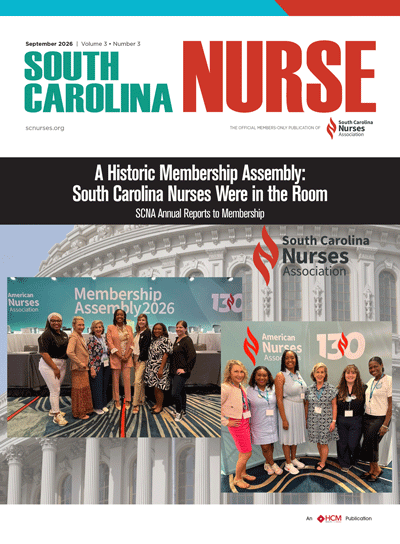
Sign up to receive the digital edition of South Carolina Nurse
Below are recent articles from
South Carolina Nurse, the official publication of the South Carolina Nurses Association.


Sign up to receive the digital edition of South Carolina Nurse
Below are recent articles from
South Carolina Nurse, the official publication of the South Carolina Nurses Association.










Julie Nyhus, MSN, FNP-BC, APRN has extensive publishing experience and demonstrated leadership in editorial excellence. As a clinical medical writer at EBSCO, she was responsible for researching, updating, editing, and writing evidence-based support tools for nurses and allied health professionals. Additional experience in health publications includes freelance work for renowned publications such as American Nurse Journal, The Nurse Practitioner Journal, and Nursing2020. She has honed her writing, editing, and peer review skills, always ensuring the clinical relevance and timeliness of the content.
Julie has over 20 years of experience as a healthcare professional and significant involvement in health publications. Her background as an advanced practice nurse, with licenses in Illinois and Indiana and board certification as a family nurse practitioner, has provided her with a deep understanding of healthcare trends, nursing issues, and clinical content. This knowledge, combined with her Master of Science in nursing and Bachelor of Arts in communication, equips her to develop content that aligns with the needs of nursing professionals.
Cheryl L. Mee MSN, MBA, RN, FAAN, Executive Editorial Director, American Nurse Journal
With more than 30 years of experience in health science publishing, Cheryl has held several senior leadership roles. She previously served as editor-in-chief of a national nursing journal at Wolters Kluwer. At Elsevier, she held dual leadership positions as Vice President of Nursing and Health Professions Journals—where she led a team of publishers supporting nursing societies—and as Director of Nursing Education and Assessment Consultation, guiding faculty in integrating digital tools into curricula to strengthen clinical judgment and teaching strategies.
Cheryl has authored more than 140 publications, reflecting her sustained contributions to nursing scholarship and practice. She also serves as adjunct faculty at the Frances Payne Bolton School of Nursing at Case Western Reserve University, where she works with doctoral nursing students.
Her career demonstrates a strong commitment to service, diversity in nursing, cultural competence, and improving health outcomes for underserved populations. For over 20 years, she has served on the Board of Americans for Native Americans, supporting initiatives such as scholarships, NCLEX fee assistance, and expanded clinical experiences for Native American nursing students. She has also led annual health screening programs that have provided care to hundreds of Native American elementary school children.