
Create and implement a standardized process.
- This quality improvement initiative focused on standardizing nursing communication during patient handoffs between hospital departments.
- By implementing structured tools and training, the project achieved a 42% reduction in communication errors, enhanced collaboration, and improved patient safety.
Consistent and well-coordinated communication can significantly influence patient outcomes. The Agency for Healthcare Research and Quality notes that, nationally, communication errors contribute to an average of almost 8% of incidents that result in a range of outcomes, from no patient injury to severe injury or even death. In Texas, the location of our project organization, approximately 13% of patients experience incidents because of preventable communication errors, with 3% resulting in major injury or death, according to Kulińska and colleagues. These same researchers note that the metropolitan area of our organization has a slightly higher rate of preventable incidents than the state average, with almost 14% of patients experiencing such events.
Our organization had a significantly higher average communication error rate compared to national, state, and local averages, with 20% of all hospital events resulting from a communication error, according to the organization’s occurrence reporting system. The hospital admits around 30,000 patients annually and has reported fewer than four unpreventable adverse events over the past 3 years.
Nurse handoff and cardiac care
Standardizing handoff communication
Transport teams and patient handoff reports
According to the organization’s quality department, hospital-specific data show a relationship between communication errors and two out of four sentinel events reported in the first quarter of 2024, indicating a rise in preventable incidents caused by communication errors when transferring patients from one department or unit to another. These findings presented an opportunity for a patient safety quality improvement (QI) project focused on reducing errors by enhancing nursing communication between departments.
Literature review
Miscommunication plays a role in many healthcare errors, posing a risk to patient safety through inconsistencies, especially when transferring a patient’s care from one department to another. Many factors contribute to miscommunication. For example, Abdelwahab and colleagues and Adler note that poor communication, inexperience, and inadequate communication skills can lead to avoidable mistakes and repetition of questions already answered by patients. According to Dietl and colleagues, negative attitudes among healthcare workers and poor working conditions also can hinder safe and efficient communication.
Several reviews (such as Abdelwahab and colleagues, Adler, and Dietl and colleagues) indicate higher rates of morbidity and death when patients receive subpar care from healthcare providers because of misunderstandings related to the patient’s needs or lack of clear communication. Care delays can cause short-term or long-term damage and affect the patient and their family members’ overall care experience. Resulting lack of psychological safety can influence a patient’s mental well-being, exacerbate their condition, and result in feelings of mistrust and neglect.
Standardization of communication tools plays an important role in ensuring safe patient treatment. According to Abdelwahab and colleagues and Adler, 70% of reviewed research supports the use of the SBAR (Situation, Background, Assessment, and Recommendation) tool as standard practice. The organization’s SBAR template includes patient information and a checklist to reduce risks and promote communication during transfers.
According to Abdelwahab and colleagues and Adler, inconsistent application of the SBAR by using multiple templates can cause confusion and miscommunication. To prevent gaps in patient care between two departments, the emergency department (ED) and the medical–surgical unit, using additional communication devices alongside a specific SBAR tool increases the continuity of care and decreases the potential for errors. Adding technology to the SBAR tool with a handheld device will improve communication and clinical decision-making support, leading to streamlined and secure communication practices. Secure messaging helps save time, avoids repeating calls, improves response time, and facilitates more efficient, readable, and real-time communication. A checklist, secure messaging, and an electronic SBAR enhance communication by providing immediate guidance to prevent forgetfulness in established processes. This checklist effectively tracks performance improvement and ensures accountability at the unit level, fostering a culture of safety, understanding, and confidence.
Based on the literature review, our QI project aimed to determine if standardizing a process for medical–surgical and ED nurses using a communication bundle would decrease the number of communication error–related events over 8 weeks in an acute care hospital.
Intervention
The organization recognized that an inconsistent handoff process served as the root cause of many preventable adverse events. The project team (DNP team leader, managers and directors of ED and med–surg nursing departments, nursing informatics, and the organization’s senior leadership team [chief nursing officer, assistant chief nursing officer, and the vice president of quality]) selected the Plan-Do-Study-Act framework because of its organization and ability to help facilitate modifying a current process, implementing change, and evaluating the effectiveness of a revised process. With checklists, secure messaging, and a single SBAR template used for every patient transfer from the ED to a med–surg unit, the project team aimed to establish clear, consistent, and structured communication.
Organizational setting
The project site, a 165-bed acute care hospital, includes an ED, three critical care units, and three med–surg units, each with 12 to 40 beds. Approximately 14 patients are admitted each day to one of the med–surg units. The hospital’s overall annual admission rate is 30,000, with just over half being med–surg admissions. The unit’s nurse staffing ratio is typically one nurse to a maximum of six patients.
The ED sees an average of 140 patients per day and has 20 beds. It has an average medical provider staffing of five and nurse staffing of six, with one senior physician overseeing resident physicians. The ED nurse-to-patient ratio is typically one nurse to four patients, based on acuity.
About 170 RNs and 30 licensed vocational nurses working on the med–surg units and in the ED participated in this QI project. The stakeholders, ensuring consistent implementation throughout the project, included the med–surg and ED managers and directors as well as the organization’s senior leadership team.
New process
The revised transfer communication process begins with the ED secretary sending a secure text message notifying the receiving unit of a pending admission. At the same time, the charge nurse or ED secretary sends an electronic version of the SBAR to the receiving nurse’s station. This allows the med–surg nurse to ensure preparation of the assigned room and to review the patient’s information before arrival.
When the patient is en route to the med–surg unit, the ED secretary sends a second secure message with the patient’s last name and assigned room number. Upon arrival, a nursing team member greets the patient and accompanies them to their room. The patient is safely transferred to the inpatient bed, and the nurse (or other designated individual—paramedic or certified nursing assistant—transporting the patient) gives a prompt bedside report to cover outstanding labs, treatments, or other pending orders not on the SBAR.
Data collection
Data collection, developed in collaboration with the ED nursing director and med–surg unit directors, includes the use of an ED checklist (completed by the ED secretary) and a survey (accessed via QR code) completed by a med–surg nurse after every patient admission.
After implementation of the revised communication process, the project team collected and entered data from the checklist and surveys for analysis to identify trends or gaps. The team leader also monitored the organization’s occurrence reporting system to determine whether the number of communication-related events decreased in the two departments over the 8-week project period.
Training
After the hospital’s senior leadership approved the proposed interventions and in collaboration with the ED and med–surg managers, nurses received training during four safe table sessions. In our organization, safe tables provide a confidential and secure environment where participants can ask questions, offer comments, and share feedback without fear of retaliation. In our experience, safe tables help to promote staff buy-in and continued dedication through collaborative safety discussions. In addition to learning about the ED checklist and med–surg nurse surveys, staff received education about the importance of secure messaging and beside communication upon unit arrival.
The safe table sessions also aimed to raise awareness about the number of communication errors that occur during patient admission to the hospital and how to reduce error risk with consistent communication. During the sessions, nurses shared feedback and perceived communication barriers related to patient transfers.
Barriers included multiple SBAR templates, inconsistent use of the ED checklist, no designated responsibility for sending SBARs to the inpatient unit, inconsistency in how med–surg units receive an SBAR or no receipt of SBAR, lack of accountability and communication among nursing staff, no requirement to provide nurse-to-nurse report at transfer, and underuse of hospital communication devices. Drawing on this input, the implementation team (project team leader, ED and med–surg managers and directors, and nursing informatics) began developing and implementing interventions, including updating the ED’s use of a checklist.
Measuring change
Before implementing the communication process, the project team collected 8 weeks of data for comparison purposes. During the intervention, the team de-identified data collected from the ED checklist, med–surg survey, and the occurrence reporting system; reviewed it daily; and entered it into an Excel spreadsheet on the organization’s secure network. The team reviewed the data Monday through Friday for tracking and trending purposes to ensure the interventions remained in place.
ED checklist
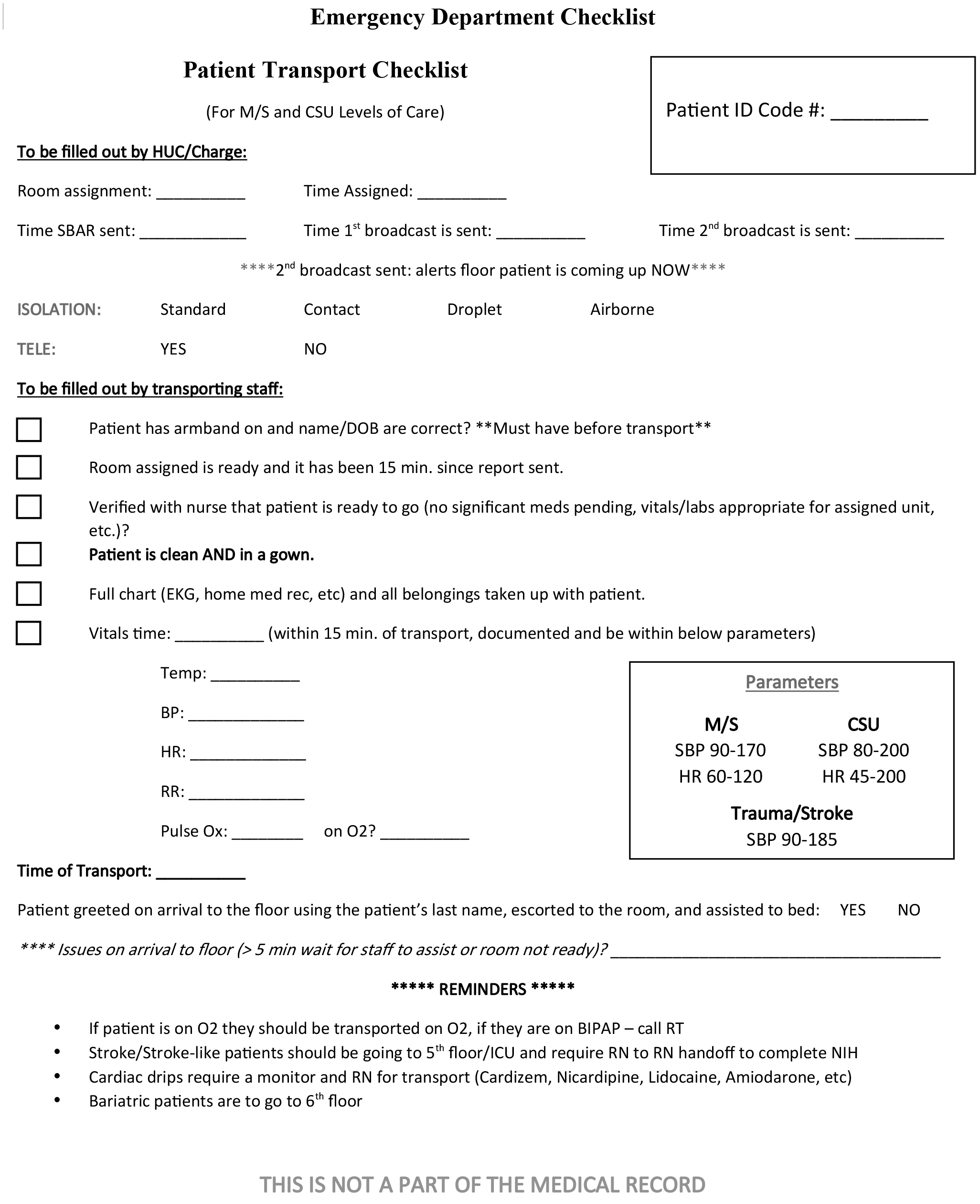
The ED checklist captured three specific actions for patient admission to the med–surg unit and the times they occurred: an initial secure message informing the med–surg unit of the patient transfer, the delivery of the patient’s SBAR, and a second secure message alerting the unit that the patient is en route. The ED secretary sends these communications at the direction of the ED primary or charge nurse.
The ED staff member (nurse, paramedic, or certified nursing assistant) transporting the patient to the med–surg unit delivers the checklist to the med–surg staff member who receives the patient. That staff member completes their portion of the checklist and signs it to indicate that they performed all transferring tasks. The ED staff member returns the completed checklist to a folder at the ED nurses’ station. The ED secretary (designated staff member to collect all completed checklists) keeps the folder at the nurses’ station, easily accessible by all ED staff. The charge nurse serves as the designated back-up for collecting completed checklists.
Each morning, a member of the project team reviewed and collected information from the checklists. The project aimed to achieve 90% adherence to the new communication process each day, calculated by determining the number of implemented changes completed and dividing it by the total number of possible changes. Success occurred at each transfer if the ED department implemented all three checklist actions. (See ED checklist.)
ED checklist
As part of the communication quality improvement project, the emergency department (ED) completed the following checklist with each patient transfer to a medical–surgical unit.
Med–surg surveys
The primary nurse for each patient admitted to the med–surg unit completed the QR code survey, which they accessed via the nurses’ station computers or secure handheld devices. The surveys tracked the completion of each component of change. The project team analyzed completed surveys daily and electronically collected responses using a Microsoft form created for the project.
The project team aimed to achieve 90% adherence daily, calculated by determining the number of implemented changes completed and dividing it by the total number of possible changes. Three implemented changes for each patient (room ready for the patient, greeting the patient immediately upon arrival, and escorting the patient to their room for a safe transition of care and bedside communication with ED staff) indicated success. (See Med–surg survey.)
Med–surg nurse survey
After receiving a patient on the medical–surgical unit, the admitting nurse completed the following survey accessed via QR code.
1. Was the SBAR received before the patient arrived on the unit?
❏ Yes – printed ❏ Yes – verbal report
❏ No – did not receive SBAR or verbal report
2. Was the first secured text message received? (This is the 15-minute “Heads-Up” notification of a patient admission)
❏ Yes ❏ No
3. Was the second secured text message received before the patient arrived on the unit? (This message is sent when the patient is physically leaving the ED.)
❏ Yes ❏ No
4. Was the patient greeted immediately upon arrival on the unit?
❏ Yes ❏ No
5. Was the room ready for the patient before arrival on the unit?
❏ Yes ❏ No
ED = emergency department, SBAR = Situation, Background, Assessment, and Recommendation
Communication error-related events
Using the organization’s occurrence reporting system, the project team assessed the project’s success based on the percentage of communication error-related events. Using reporting system data, the team calculated the percentage of communication error-related events by dividing the number of events resulting from a communication error by the total number of events. The project aimed to reduce communication error-related events by 50% compared to the pre-implementation percentage.
Results
Weekly process and outcome data tracked throughout the project to monitor performance before, during, and after the implemented changes indicated notable improvement in reducing communication errors from 26% to 15% of all reported events, representing a 42% improvement in patient safety. However, the organization’s communication error rate remains 1% higher than the metropolitan area’s error rate. (See Miscommunication error rate comparison.)
Miscommunication error rate comparison
The error rate resulting from miscommunication during transfers from the emergency department to medical–surgical units decreased with implementation of the new communication process. The following table compares the miscommunication error rate 8 weeks pre-implementation to the error rate 8 weeks post-implementation.
Nursing implications
This QI initiative has direct implications for nursing practice by strengthening communication processes fundamental to safe, patient-centered care. It equips nurses with standardized tools to streamline workflows, improve communication, and enhance teamwork. For example, the standardized checklist provides a structured step-by-step guide to help reduce omissions and mistakes related to overlooked pending lab tests and human error as a result of forgetfulness, fatigue, stress, and multiple patient tasks. Checklists also can help save time and mental energy and increase confidence and accountability. Face-to-face communication between the ED and med–surg staff allows for real-time clarification, builds shared understanding, reduces assumptions (such as assuming all provider orders have been completed), and strengthens teamwork.
In addition, we’ve found that using a single SBAR template reduces confusion and inconsistency in shared information, provides a clear and concise format for handing off critical information between nurses, improves efficiency, reduces handoff time, and enhances patient safety and nurse confidence.
Sustainability and support
The QI project achieved its goal of reducing communication-related errors when transferring patients from the ED to med–surg units. The project aimed to reduce communication error–related events by 50% of the pre-implementation average rate of 26%. The implemented changes achieved notable improvement by reducing these events to an average rate of 15% of all reported events, representing a 42% improvement in patient safety. The sustainability of these changes will require support from organization leadership and effective performance tracking, which will help to foster continuous quality improvement and accountability within both departments.
Melissa Kleinsmith is employed at Texas Health and Human Services Commission. Formerly, she was the patient safety and risk management director at Medical City North Hills in North Richland Hills, Texas. Kirsten Drake is a clinical assistant professor at the University of Texas at Arlington.
American Nurse Journal. 2026; 21(9). Doi: 10.51256/ANJ0936
References
Abdelwahab M, Chaparadza S, Asiri T, Lam C. Hospital communication challenges and impact on patient experience (YEL 2022). International Hospital Federation. October 26, 2022. ihf-fih.org/news-insights/hospital-communication-challenges-and-impact-on-patient-experience-yel-2022
Adler S. Communication tools in nursing. The HIPAA Journal. April 21, 2025. https://www.hipaajournal.com/communication-tools-in-nursing/
Agency for Healthcare Research and Quality. Generic dashboard. September 2025. ahrq.gov/npsd/data/dashboard/generic.html
Bobbitt Z. Descriptive vs. inferential statistics: What’s the difference? Statology. May 2022. https://www.statology.org/descriptive-inferential-statistics/
Dietl J, Derksen C, Keller FM, Schmiedhofer M, Lippke S. Psychosocial processes in healthcare workers: How individuals’ perceptions of interpersonal communication is related to patient safety threats and higher-quality care. Int J Environ Res Public Health. 2023;20(9):5698. doi:10.3390/ijerph20095698
Humphrey K, Sundberg M, Milliren CE, Graham DA, Landrigan CP. Frequency and nature of communication and handoff failures in medical malpractice claims. J Patient Saf. 2022;18(2):130-7. doi:10.1097/PTS.0000000000000937
Janagama SR, Strehlow M, Gimkala A, et al. Critical communication: A cross-sectional study of signout at the prehospital and hospital interface. Cureus. 2020;12(2):e7114. doi:10.7759/cureus.7114
Jemal M, Kure MA, Gobena T, Geda B. Nurse-physician communication in patient care and associated factors in public hospitals of Harari Regional State and Dire-Dawa City Administration, Eastern Ethiopia: A multicenter-mixed methods study. J Multidiscip Healthc. 2021;14:2315-31. doi:10.2147/JMDH.S320721
Kulińska J, Rypicz Ł, Zatońska K. The impact of effective communication on perceptions of patient safety—A prospective study in selected Polish hospitals. Int J Environ Res Public Health. 2022;19(15):9174. doi:10.3390/ijerph19159174
McLaney E, Morassaei S, Hughes L, Davies R, Campbell M, Di Prospero L. A framework for interprofessional team collaboration in a hospital setting: Advancing team competencies and behaviours. Healthc Manage Forum. 2020;35(2):112-7. doi:10.1177/08404704211063584
Muoio D. Communication failures, policy noncompliance fuel jump in reported patient safety events, Joint Commission finds. Fierce Healthcare. April 6, 2023. fiercehealthcare.com/providers/communication-failures-policy-noncompliance-fuel-jump-reported-patient-safety-events
Street R, Petrocelli JV, Amroze A, et al. How communication “failed” or “saved the day”: Counterfactual account of medical errors. J Patient Exp. 2020;7(6):1247-54. doi:10.1177/2374373520925270
Texas Department of State Health Services. Patient safety indicators. 2022. healthdata.dshs.texas.gov/dashboard/hospitals/quality-indicators/patient-safety-indicators
Texas Department of State Health Services. Texas healthcare safety annual reports. June 3, 2025. txhsn.dshs.texas.gov/AnnualReports#
Key words: communication error rate, quality improvement, patient safety