

Developing and implementing a plan for the future.
Editor’s note: Texas, where Midland Health is located, uses the title licensed vocational nurse (LVN) while elsewhere in the country licensed practical nurse (LPN) is more common. Throughout this article, when referring to Midland Health’s program, we use LVN; when speaking in more general terms, we use LPN/LVN.
- Career ladder programs support professional growth and educational advancement in nursing.
- Career ladders also provide a structured pathway for licensed practical nurses/licensed vocational nurses to pursue RN licensure while encouraging continued formal education.
- These programs also help promote career development, expand opportunities within nursing practice, and support workforce advancement.
In response to persistent nurse staffing shortages, Midland Health, a rural West Texas hospital, reintroduced licensed vocational nurses (LVNs) into acute care medical–surgical settings. This change enables RNs to concentrate on higher-acuity patients while leveraging the valuable clinical skills of licensed practical nurses (LPNs)/LVNs to meet staffing demands.
Despite their essential role, LVNs at Midland Health lacked a defined pathway for career advancement, creating risks for attrition and professional stagnation. To address this issue, I developed and implemented a structured LVN-specific career ladder designed to support professional growth, enhance job satisfaction, and facilitate progression toward RN licensure. The chief nursing officer and human resources department approved the project.
By investing in an inclusive advancement framework, Midland Health demonstrates its commitment to strengthening the nursing workforce, addressing immediate clinical needs, and fostering long-term educational and career mobility for LVNs. Ultimately, the strategic implementation of this structured career ladder aims to expand the organization’s RN workforce.
Background and significance
Since 2016, Midland Health has offered an optional clinical nurse professional development ladder specific to RNs. The ladder, which has 67% participation, allows RNs to earn, in addition to yearly pay raises, a predetermined salary increase based on the ladder level. The nurse-driven advancement opportunities, as outlined in the professional development program, are offered in addition to Texas State Board of Nursing and Texas Nurse Practice Act mandatory continuing education hours. Participants can opt out at any time.
In 2024, more than 150 LVNs graduated from three local community college vocational nursing programs, which serve as ideal pipelines for targeted recruitment. Two colleges offer LVN-to-RN transition programs at the associate degree level. The third college, in addition to its traditional LVN curriculum, provides a dual-credit LVN program for high school students in which they earn college credit and become eligible to take the LVN licensure exam upon graduation from high school.
Midland Health is optimizing the LVN pipeline with competitive and attractive options for area LVNs, offering positions on medical–surgical units as a bridge to filling staffing gaps on traditionally difficult-to-staff units (post-surgical, medical, and orthopedic/neurologic). Hospital policy requires LVNs to work on a medical–surgical unit for at least 1 year; gain valuable experience; and develop a conceptual foundation of workflow, core knowledge, skills, and values needed for person-centered care. After that year, they’re eligible to transfer to any unit that employs LVNs.
The relationship between the schools and the hospital presents opportunities for LVNs to work in acute care settings while decreasing the staffing burden on difficult-to-staff units. The LVN-to-RN career ladder includes a rating system that recognizes LVNs as they progress on their path to becoming RNs.
What the literature says
According to Haddad and colleagues, the nursing shortage remains an ongoing issue that could last until at least 2030. The gap between the projected nurse supply and the need requires innovative approaches to recruitment and retention. Tamata and Mohammadnezhad’s systematic literature review found four factors affecting hospital nurse shortages: policy and planning barriers, challenges in training and enrollment, nurse turnover, and nurse stress and burnout. The Midland Health LVN career ladder program offers an opportunity to address the third and fourth factors.
However, as Jones and colleagues note, little research exists on even the basic career patterns of LPNs/LVNs. Career ladders serve various purposes. They provide clarity on task hierarchy, transparency into career progression, motivation, and opportunities for expanded expertise. These dynamics apply to all licensed nurses.
Career ladder programs serve as an effective strategy for professional development, satisfaction, and retention in nursing. A cross-sectional study by Ahn and Choi indicates a positive correlation between nurses’ perception of career satisfaction in organizations and a career ladder system. Further research will help determine the impact the mixed skillsets of LPNs/LVNs and RNs have on patient outcomes.
LVN career ladder
The success of a career ladder depends on an organization’s leadership, human resources support, and front-line staff engagement. A career ladder could easily fail without all three groups’ active participation.
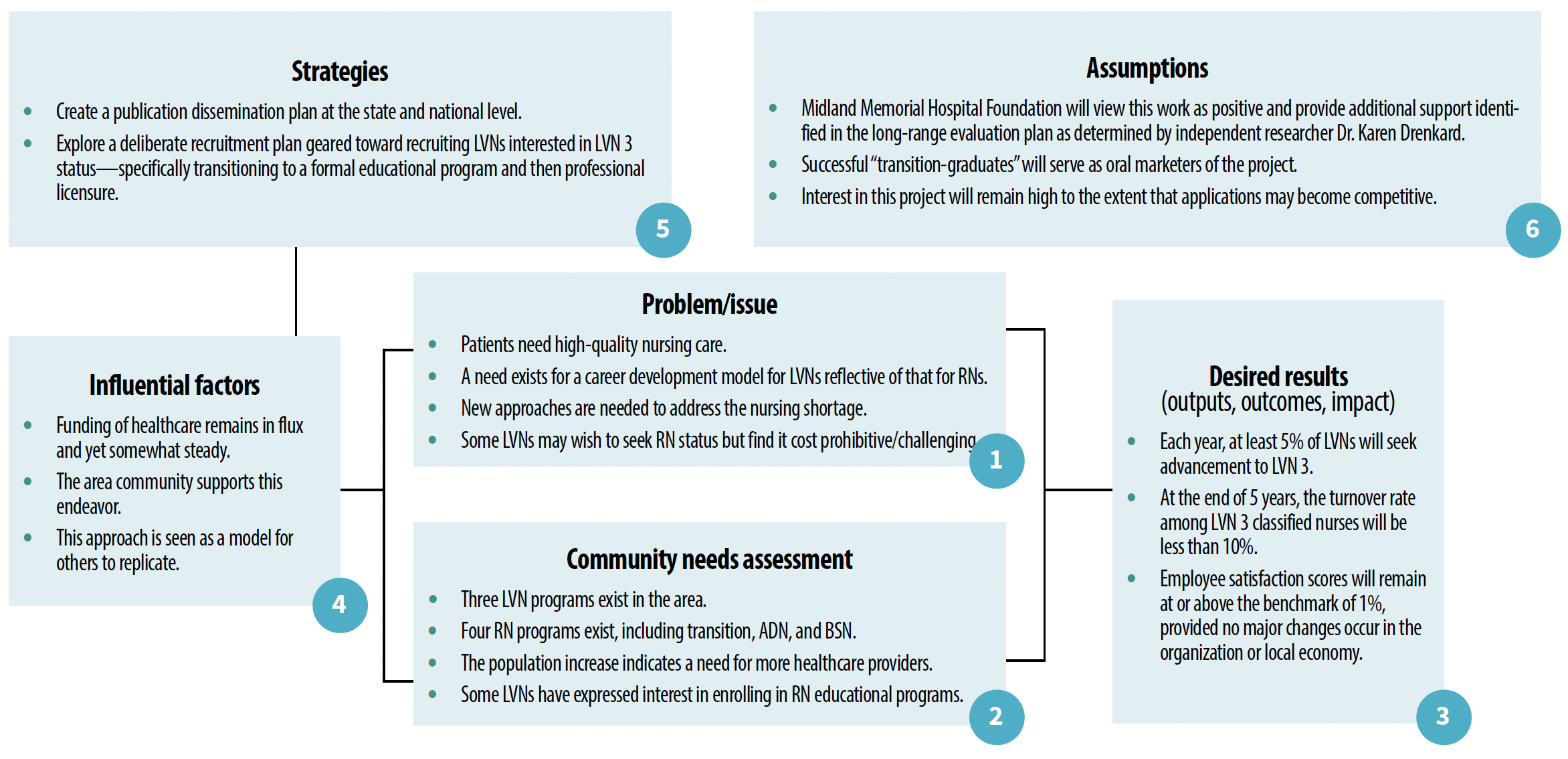
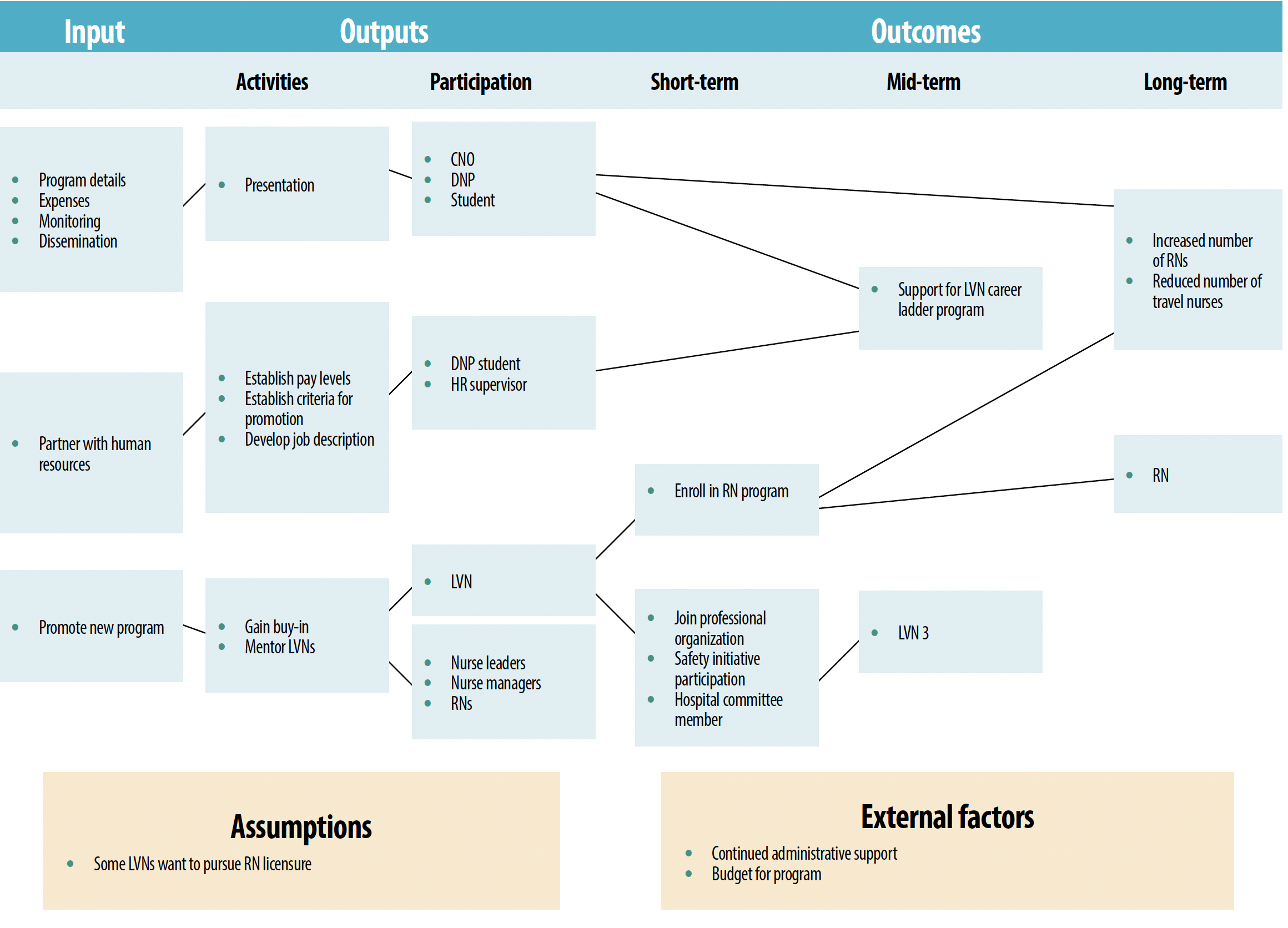
I used the Kellogg Logic Model to guide planning, design, and implementation of our LVN career ladder. I also used it to identify short-term (LVNs joining a professional organization and making a commitment to career development and growth) and long-term (increasing the number of RNs) outcomes. I served as the evaluator of Logic Model development, which was designed specifically for this project. (See Logic model.)
Logic model
The project team used the Kellogg Logic Model to plan, design, and implement the licensed vocational nurse (LVN) career ladder.
Planning and design
Career Ladder
Gauging success
The project team sent program evaluation surveys via email to all LVNs (those who participated in the clinical ladder program and those who didn’t) and managers. All LVNs were asked why they chose to participate or not participate in the program. The manager surveys included three open-ended questions related to the benefits of the program, supportive hospital resources, and unit tension.
Results
The project team evaluated the LVN clinical ladder program in three ways: design and implementation process, survey data, and cost-benefit analysis.
Design and implementation
As the project leader, I evaluated the design and implementation process. In response to the continuing nursing shortage and the willingness of nurse leaders to consider a new approach to increasing nursing staff, program design and implementation moved quickly.
The chief nursing officer’s support for the program influenced the nursing and human resources departments. Because this approach had the potential to reduce recruitment challenges for human resources, the department was eager to help develop a system that worked. Initial efforts included creating job descriptions; identifying legal ramifications; designing appropriate advertising materials; and considering budgetary, personnel, developmental, and community implications.
Surveys
Site-specific surveys were sent to LVN participants, LVN nonparticipants, and related managers. LVN surveys contained closed and open-ended questions; the manager surveys contained all open-ended questions.
One clinical manager described the career ladder as “a great opportunity for LVNs.” An LVN 3 participant stated, “Without the program, I would not be able to go back to school.” The positive responses indicated the program was well-received and likely met the needs and expectations of LVN participants. Positive feedback suggested the career ladder program has the potential to motivate LVNs to pursue further professional development, enhance job satisfaction, and improve retention within the organization. (See Survey responses.)
Survey responses
Midland Health licensed vocational nurses (LVNs)—those who participated in the career ladder program and those who didn’t—responded to online surveys, as did nurse managers. The project team reviewed open-ended comments for general themes and categorized them by key meaning. Those words appear below.
Nonparticipant LVN survey responses
Yes = 4 (33%)
No = 8 (67%)
Yes = 11 (92%)
No = 1(8%)
- Lack of finances/funding
- Doesn’t want to go back to school at this time
- Consistent promotion of the program and its benefits; many say they’re unaware of program
- Need point-based system similar to RN program
- Doesn’t understand program and hasn’t sought clarification
Participant LVN survey responses
Remain LVN =1
Pursue RN =2
Pursue BSN =6
Other =0
the hospital to achieve your career goals?
Yes = 8 (100%)
No = 0 (%)
Not sure = 0 (%)
development? (open-ended question)
- Individual flexibility per contract
- More communication on tuition reimbursement
program? (open-ended question)
- Great opportunity; only program of its kind for LVNs
- Experience has made me want to grow professionally
- Continue education to become RN
Nurse manager survey responses (open-ended questions)
- Staff have not yet completed
- Many interested
program?
- Support system to guide process
- Career ladder luncheons for LVNs
- No tension
- Only interested in pay increase
The career ladder program consists of three levels that build upon each other.
LVN 1. New graduate LVNs participate in an extensive residency lasting 12 to 14 weeks. They learn policies, skills, documentation, time management, and professional behavior.
LVN 2. As LVNs complete LVN 1 requirements and can then practice independently, they advance to LVN 2, which indicates that they’re no longer on orientation or in the residency program. To qualify as an LVN 2, they must have had at least 1 year of experience in an acute care setting or successful completion of the hospital’s residency program. No application is required for transition from LVN 1 to LVN 2. Progression to LVN 2 includes a pay increase.
LVN 3. LVN 2s can progress on the career ladder via two options. Option 1 involves admission to an RN program (LVN-to-RN transition, associate degree in nursing, or bachelor of science in nursing). Option 2 is for LVNs employed for at least 3 years who aren’t pursuing RN licensure. Both options require active membership on a hospital committee, participation in a hospital quality improvement project, and membership in a professional organization.
Candidates for both LVN 3 options require manager or director support and application for career ladder progression. At LVN 3 level, the benefits of participation include tuition reimbursement, an option to participate in a 24-for-36 site-specific program (reduced workload to 24 hours/week with a pay stipend of 12 hours/week), and flexible scheduling to accommodate school schedules. The education stipend program requires a signed 2-year employment agreement.
The career ladder provides LVNs with a path for career progression that easily transitions into the RN professional development ladder. Upon completion of an RN program and licensure, those with an associate’s degree can transition to RN 2 and those with a bachelor’s degree or higher can transition to RN 3. (See Career ladder comparison.)
Career ladder comparison
Midland Health offers career ladder programs for licensed vocational nurses (LVNs) and RNs.
Novice new graduate
No experience
Novice new graduate
OR
Nurse who’s been absent from bedside care for an extended period
Licensed with 1 year of experience
OR
Successful completion of LVN residency program
RN with > 1 year of experience
OR
Successful completion of RN residency program
Meets requirements of LVN 2
AND
Member of a professional organization
Participation in a hospital committee
Participation in at least one quality improvement project within the hospital
AND/OR
Enrolled in an RN program (LVN-to-RN, ADN, or BSN)
Meets requirement of RN 2
AND
Certification in a national specialty
OR
Graduate nursing degree (BSN, MSN, DNP, PhD in nursing)
OR
At least 5 years of clinical experience
Meets requirement of RN 3
AND
Letter of recommendation
5 years’ experience, at least 1 year at organization
AND
Completion of special unit-based project/poster presentation
OR
Active enrollment in nursing courses for
previous 6 months, completion of 6 credit hours
Meets requirement of RN 3
AND
Letter of recommendation
5 years’ experience, at least 2 years at organization
AND
Completion of special hospital-wide project/
poster presentation
OR
Active enrollment in nursing courses for the
previous 6 months, completion of 6 credit hours
Timeline and participants
The career ladder project ran from December 1, 2024 to March 3, 2025. Of the hospital’s total LVN staff (n=39), 20 answered the surveys. (See Demographics of respondents)
Demographics of respondents
Of the 39 licensed vocational nurses (LVNs) employed at Midland Health, 20 (participating and nonparticipating) responded to the career ladder survey.
Cost-benefit analysis
A preliminary cost-benefit analysis showed an initial net savings of more than $89,000 per LVN per year with 54% savings from reduced contract labor use. To provide a comprehensive evaluation, this analysis incorporates both monetary and nonmonetary factors, including employee satisfaction, flexible scheduling, employee recognition, leadership engagement, and a supportive student environment. Although the initial cost savings from reducing contract labor are significant, the full impact of the project will require 3 to 5 years of data.
What we learned
Midland Health nurse leaders are pleased with the results of adding LVNs into the staffing mix. Robinson and colleagues describe how having LPNs in the acute care setting can create a collaborative care team model in which the RN and LPN work together to maximize both roles. In a healthy work environment, the mix of LPN/LVN and RN skills should match patient needs with nursing competencies.
Desir and colleagues describe LPNs as a much-needed support for the nursing workforce. Additional support decreases the immediate burden of high nurse–patient ratios. The career ladder provides an opportunity for LVNs to receive internal support and recognition to pursue educational opportunities, subsequently increasing the number of RNs within the organization.
Although the inclusion of LPNs/LVNs in the acute care setting offers an immediate approach to nurse staffing concerns, trust, interprofessional respect, safety, and coordinated patient care require education on LPN/LVN and RN scope of practice. LVNs’ re-entry into the acute care setting at Midland Health presents a culture change for the organization. The career ladder helped to bring excitement and enthusiasm to the internal dialogue, resulting in a positive influence on workplace culture. Support from nurse leaders contributed to the successful transition.
Promotion of the career ladder program to LVNs, clinical managers, and RNs provides an excellent opportunity to engage team members with thoughtful discussions that include education and help to alleviate concerns. When LPNs/LVNs support RNs by managing routine and stable patient care tasks, RNs can focus on complex clinical responsibilities. This collaborative model helps address staffing shortages and improve workload balance. Midland Health leaders have expressed enthusiasm about the positive impact of the LVN career ladder.
Limitations
This project offers one organization’s view of an LVN career ladder. It incorporates a nontraditional expectation for career ladders—the potential for transition to a different level of licensure. Our current evaluation is based solely on the initiation phase of the project; a longitudinal evaluation of data will offer a more accurate reflection of the program’s effectiveness. Although other organizations can implement this project, they should adapt it based on their unique needs. Replication depends on leadership support and nurse and manager engagement.
Nursing implications
Although the cost savings achieved by reducing contract labor are significant for Midland Health, the full impact of the project extends beyond the financial. LVNs feel encouraged to pursue formal education, which helps to increase the number of RNs. LVNs also feel motivated to get more involved in their respective units and the hospital. The reintroduction of LVNs to acute care required intentional planning with attention to the education needs of all nurses and staff.
In addition, the career ladder program aligns with the Future of Nursing 2020–2030 report’s call to provide structured opportunities for professional growth that will help build and sustain a nursing workforce of sufficient size, diversity, distribution, and expertise.
Fulfilling a commitment
An LPN/LVN career ladder program offers an innovative strategy to increase the supply of RNs and supports a population of nursing professionals who might not otherwise be able to afford to transition from one licensure level to another. The career ladder supports the project site’s commitment to advancing the nursing through professional growth and development.
Cassandra McDorman is a practice transition manager at Midland Health in Midland, Texas.
American Nurse Journal. 2026; 21(9). Doi: 10.51256/ANJ0925
References
Adams R, Ryan T, Wood E. Understanding the factors that affect retention within the mental health nursing workforce: A systematic review and thematic synthesis. Int J Ment Health Nurs. 2021;30(6):1476-97. doi:10.1111/inm.12904
Ahn YS, Choi JS. Nurses’ perceptions of career ladder systems, job satisfaction and turnover intention: A cross-sectional study. Nurs Open. 2023;10(1):195-201. doi:10.1002/nop2.1294
Al Mohajer M. Understanding the gap between nursing workforce in the United States and population need—A policy brief. Avicenna J Med. 2023;13(4):206–14. doi:10.1055/s-0043-1775724
American Nurses Association. Code of Ethics for Nurses. 2025. codeofethics.ana.org/home
Carrion AJ, Miles JD, Thompson MD, Journee B, Nelson E. Program evaluation through the use of logic models. Curr Pharm Teach Learn. 2021;13(7):789–95. doi:10.1016/j.cptl.2021.03.006
Desir ML, Laughon D, Tao H, Green JF. The impact of a licensed practical nurse–registered nurse care delivery model on the work environment. Nurse Leader. 2024;22(1):95-103. doi:10.1016/j.mnl.2023.09.004
Haddad LM, Annamaraju P, Toney-Butler TJ. Nursing shortage. StatPearls. February 13, 2023. ncbi.nlm.nih.gov/books/NBK493175/?
Jones CB, McCollum M, Tran AK, Toles M, Knafl GJ. Supporting the dynamic careers of licensed practical nurses: A strategy to bolster the long-term care nurse workforce. Policy Polit Nurs Pract. 2021;22(4):297-309. doi:10.1177/15271544211030268
National Academies of Sciences, Engineering, and Medicine. The Future of Nursing 2020–2030: Charting a Path to Achieve Health Equity. Washington, DC: The National Academies Press; 2021. doi:10.17226/25982
Robinson C, Russell MB, Eaton M, Holecek N, Harding M, Martinez N. Renewing the care team model: Leveraging the LPN role in the acute care setting. Nurs Manage. 2023; 54(1):24-31. doi:10.1097/01.NUMA.0000905032.53383.4e
Tamata AT, Mohammadnezhad M. A systematic review study on the factors affecting shortage of nursing workforce in the hospitals. Nurs Open. 2023;10(3):1247-57. doi:10.1002/nop2.1434
Texas Board of Nursing. Nurse Practice Act, Tex. Occ. Code § 216.3 (2023). bon.texas.gov/laws_and_rules_nursing_practice_act.asp
Texas Board of Nursing. Position statement 15.25: Administration of medication & treatments by LVNs. bon.texas.gov/practice_bon_position_statements_content.asp.html#15.25
W. K. Kellogg Foundation. Logic Model Development Guide. users.nber.org/~rdehejia/!@$DRM/Lecture%2002/extra/kellogg%20logic%20models.pdf
Key words: licensed vocational nurses, licensed practical nurses, career ladder, professional growth