

Preventing falls in the home: A multifactorial approach
Implementing a comprehensive and multifaceted fall prevention program for seniors in their homes is incredibly important. By addressing various factors that contribute to falls, we can help create a safer living environment for our beloved elders, allowing them to maintain their independence and quality of life. It’s about more than just safety—it’s about dignity, confidence, and the peace of mind that comes with knowing they are protected. To start, it is essential to explore the serious implications that falls can have on individuals aged 60 and above. Falls are not just common accidents; they can lead to severe physical injuries such as fractures, head trauma, and a loss of independence, which can significantly affect the quality of life for older adults. Furthermore, the psychological impact of falling, including a fear of falling again, can lead to decreased mobility and social isolation.
Considering the growing population of seniors, it’s crucial to understand the factors contributing to falls, which can range from environmental hazards and health conditions to medication side effects. A multifactorial approach involves assessing and addressing these risks through various strategies, such as home modifications, strength and balance training, vision checks, medication reviews, and patient education. By tailoring a program to meet the unique needs and circumstances of each senior, we can significantly reduce the likelihood of falls and enhance overall well-being.
Reducing falls in the elderly population at home is crucial, as falls significantly contribute to injury, hospitalization, and mortality within this age group. The statistics highlight a worrying trend: falls are one of the leading causes of serious injuries among seniors, often resulting in broken bones, such as hip fractures, and traumatic brain injuries, which can lead to long-term disabilities (Vaishya & Vaish, 2020). These incidents not only jeopardize the physical health of older adults but also create emotional and psychological repercussions, often instilling fear and anxiety about mobility and independence. Additionally, the aftermath of a fall can mean a steep decline in overall quality of life, as individuals may require extensive rehabilitation or assistance with daily activities. Preventing falls is vital for maintaining the health, independence, and well-being of elderly individuals living at home. Preventing falls also helps maintain a senior’s independence and confidence, while avoiding the significant medical and financial costs associated with fall-related injuries (National Institute on Aging, 2022).
However, these incidents can be effectively prevented through home modifications, promoting physical activity, and addressing risk factors such as vision impairments and medication side effects. To enhance the safety and well-being of the patient, it is essential to make several significant modifications to their home environment. First and foremost, maintaining a clutter-free space will minimize the risk of trips and falls, allowing for easier navigation. It’s also important to reduce or ideally eliminate throw rugs, as they can easily become tripping hazards.
Proper lighting plays a crucial role as well; ensuring that all areas of the home are well-lit will help the patient see clearly and move confidently throughout their space. Additionally, providing the patient with non-skid footwear will greatly decrease the likelihood of slipping, offering them more stability as they walk.
Finally, it’s vital to ensure that the patient is using their assistive devices safely and correctly. This includes checking that walking aids are in good condition and easily accessible, allowing the patient to maintain their independence while minimizing risks. Together, these changes can significantly improve the patient’s safety and quality of life.
To enhance the effectiveness of the fall prevention program and improve patient outcomes, it is essential to introduce a comprehensive multifactorial approach. This program will integrate several vital components, including thorough home inspections to identify potential hazards, tailored patient education to raise awareness of fall risks, and systematic assessments of fall risk using tools such as the Timed Up and Go (TUG) test. Furthermore, it will involve training clinicians on the proper implementation of the fall prevention strategies, ensuring they are well-equipped to support their patients. Regular quality improvement audits of the fall program will also be conducted to monitor its effectiveness and make necessary adjustments. Together, these elements will create a robust framework aimed at reducing falls and enhancing the safety and well-being of patients.. Multifactorial programs that combine multiple components, such as exercise, medication management, and home safety, have shown effectiveness in reducing the rate of falls (Hopewell et al., 2019). The effectiveness of a program in real-world settings is heavily influenced by how well it is put into practice. A program that fails to consider potential barriers to implementation, such as difficulties in engaging patients and securing their commitment, risks falling short of the positive outcomes observed in controlled clinical trials. Without addressing these challenges, the program may struggle to produce similar levels of success when applied in everyday situations. In community-dwelling adults over the age of 65 years old, who are at risk for falls, how does implementation of a multifactorial fall prevention program impact fall rates and injuries compared to standard fall prevention care over a 6-month period?
During this research, the following databases were searched: Google Scholar, EBSCO, and NIH. These databases provided many articles on my literature research topic. There were several key words used, such as falls, elderly 60 and over, fall prevention, fall prevention programs, community fall programs, reducing falls, and risk for falls in the elderly. The timeframe was narrowed for the research articles to only include articles between 2019-2025. Once this filter was added, it helped to narrow the research articles from over 1 million to 17,600, which is still a very large number. The research articles were narrowed even further by being more specific with research keywords. Alternating or reducing the keywords used to include different articles relevant to the literature research topic also helped to further narrow down articles relevant to the research topic. There were 14 articles that were read and 7 articles that were included in this research paper. It was observed that many articles focused on falls among the elderly, but the majority pertained to inpatient facilities such as nursing homes and hospitals. These settings were not applicable to the research objectives, which concentrate on community-based issues. Therefore, the decision was made to exclude any studies that specifically examined fall incidents in these institutional environments, as they did not align with the focus on the experiences of older adults living independently in the community. It was determined to ensure to include articles that appeared to be pertinent to the research topic, regardless of whether the studies were conducted in different countries. The main focus was on ensuring that the core elements of the research aligned with the topic of interest, allowing for a broader understanding and more comprehensive analysis.
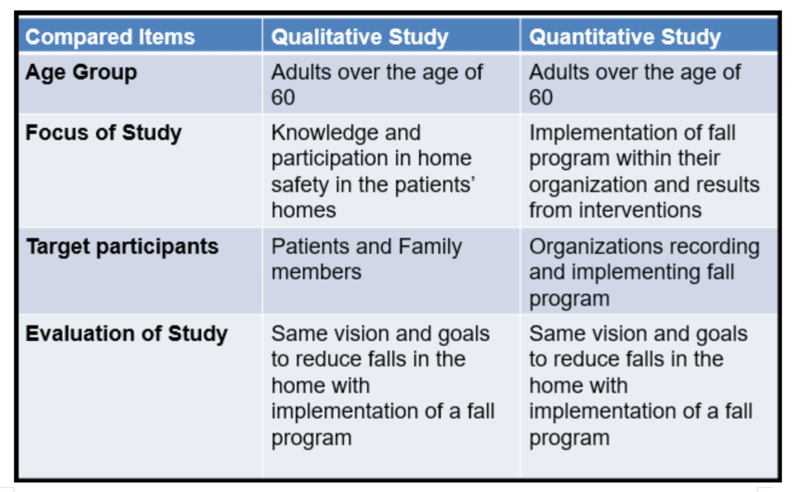
The two qualitative studies both included adults over the age of 60. These studies were similar in the fact that each included the knowledge of the participants in home environment safety and their practice and participation in home modifications to home safety. In theme one, these studies indicated significant opportunities to improve education for patients and their caregivers to help further prevent future falls. These two studies differ slightly in the view of the participants, such as the study performed by the Journal of Mid-Life Health, where the view was from the patients themselves (Shah et al., 2025). In the study by BMC Geriatrics, the view is from the family and caregiver who care for the older adult (Songthap et al., 2023).
Upon reviewing the two quantitative studies, it is clear that they differ regarding their targeted participant groups; however, both place a strong emphasis on the implementation of fall prevention programs, thus forming a shared theme. Each study highlights the importance of tailored interventions designed to reduce falls and enhance safety within their respective populations. Furthermore, they employ comparable methodologies to assess the effectiveness of various strategies utilized in these fall prevention programs, thereby offering insightful perspectives on best practices and areas for enhancement. The study performed by Logan, P. (2021) focused on fall prevention programs and their impact on patients in long-term care facilities, whereas the study by Juckett, L.A. (2021) focused on fall prevention programs within a community setting. Both of these studies come from the point of view of healthcare professionals rather than the patients or caregivers themselves.
In reviewing all four studies, they all have a similar goal, which is fall prevention, refer to Table A. There were no contradictions found among these studies. There are notable differences; however, even with their differences, they continue to have the same vision and goal for the patient. It is important when conducting research that different perspectives are considered. Different perspectives are essential in research because they challenge assumptions, minimize bias, and lead to more comprehensive, objective, and nuanced conclusions. By incorporating diverse viewpoints and data sources, researchers can achieve a deeper understanding of complex issues, enhance the quality of their work, and ensure that their findings are more relevant to a broader population.
An increased incidence of falls in the elderly at home was identified in the home health community; therefore, a multifactorial fall prevention program was implemented in the majority of agencies. This program has been reviewed and altered to accommodate improvements identified, such as incorporating a multi-disciplinary approach when reporting falls. There have also been educational sessions added to clinicians who are implementing and educating the patients and their family members on the fall prevention program and assisting them in setting up their home for optimal home safety. To help sustain this improvement in the fall program and reduce falls in the home, there are quarterly reviews that occur that investigate, identify, and implement any changes that need to be made. Recently, there was an improved fall report that included additional information for the clinician reporting the fall to fill out to better understand what occurred, to help implement more education, assessment, or home safety maintenance, depending on what occurred. There are also performance improvement plans that are being initiated when the fall occurrences increase over 10%, which also helps to identify gaps and areas for improvement.
The expected outcomes for the organization are that all clinicians will be educated on the multifactorial fall prevention program. The organization will test each clinician’s knowledge of the fall prevention program at new hire and annually. There will be an expected decrease in falls in the home, with the goal of being less than 10% per quarter. There will also be a process review to be performed each quarter to ensure there are no changes or modifications needed to the process to ensure positive patient outcomes, which is the whole purpose of this literature review is to promote patient safety and improve patient outcomes.
References
Hopewell, S., Copsey, B., Nicolson, P., Adedire, B., Boniface, G., & Lamb, S. (2020). Multifactorial interventions for preventing falls in older people living in the community: A systematic review and meta-analysis of 41 trials and almost 20,000 participants. British Journal of Sports Medicine, 54(22), 1340–1350. https://doi.org/10.1136/bjsports-2019-100732
Juckett, L. A., Bunger, A. C., Jarrott, S. E., Dabelko-Schoeny, H. I., Krok-Schoen, J., Poling, R. M., Mion, L. C., & Tucker, S. (2021). Determinants of fall prevention guideline implementation in the home- and community-based service setting. The Gerontologist, 61(6), 942–953. https://doi-org.proxy.library.maryville.edu/10.1093/geront/gnaa133
Logan, P. A., Horne, J. C., Gladman, J. R. F., Gordon, A. L., Sach, T., Clark, A., Robinson, K., Armstrong, S., Stirling, S., Leighton, P., Darby, J., Allen, F., Irvine, L., Wilson, E. C. F., Fox, C., Conroy, S., Mountain, G., McCartney, K., Godfrey, M., & Sims, E. (2021). Multifactorial falls prevention programme compared with usual care in UK care homes for older people: multicentre cluster randomised controlled trial with economic evaluation. BMJ, 375. https://doi-org.proxy.library.maryville.edu/10.1136/bmj-2021-066991
National Institute on Aging. (2022, September 12). Falls and fractures in older adults: Causes and prevention. https://www.nia.nih.gov/health/falls-and-falls-prevention/falls-and-fractures-older-adults-causes-and-prevention
Qualitative vs quantitative research. (2023, May 4). Qualtrics. https://www.qualtrics.com/articles/strategy-research/qualitative-vs-quantitative-research/
Shah, R., & Sawant, S. (2025). Awareness and practice of home modifications for fall prevention among the elderly population in Urban Pune: A randomized cross-sectional survey. Journal of Mid-Life Health, 16(3), 328–335. https://doi-org.proxy.library.maryville.edu/10.4103/jmh.jmh_60_25
Songthap, A., Suphunnakul, P., & Rakprasit, J. (2023). Factors affecting home environmental safety management for fall prevention for older adults in northern Thailand. BMC Geriatrics, 23(1), 704. https://doi-org.proxy.library.maryville.edu/10.1186/s12877-023-04419-7
Vaishya, R., & Vaish, A. (2020). Falls in older adults are serious. Indian Journal of Orthopaedics, 54(1), 69–74. https://doi.org/10.1007/s43465-019-00037-x