


Background
Mental health disorders represent a significant and persistent public health challenge worldwide affecting individuals across the lifespan. Even prior to the COVID-19 pandemic, conditions such as anxiety and depression were highly prevalent and placed substantial strain on healthcare systems. Globally, mental health disorders were among the leading causes of disability, with anxiety and depressive disorders affecting millions of people (World Health Organization [WHO], 2019). In the United States (US), approximately one in five adults experienced a mental illness each year (National Institute of Mental Health [NIMH], 2019).
The COVID-19 pandemic further exacerbated these existing challenges, leading to marked increases in psychological distress, anxiety, depression, and post-traumatic stress disorder (PTSD) (Chamaa et al., 2021; Galea et al., 2020). Social isolation, disrupted routines, prolonged uncertainty, and widespread loss intensified mental health concerns, including inhibited grief and loneliness (Ratcliffe, 2020; Rodrigues et al., 2023). According to the American Psychological Association (APA, 2020), the prevalence of mental health conditions doubled during the pandemic. In the US, depression rates increased from pre-pandemic prevalence of 5-10% to as high as 33.7% during the COVID-19 period (Shetty et al., 2023), resulting in a substantial rise in demand for mental health services.
Nurse practitioners (NPs), who are trained in holistic, patient-centered care, and they play a critical role in addressing mental health needs across the lifespan (Stucky et al., 2020). During and following the COVID-19 pandemic, NPs were often at the forefront of screening, diagnosing, and managing mental health conditions, particularly in undeserved and primary care settings (Dhaliwal et al., 2022; Reilly et al., 2020). NPs with their advanced training and patient-centered holistic approach are critical in their role for mitigating mental health crises by providing accessible and comprehensive care (Turi, 2023).
Despite their vital role, the specific strategies used by NPs, the effectiveness of these interventions, and the challenges encountered during implementation have not been consistently synthesized in the literature. Understanding how NPs responded to the post-COVID-19 mental health crisis is essential for informing future workforce preparation, policy development, and clinical practice during and after large-scale emergencies (Turi, 2023).
Purpose
To better understand this topic, a literature review was conducted to examine NPs-led mental health interventions implemented in response to the post-COVID-19 mental health crisis, their reported effectiveness, and the challenges associated with their implementation. By examining the role of NPs in addressing the growing mental health crisis, this review will contribute to a deeper understanding of best practices and inform future, clinical, educational, and policy initiatives.
Methods
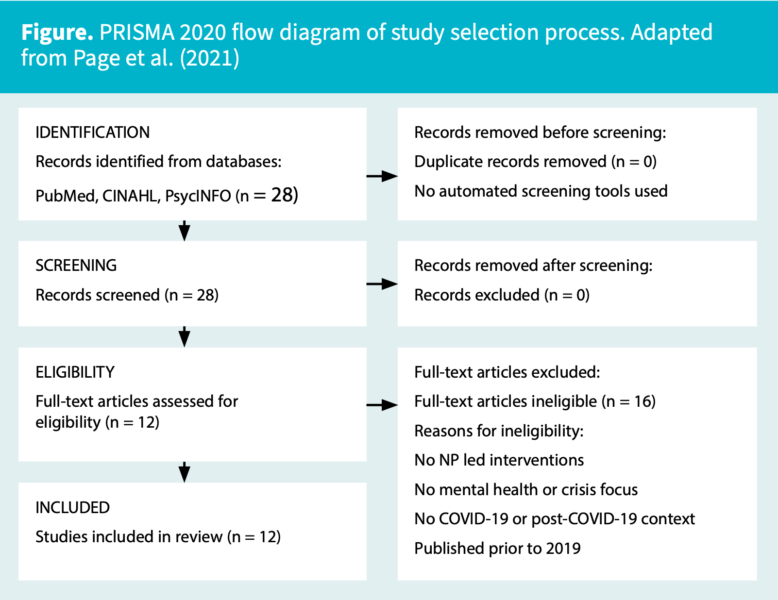
This study employed a literature review design to synthesize current research on NP-led interventions addressing mental health issues in the post COVID-19 era. A systematic search of literature was conducted using databases such as PubMed, CINAHL, and PsyINFO of studies published between 2019 – 2024 reflecting the evolving mental health landscape following the global pandemic. Search terms included combinations of “nurse practitioner,” “mental health,” “COVID-19,” “post-pandemic,” “interventions,” and “psychological distress.” Inclusion criteria consisted of peer reviewed articles published between 2019 – 2024, written in English, and focused on NP-led mental health care during or after the COVID-19 pandemic. A PRISMA 2020 flow diagram (Figure 1) presents the study selection process, including article identification, screening, eligibility, and final inclusion (Page et al., 2021). (See figure 1)
Theme 1: NP-Led Interventions
Several studies highlighted the use of telemental health services to improve access and continuity of care (Dhaliwal et al., 2022; Goldin et al., 2021; Reilly, J. et al., 2023; Reilly, S. et al, 2020; Zemlack et al., 2024). Fasching (2021) described the use of telehealth combined with consultation and counseling services for parents, school administrators, and medical practices, emphasizing the expanded roles of APRNs in addressing pediatric and school-based mental health needs. Coleman et al. (2023) reported the use of Cognitive Behavioral Therapy (CBT) in primary care for children and adolescents with anxiety disorders, while Ahmed et al. (2020) described the implementation of a computerized mental health assessment tool in an NP-led clinic to enhance screening and referrals. Judge-Ellis et al, (2023) reported the expanded scope of practice roles amongst NPs acquiring dual certification in primary care and psychiatric mental health.
Policy-focused interventions were also reported. Stucky et al. (2020) highlighted advocacy efforts for permanent national NP full practice authority to improve healthcare system resilience and workforce capacity. Myers et al. (2021) examined pandemic-related regulatory changes affecting APRN practice authority.
Theme 2: Effectiveness of Interventions
Telehealth was frequently associated with improved access, continuity of care, and reduced geographic and financial barriers (Dhaliwal et al., 2022; Goldin et al., 2021; Reilly, J. et al., 2023; Reilly, S. et al., 2020; Zemlack et al., 2024). Reilly, J. et al. (2023) reported high provider satisfaction with the rapid transition to tele-mental health services and continued use of these models following implementation. Fasching (2021) noted that telehealth and consultation services expanded the scope of APRN practice, revealed health disparities, and lowered access barriers in underserved populations. Other studies reported improved clinical outcomes, including enhanced depression management, better diabetes control, increased screening rates, and improved patient engagement (Birch, et al., 2021; Coleman et al., 2023; Judge-Ellis et al., 2023). Ahmed et al. (2020) also found improved clinician-patient communication and increased referrals to mental health and social services.
Theme 3: Challenges to Implementation
Reilly S., et al. (2020) reported a lack of training among some practitioners and the need to develop new cognitive and psychological assessment tools for tele-mental health care. Fasching et al. (2021) identified persistent mental health stigma as a major barrier to care. Technology-related challenges, including patient and provider discomfort, privacy concerns, and training gaps, were also noted across multiple studies (Dhaliwal et al., 2022; Goldin et al., 2021; Zemlack et al., 2024).
Regulatory and policy barriers, including state-level practice restrictions and opposition to NP full practice authority further limited the sustainability of NP-led mental health services (Myers et al., 2021; Stucky et al., 2020). Additional challenges included leadership changes, information system limitations; cultural considerations, and the burden of managing high-cost, complex mental health cases (Birch et al., 2021; Judge-Ellis et al., 2023). (See Table.)
Discussion and Conclusion
This literature review highlights the critical role of nurse practitioners in addressing mental health needs following the COVID-19 pandemic. Across the literature, NPs implemented a range of interventions that were responsive to growing demand and, in many cases, effective in improving patient outcomes. These interventions included telehealth services that supported continuity of care, medication management, and collaborative practices, all of which reflect the holistic and patient-centered foundation of NP practice. Evidence from this review further suggests that NP-led interventions contributed to improved symptom management, increased access to care, and greater patient and provider satisfaction, particularly in underserved communities where mental health services remain limited. The integration of mental health services into primary care settings appears especially important, as it strengthens access, continuity, and the delivery of more comprehensive care (Turi, 2023). Similarly, the rapid expansion of telehealth and other crisis-responsive models improved service availability during a period of significant disruption, while also demonstrating the adaptability of the NP role in meeting emergent mental health needs (Yellowlees, 2022). At the same time, the review underscores persistent challenges, including provider burnout, resource limitations, and broader systemic barriers that constrain implementation and sustainability. These findings suggest that, although NPs are well positioned to lead innovative and responsive mental health care strategies, long-term success depends on stronger structural support. Strengthening NP education through expanded mental health, trauma-informed, and crisis-intervention training may better prepare clinicians for future emergencies (Emerson et al., 2025). In addition, collaborative practice models that engage NPs alongside psychiatrists, psychologists, and social workers may further support comprehensive, team-based care that addresses both physical and mental health needs (Finley, 2020; Emerson et al., 2025). Overall, the literature suggests that NPs are essential to strengthening access, continuity, and quality in mental health care. Continued investment in education, collaboration, and system-level support will be important to sustain and expand this role in future public health challenges.
| Table. Thematic Synthesis of NP-led Interventions, Effectiveness, and Challenges | ||
| The following table summarizes key NP-led interventions, their reported effectiveness, and the implementation challenges identified in this review. | ||
| THEME | KEY FINDINGS | SUPPORTING STUDIES |
| NP-Led Interventions | Telehealth-based consultation and counseling for parents, schools, and medical practicesCognitive Behavioral Therapy for anxiety in primary careComputer-assisted mental health screening in NP-led clinicsDual certification of NPs in primary care and psychiatric mental health Legislative advocacy for NP full practice authority | Ahmed et al. (2020); Coleman et al. (2023); Dhaliwal et al. (2022); Fasching (2021); Goldin et al. (2021); Judge-Ellis et al. (2023); Myers et al. (2021); Reilly, J. et al. (2023); Reilly, S. et al. (2020); Stucky et al. (2020); Zemlack et al. (2024) |
| Effectiveness of Interventions | Improved access, continuity of care, and reduced geographic and financial barriersHigh provider satisfaction with tele-mental health services Expanded APRN scope and improved access in underserved populations Improved clinical outcomes (depression management, screening rates, patient engagement) Enhanced clinician-patient communication and referrals | Ahmed et al. (2020); Birch et al. (2021); Coleman et al. (2023); Dhaliwal et al. (2022); Fasching (2021); Goldin et al. (2021); Judge-Ellis et al. (2023); Reilly, J. et al. (2023); Reilly, S. et al. (2020); Zemlack et al. (2024) |
| Challenges | Mental health stigma Provider training gaps and need for new assessment tools Technology barriers (patient and provider discomfort, privacy concerns, training gaps) Regulatory restrictions and opposition to NP full practice authority Leadership and system disruptions; high-cost, complex cases | Birch et al. (2021); Dhaliwal et al. (2022); Fasching (2021); Goldin et al. (2021); Judge-Ellis et al. (2023); Myers et al. (2021); Reilly, S. et al. (2020); Stucky et al. (2020); Zemlack et al. (2024) |
References
Ahmad, F., Wang, J., Wong, B., & Fung, WLA. (2020). Interactive mental health assessments for Chinese Canadians: A pilot randomized controlled trial in nurse practitioner-led primary clinic. Asia-Pacific Psychiatry, 14, e12400. doi: 10.1111/appy.12400.
American Psychological Association (2020). Stress in America 2020: A national mental health crisis. Retrieved from https://www.apa.org/news/press/releases/2020/10/stress-mental-health-crisis
Balestra, M. L. (2019). Telehealth and legal implications for nurse practitioners. The Journal for Nurse Practitioners, 15(2), 87-90.
Birch, K., Ling, A., & Phoenix, B. (2021). Psychiatric nurse practitioners as leaders inbehavioral health integration. The Journal of Nurse Practitioners, 17(1), 112-115. https://doi.org/10.1016/j.nurpra.2020.09.001
Chamma, F., Bahmad, HF, Darwish, B., Kobeissi, J. M., Hoballah, M., Nassif, S. B., Ghandour, Y., Saliba, J. P., Lawand, N., Abou-Kheir, W. (2021). PTSD in the covid-19 era. Current Neuropharmacology, 19(12), 2164-2179. doi: 10.2174/1570159X19666210113152954.
Coleman, E., Rice, M., & Smith, T. S. (2023). Addressing anxiety in primary care with cognitive behavioral therapy. The Journal of Nurse Practitioners, 19, (2023), 104583. https://doi.org/10.1016/j.nurpra.2023.104583
Dhaliwal, J. K., Hall, T. D., LaRue, J. L., Maynard, S. E., Pierre, P. E., & Bransby, K. A., (2022). Expansion of telehealth in primary care during the covid-19 pandemic: Benefits and barriers. Journal of the American Association of Nurse Practitioners, 34(2), 224-229. doi:10.1097/JXX.0000000000000626.
Emerson, M. R., Langenberg, M., Szymanski, T. S., Schardt, W. Lano, A., & Hof, K. (2025). Meeting the needs of rural populations through a nurse practitioner–led integrated care program for student health. Journal of the American Association of Nurse Practitioners, 37(8), 446-455. doi: 10.1097/JXX.0000000000001154.
Fasching, F. (2021). Four ways covid-19 changed the role of the psychiatric mental health nurse practitioner. Daily Nurse: The Pulse of Nursing, July 13, 2021. Retrieved from https://dailynurse.springerpub.com/psych-mental-health/four-ways-covid-19-changed-the-role-of-the-psychiatric-mental-health-nurse-practitioner/
Finley, B.A. (2020). Psychiatric mental health nurse practitioners meeting rural mental health challenges. Journal of the American Psychiatric Nurses Association, 26(1), 97-101. doi: 10.1177/1078390319886357.
Galea, S., Merchant, R. M., & Lurie, N. (2020). The mental health consequences of covid-19 and physical distancing: The need for prevention and early intervention. JAMA Internal Medicine, 180(6), 817-818. Retrieved from https://doi.org/10.1001/jamainternmed.2020.1562
Goldin D., Maltseva T., Scaccianoce M., & Brenes F. (2021). Cultural and practical implications for psychiatric telehealth services: A response to covid-19. Journal of Transcultural Nursing, 32(2), 186-190. doi:10.1177/1043659620973069
Greenberg, N., Docherty, M., Gnanapragasam, S., & Wessely, S. (2020). Managing mental health challenges faced by healthcare workers during covid-19 pandemic. BMJ, 368, m1211. Retrieved from https://doi.org/10.1136/bmj.m1211
Gurusamy, J., Amudhan, S., Menen, M., Veerabhadraiah, Kathyayani. B., & Damodharan, D. (2023). Barriers and needs of mental health nursing practitioners toward the provision of physical health care for individuals with severe mental illness: Findings from a cross-sectional survey in India. Issues in Mental Health Nursing, 44(10), 1009–1019. https://doi.org/10.1080/01612840.2023.2262581.
Judge-Ellis, T., Gentil-Archer, A., Achenbach, A., Dehner, H., Kelleher, K., Buckwalter, K. (2023). The role of the duality certified primary care/psychiatric mental health nurse practitioner in treating high-needs/high-cost patients. Journal of the American Association of Nurse Practitioners, 35(11), 751-758, November 2023. doi: 10.1097/JXX.0000000000000931.
Keyes, B., McCombe, G., Broughan, J., et al. (2023). Enhancing GP care of mental healthdisorders post-covid-19: A scoping review of interventions and outcomes. Irish Journal of Psychological Medicine, 40(3), 470-486. doi: 10.1017/ipm.2022.17.
Moreno, C., Wykes, T., Galderisi, S., et al. (2020). How mental health care should change as a consequence of the covid-19 pandemic. The Lancet Psychiatry, 7(9), 813-824.
Myers, C. R., Muñoz, L. R., Stansberry, T., Johnson, M., & Schorn, M. (2021). COVID-19 pandemic mental health challenges: Patients and providers. Issues in Mental Health Nursing, 43(5), 401–408. https://doi.org/10.1080/01612840.2021.1993389
Neria, Y., Nandi, A., & Galea, S. (2008). Post-traumatic stress disorder following disasters: A systematic review. Psychological Medicine, 38(4), 467-480.
Page, M. J., McKenzie, J. E., Bossuyt, P. M., Boutron, I., Hoffmann, T. C., Mulrow, C. D., et al. (2021). The PRISMA 2020 statement: An updated guideline for reporting systematic reviews. BMJ, 372, n71. https://doi.org/10.1136/bmj.n71
Petry, S. E., Hughes, D., & Galanos, A. (2021). Grief: The epidemic within an epidemic American Journal of Hospice and Palliative Medicine, 38(4), 419-422. doi: 10.1177/1049909120978796.
Pfefferbaum, B. & Northe, C. S. (2020). Mental health and the covid-19 pandemic. New England Journal of Medicine, 383(6), 510-512.
Ratcliffe, M. (2023). Phenomenological reflections on grief during the covid-19 pandemic.Phenomenology and the Cognitive Sciences, 22, 1067-1086. Retrieved from https://doi.org/10.1007/s11097-022-09840-8
Reilly, J., Liphart Rhoads, J., Bettin, T., Dennik-Champion, G. & Bansal, G. (2023) Experiences of nurse practitioners with telehealth during the covid-19 pandemic. Journal of the American Association of Nurse Practitioners, 35(12), 787-793. doi: 10.1097/JXX00000000000000904.
Reilly S. E., Zane K. L., McCuddy W. T., Soulliard Z. A., Scarisbrick D.M., Miller L.E., & Mahoney III, J. J. (2020). Mental health practitioners’ immediate practical response during the covid-19 pandemic: Observational questionnaire study. JMIR Mental Health, 2020; 7(10), e21237. doi:10.2196/21237.
Rodrigues, M., Silva, R., & Franco, M. (2023). COVID-19: Financial stress and well-being in families. Journal of Family Issues, 44(5), 1254-1275. Retrieved from: https://doi.org/10.1177/0192513X211057009
Shetty, P., Avari, L., Madry, J., Betts, C., & Kirmani, B. (2023). The relationship betweencovid-19 and the development of depression: Implications on mental health. Neuroscience Insights, 18, 1-8. https://pubmed.ncbi.nlm.nih.gov/37608908/
Smith, A. C., Thomas, E., Snoswell, C. L., Haydon, H., Mehrotra, A., Clemensen, J., &Caffery, L. J. (2020). Telehealth for global emergencies: Implications for coronavirus disease 2019 (covid-19). Journal of Telemedicine and Telecare, 26(5), 309-313.
Stucky, C. H., Brown, W. J., & Stucky, M. G. (2020). COVID-19: An unprecedentedopportunity for nurse practitioners to reform healthcare and advocate for permanent full practice authority. Nursing Forum, 56(1), 222-227. Retrieved from https://doi.org/10.1111/nuf.12515
Tapp, J., Ketel, C., Vick, R., Zsamboky, M., Pfieffer, M.L., Gardner, V., Cole, S., Pitts, C. (2024). Closing the provider gap in rural and underserved communities: Preparing family nurse practitioner students for entry-to-practice. Nurse Educator, 2024 Aug 22. doi: 10.1097/NNE.0000000000001723.
E., McMenamin, MPhil., Supakorn, K., Kurtzman, E., & Poghosyan, L. (2023). The effectiveness of nurse practitioner care for patients with mental health conditions in primary care settings. Nursing Outlook, 71(4), July-August 2023, 101995. Retrieved from https://pmc.ncbi.nlm.nih.gov/articles/PMC10592550/
World Health Organization (2022). Mental health and covid-19: Early evidence of the pandemic’s impact. Scientific Brief, 2 March 2022. WHO. Retrieved from https://iris.who.int/bitstream/handle/10665/352189/WHO-2019-nCoV-Sci-Brief-Mental-health-2022.1-eng.pdf?sequence=1
Yellowlees, P. (2022). Impact of COVID-19 on mental health care practitioners. PsychiatricClinics of North America, 2022 Mar, 45(1), 109-121. doi: 10.1016/j.psc.2021.11.007.
Zemlack, J. L., Wilson, P., VanGraafeiland, B., & Rodney, T. (2024). Telehealth and thepsychiatric mental health nurse practitioner: Beyond the covid-19 pandemic. Journal of the American Psychiatric Nurses Association, 30(1), 174-179. doi: 10:1177/1078390321104511.