
Insights from a children’s hospital and a healthcare system
- Healthcare worker burnout and staff shortages have put immense pressure on healthcare organizations, intensifying nursing and physician turnover.
- The American Nurses Credentialing Center has introduced the Well-Being Excellence credential, an evidence-based framework designed to enhance the nursing workforce.
- Two organizations that participated in the pilot process to develop this credential share their stores and the credential’s impact.
Working in healthcare can be both challenging and high stakes, placing immense pressure on employees, who frequently experience significantly higher rates of negative well-being outcomes compared to other professions. According to the Centers for Disease Control and Prevention, almost half of the healthcare workforce reports feeling burned out. A study by Aiken and colleagues found physicians and nurses more likely to report mental health symptoms such as anxiety, depression, and post-traumatic stress disorder.
In addition, Aiken and colleagues and Yusoff and colleagues report that job dissatisfaction, struggles with work–life balance, and risk of workplace violence contribute to high turnover rates among healthcare workers, which further exacerbate staffing shortages and overburden those who remain. Recently, these challenges have intensified, prompting national and international bodies to explore and propose meaningful solutions and offer relief to the already strained healthcare workforce.
A well-being plan and credential
In 2022, the National Academy of Medicine launched the National Plan for Health Workforce Well-Being (National Plan), which focuses on seven priority areas. The National Plan offers comprehensive recommendations to create supportive environments for healthcare workers and address the myriad challenges they face. Despite extensive guidance from the National Plan and other governmental agencies and professional associations, some organizations struggle to build a comprehensive well-being program, while others have strong programs and seek external validation of their efforts. (See Seven priorities.)
Seven priorities
The National Academy of Medicine established the following seven priorities for health workforce well-being:
- Create and sustain positive work and learning environments and culture.
- Invest in measurement, assessment, strategies, and research.
- Support mental health and reduce stigma.
- Address compliance, regulatory, and policy barriers for daily work.
- Engage effective technology tools.
- Institutionalize well-being as a long-term value.
- Recruit and retain a diverse and inclusive workforce.
In 2024, to provide actionable steps for the development of well-being programs and a method for validating associated efforts, the American Nurses Credentialing Center (ANCC) launched the Well-Being Excellence™ (WBE) credential. This evidence-based framework includes foundational and advanced elements to foster the overall well-being of the entire healthcare team.
Morrison and colleagues describe how developing the WBE credential began with a thorough review of the current state of employee well-being in healthcare and beyond, along with the literature and recommendations from the National Plan, governmental agencies, and professional associations. The work continued with an expert panel to advise the Commission on Pathway to Excellence®, the WBE governing body. The panel provided guidance on many aspects of the credential, including eligibility requirements, essential elements, how organizations can demonstrate their progression and development of the foundational criteria, and potential validation methods.
Requirements
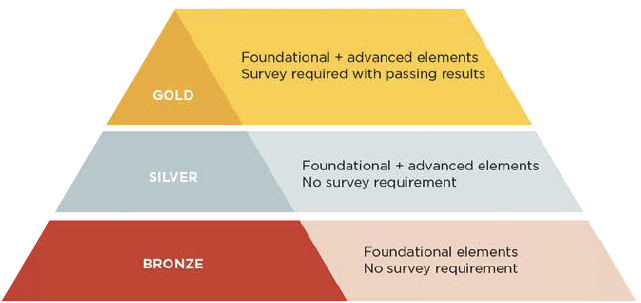
The WBE credential includes and incorporates nurses and all employees who can benefit from the well-being program at the applicant organization. In addition, the credential can be achieved at various tiers (Gold, Silver, and Bronze), allowing applicants to take a stepwise approach and advance to a higher level when ready while also experiencing success and growth along the journey.
The requirements for achieving the credential tiers include meeting the thresholds for the foundational elements for Bronze; foundational and advanced elements for Silver; and foundational and advanced elements and survey validation for Gold. The credential includes 20 foundational elements and 16 advanced elements, each linked to a foundational element concept to show progression. The 36 elements include well-being as part of the organizational strategic plan, diverse interprofessional team member participation in shared decision-making, encouragement and support for employees to self-report mistakes in the workplace, and meaningful employee recognition by colleagues and leaders. (See Tiers and elements.)
Tiers and elements
Organizations apply for the Well-Being Excellence™ credential by meeting criteria specific to three levels. Each level builds on the previous one, which allows organizations to take a step-wise approach.
Validation
The final step to validating the WBE credential criteria involved a pilot cohort of six applicants from organizations with a demonstrated commitment to employees through established well-being programs. The pilot applicants, selected for their leadership around workforce well-being, contributed to refining the credential by providing feedback about their experiences. Two of these pilot organizations—Children’s National Hospital and BayCare Health System—shared their stories.
Children’s National Hospital
Søvold and colleagues found that the significant strain of burnout and mental health challenges inherent in healthcare roles underscores the need to adopt a structured and holistic strategy that promotes staff well-being. For organizations to thrive and remain highly reliable, all facets of the organization’s health must be considered. The WBE credential, which provides a blueprint to assess, evaluate, and validate a well-being program, is comprehensive and responsive to the needs of healthcare professionals in an ever-evolving workplace environment. Children’s National Hospital’s pursuit of the WBE credential serves as a testament to the organization’s commitment to fostering a culture of staff health, resilience, and holistic care.
Recent data from Boniol and colleagues and Kumar and colleagues suggest an estimated global shortage of 10 to 18 million healthcare workers by 2030. In addition, the U.S. Health Resources and Services Administration National Center for Health Workforce Analysis predicts that shortages will impact healthcare worker professions across the continuum, noting an estimated shortage of 207,980 RNs by 2037 and an overall physician shortage of 187,130, with the most significant shortages in primary care (42%) and nonmetro areas (60%).
Many factors contribute to current and projected shortages. Razai and colleagues indicate that a multifaceted approach to addressing healthcare worker well-being can aid retention and recruitment. Kumar and colleagues suggest that attracting and retaining top talent require organizations to foster a nurturing environment that promotes optimal well-being for all staff. One such strategy involves applying the healthcare workforce triangle (Grow, Thrive, Stay) described by Kumar and colleagues. This strategy aligns with Children’s National’s organizational policies to improve talent pathways, reduce cognitive overload, and address the root cause of burnout and attrition.
For example, Children’s National implemented a nursing pathway program that supports nursing students as they transition from high school or associate degree nursing programs to attain a bachelor of science in nursing. Through this program, students pair with one-to-one mentors, receive tuition scholarships, and participate in a summer employment program. To address cognitive overload, burnout, and attrition, Children’s National implemented technological solutions to improve nursing workload and reduce administrative burden. The organization also supports break time at work via night shift napping and respite rooms.
Going for Gold
The WBE credential evidence-based framework enabled Children’s National to showcase the depth and breadth of its organizational strategy, initiatives, and outcomes for healthcare worker well-being. The WBE champion began the process by conducting a gap analysis of the existing structure, processes, and outcomes against the WBE foundational and advanced elements. This initial assessment allowed the organization to identify which criteria it could address with sufficient evidence and which areas required further evaluation.
The analysis indicated that Children’s National could meet all 20 foundational elements and 14 of 16 advanced elements. Of the advanced elements, organizations must meet 12 to achieve Silver recognition. The WBE champion presented an executive summary of the gap analysis to the chief nursing officer/WBE executive sponsor and chief executive officer, who agreed that the organization was well-positioned to apply as a pilot organization for WBE. In July 2024, the organization registered to pursue the WBE Gold tier, which required submitting evidence for both the foundational and advanced elements and participating in the survey process.
A dedicated team of organizational well-being experts (from various departments to ensure diverse perspectives) facilitated the initiative. The team began collecting evidence for each element and compiled the WBE document. To meet all criteria within each element, the team collected clear and supporting evidence.
Gathering evidence for some elements proved straightforward, but other elements posed challenges, which led to a redesign of the enterprise well-being structure and processes. The redesign enhanced engagement and collaboration among the Well-being Steering Committee members, essential to the evidence-gathering process. This enabled an iterative approach to collecting robust evidence, demonstrating the comprehensive nature of well-being initiatives for all staff.
In addition, as a pilot organization, Children’s National participated in three learning sessions facilitated by the ANCC team. These sessions offered a platform for clarifying criteria, addressing challenges, and learning from other pilot organizations.
Challenges and solutions
The survey process emerged as the most challenging aspect of the application, with concern for staff survey fatigue. Ghafourifard describes survey fatigue as resulting when participants become tired or disinterested in responding. In addition, the inherent complexity and intensity of a healthcare work environment pose a substantial challenge when surveying staff. Other WBE survey concerns included issues related to question redundancy and some questions mirroring those found in other organizational surveys, such as those related to employee engagement and quality/safety.
The organization collaborated closely with system-level leadership to address survey fatigue and develop a plan to optimize participation. The team partnered with public relations and marketing personnel to establish a comprehensive communication strategy shared through email and various team meetings before the survey period. The plan expanded during the 3-week survey period to include rounding and hosting a table in the main campus cafeteria.
Although the Children’s National didn’t meet the threshold to achieve Gold-tier recognition, the survey process served as an invaluable learning experience. The results validated the strengths of the organization’s well-being initiatives across several areas and uncovered opportunities for improvement.
Key learnings
The Well-being Steering Committee’s role in reviewing the draft WBE document to validate the evidence, provide feedback, and identify opportunities to strengthen the submission proved critical. This collaborative process led to the discovery of many department or discipline-specific well-being programs, in addition to the system-led initiatives, which highlighted how leaders from across the organization understood the importance of designing interventions that meet the unique needs of their teams. This system-level and department-/discipline-specific approach to well-being is similar to the framework described by Shanafelt and colleagues for organizational well-being programs, which emphasizes the need for oversight while supporting the individual needs of departments and disciplines.
Through this process, Children’s National successfully identified evidence for all foundational and advanced elements criteria. The final WBE document, reviewed and approved by the WBE executive sponsor, represented strong system-level and department-/discipline-specific evidence, including how structures and processes are embedded throughout the organization. The credentialing process also led to discovering innovative approaches and best practices throughout the organization, highlighting opportunities for expansion.
Adopting an enterprise-wide approach to well-being includes integrating evidence-based strategies into the organizational culture and infrastructure, engaging with the entire workforce, and ensuring a sustainable strategy. This holistic perspective considers the whole person and integrates a governance strategy, safety and quality structures, and policies that support organizational transformation through a well-being lens. This approach aligns with a World Economic Forum report by Jeffrey and colleagues, which emphasizes that engaged healthcare workers will more likely provide high-quality care, illustrating the direct connection between workforce well-being and organizational success.
Necessary and strategic benefit
Children’s National achieved ANCC WBE Silver-tier credential by meeting all the foundational and advanced elements, distinguishing itself as the first pediatric hospital to attain this recognition. Appraisers noted several best practices within the organization, including its approach to mitigating visitor escalation behaviors, strategies for facilitating employee participation in shared decision-making, and meaningful recognition initiatives (including a technology solution designed to support timely, employee-specific appreciation). Advanced elements of best practice include research initiatives that involve employees in identifying well-being offerings, employee assistance programs provided via designated mental health specialists and peer support, and nurse-led nightshift wellness initiatives.
As a pilot organization, Children’s National’s WBE journey highlighted the comprehensiveness and effectiveness of its existing well-being program and the opportunities for continual improvement. Adoption of evidence-based standards, such as the WBE credential, provides a framework to evaluate, validate, and enhance well-being programs. Children’s National intends to build on the foundation established by the WBE and remains dedicated to continually evolving and optimizing its well-being programs to meet the changing needs of its workforce.
BayCare Health System
In line with the belief that its team members are its greatest asset, BayCare Health System remains committed to fostering positive work environments and promoting staff well-being. As part of a pilot program for the American Nurses Foundation—Nurse Well-Being: Building Peer and Leadership Support (which uses the Stress First Aid framework)—BayCare observed that team members not only experienced significant benefits, but the organization also reaped rewards, demonstrated by improved retention rates and zero first-year turnover in many pilot units. This experience underscored the crucial role of well-being in enhancing retention and recruitment efforts. Participating in the WBE credential process enabled BayCare to conduct a comprehensive evaluation of its existing well-being programs.
BayCare strives to continually improve its structures, processes, and outcomes to better serve both the team and surrounding communities. In addition to increasing awareness among team members about BayCare’s available well-being programs and structures, the WBE credential also supports enhanced community understanding. By fostering an organizational culture centered on well-being and evidence-based practices, BayCare has experienced healthcare quality, patient outcome, and safety improvements.
Existing initiatives
BayCare works to cultivate a supportive environment for its team members centered on the vital role of the chief team resource officer, who’s a member of the BayCare chief executive officer’s (CEO’s) cabinet. BayCare’s cabinet consists of senior executives who lead the organization’s growth, clinical excellence, and response to regional healthcare needs, while also ensuring that team members’ well-being remains a top priority. Several key leaders (including the vice president of team member relations; vice president of total rewards; vice president of talent acquisition and inclusion; director of team resources, employee health and BayCare Medical Group; director of organizational development and learning operations; and director of team resource operations) report directly to the chief team resource officer.
The structure of team members within the nursing division accounts for a third of the total BayCare workforce. At the helm sits the chief nurse executive (CNE), a pivotal figure who leads the nursing team and holds a seat on BayCare’s cabinet, directly reporting to the president and CEO. This unique position ensures that nurses’ perspectives and needs remain prioritized and considered in decisions that affect the well-being of all team members, including nursing and non-nursing staff. The vice president of patient services, chief nurse officers, and the vice president of nursing system and resources report to the CNE. These roles encompass a range of strategic responsibilities, particularly in the realm of evidence-based clinical practice and professional development.
A prime example of team member engagement and shared governance occurs in the monthly interprofessional wellness committee meeting. The committee, which operates on a system-wide basis within BayCare, consists of representatives from all sectors (clinical and nonclinical) who ensure a comprehensive approach to wellness that incorporates diverse perspectives and expertise. BayCare believes that collaboration functions as a cornerstone of the organization, significantly contributing to team member well-being by fostering a culture of shared governance, encouraging open lines of communication among diverse groups, enhancing team member engagement, and promoting collaboration across disciplines.
Journey to credential
BayCare’s initial steps in the credential journey involved identifying a WBE executive sponsor and champion to support the credentialing process and a gap analysis of the foundational and advanced elements. A professional practice leadership committee—consisting of the Well-Being Champion, VP of nursing systems and resources, directors of development and practice, and the professional practice managers—reviewed the 20 foundational elements and determined that BayCare had all 20 in place. The next step involved evaluating the advanced elements by the same team and determining the feasibility of achieving the Silver tier. The Silver tier requires 12 of 16 advanced elements, and since 15 out of the 16 elements were in place, BayCare applied for the Silver tier.
Subsequently, the sponsor and champion met with executive leadership to discuss the benefits of obtaining the WBE credential. For BayCare, these benefits included validating existing well-being programs and direction, identifying areas for continual improvement, and enhancing retention and recruitment initiatives.
The next phase involved forming a WBE team, with the Well-Being Champion serving as leader. The team included a diverse group of interprofessional employees who systematically reviewed the foundational and advanced elements, acknowledging that advanced elements build upon the foundational ones. After this review, the team identified subject matter experts (SMEs) for each area and created a timeline with achievable goals to ensure adherence to the application deadline.
With the timeline established, the team organized elements by common SMEs and distributed them among the four members of the WBE team; each member managed approximately five foundational elements and four corresponding advanced elements. These team members then reached out to the appropriate SME to collect background information to adequately address each of the elements.
Members of the WBE team and the SMEs contributed to the document in accordance with the elements assigned to them. The WBE team met in person about every 2 weeks to review the information gathered and discuss the intent behind each element, as well as the overall alignment of the documentation. After the SMEs drafted a response to an element, the WBE team reviewed and rephrased the document to ensure a consistent voice throughout.
After completing each component, the team submitted their work to the executive sponsor for review and feedback. Next, the professional practice managers reviewed the finalized document for clarity and grammatical accuracy. The WBE team then forwarded the completed document to senior leadership, including the CNE and chief human resource officer, before submitting it to the ANCC WBE program office.
Challenges and learnings
BayCare encountered some challenges during the credential journey. For example, although the organization has implemented all 20 foundational elements, many programs remain dispersed among different departments, clinical specialties, and directors, resulting in silos. This structure fosters areas of expertise, but not all team members know of the available resources and how departments such as security, innovation, and organizational development and learning contribute to overall staff well-being. In addition, BayCare offers a range of well-being and wellness activities for its 34,000 team members, making it challenging for all departments to effectively showcase the full spectrum of opportunities.
BayCare also struggled to define “well-being.” According to the National Institute for Occupational Safety and Health, well-being reflects a holistic approach to how individuals perceive their lives, incorporating physical, emotional, psychological, productivity, and economic aspects. In contrast, The Global Wellness Institute and AlNujadi and colleagues describe wellness as the active pursuit and engagement of activities that promote holistic health. The WBE team frequently blended these concepts when discussing overall well-being and the credential. Establishing a standardized definition for communication across the organization will prove crucial to achieving success.
Before ANCC created the WBE credential, BayCare had already established a proactive strategy through its Wellness Committee, which includes an interprofessional group of representatives from both clinical and non-clinical sectors within the organization. This committee meets monthly to discuss system-wide well-being initiatives, addressing all facets of health, including mental, physical, and spiritual wellness. In addition, BayCare continues to distribute a monthly e-newsletter called Total Rewards, which highlights topics related to benefits, well-being, work–life perks, retirement, and finance insights.
ANCC and WBE recognized BayCare’s “extraordinary team of the future” pillar. This cornerstone of the system’s strategic plan prioritizes team member well-being for executive leadership. Including well-being in the system-level strategic plan holds all senior leaders accountable for their team members’ well-being. Strategic initiatives under the umbrella of “extraordinary team of the future” include frontline management development and support, reimagining team member development, inclusion and belonging, supporting our team with technology, and team member housing assistance.
Unexpected benefits
The emergence of various well-being program silos prompted collaborative efforts among groups such as communications, employee assistance, team resources, and behavioral health. In addition, the Well-Being Champion initiated discussions with the medical director and chief experience officer to identify standard practices and foster joint initiatives with physicians.
As a result of the WBE journey, BayCare added hospital and unit-based Well-Being Champions to the existing nursing clinical ladder. Well-being also has become the number one strategic priority in the CNE strategic plan for 2025 and 2026. The organization has introduced new initiatives, including a pilot program that offers an employee assistance program and a full-time on-site counselor at four BayCare hospitals. This approach aims to reduce the stigma surrounding counseling and enhance accessibility. The on-site resource gives team members immediate access to support and allows them to schedule appointments on workdays, eliminating the need to travel to an off-site office during days off.
Translating commitment into action
BayCare Health System’s WBE journey embodies a strong, intentional commitment to fostering a culture where the well-being of every team member is integral to leadership, operations, and care delivery. By piloting innovative peer support programs and implementing a comprehensive system-wide evaluation of the foundational and advanced WBE elements, BayCare has translated commitment into tangible action. Through the pursuit of the WBE credential, the organization has gained valuable insights, a determination to break down silos, and a reinforced leadership structure to prioritize well-being at every level of the organization.
As a result, BayCare not only enhanced team member retention and engagement but also improved overall quality, safety, and patient outcomes. This journey highlighted the effectiveness of shared governance, collaborative leadership, and continual improvement. By prioritizing well-being as a strategic focus, BayCare has established itself as a model for other healthcare systems aiming to empower their workforce and foster lasting cultural change. The insights gained and the momentum achieved will drive deeper alignment, increased visibility, and sustained excellence in team members’ well-being for years to come.
WBE nursing implications
Nurse leaders are uniquely positioned to champion a culture of holistic support, recognizing that team members’ well-being directly influences retention, job satisfaction, and patient care quality. By prioritizing comprehensive mental, physical, and emotional resources—accessible counseling, peer support, and flexible scheduling—leaders can help reduce burnout and cultivate resilience among nursing staff. Establishing a clear definition of organizational well-being and consistently communicating expectations empowers nurses to proactively engage in their own health, while shared governance and open collaboration ensure that voices from all levels are heard and valued.
Integrating well-being into strategic planning elevates its importance across the organization, transforming it from a programmatic offering to a core value. Pursuit of the WBE credential reinforces this journey to excellence, providing a tangible framework for sustainable improvements and fostering a work environment where nurses can thrive long term.
Well-being trailblazers
The WBE pilot applicants—working under swift timelines dictated by the credential development process—served as trailblazers. They contributed to improving the experience for organizations pursuing WBE in the future. Through the pilot process, each organization evaluated its programs against the WBE framework and criteria, identifying strengths and areas for improvement. The WBE documents highlighted each organization’s existing well-being strategies and initiatives, and employee surveys provided an opportunity to hear from the workforce about their perceptions of well-being support and offerings.
The pilot cohort, now the first credentialed WBE organizations, learned from both their internal colleagues and from the other pilots through the journey. The ANCC and WBE office is grateful for their participation and contributions.
For more information about the Well-Being Excellence credential visit nursingworld.org/organizational-programs/well-being-excellence/
Simmy King is chief nursing informatics and education officer at Children’s National Hospital in Washington, DC. Jill Horner is the nurse wellness program manager at Children’s National Hospital. Rodney Hauch is an advanced professional development practitioner at BayCare Health System in Clearwater, Florida. Jacqueline Munro is vice president of nursing systems and resources at BayCare Health System. Nikki Daley is chief team resources officer at BayCare Health System. Melissa Bates is a senior analyst for Pathway to Excellence and Well-Being Excellence at the American Nurses Credentialing Center in Silver Spring, Maryland.
American Nurse Journal. 2026; 21(1). Doi: 10.51256/ANJ012622
References
Aiken LH, Lasater KB, Sloane DM, et al. Physician and nurse well-being and preferred interventions to address burnout in hospital practice: Factors associated with turnover, outcomes, and patient safety. JAMA Health Forum. 2023;4(7):e231809. doi:10.1001/jamahealthforum.2023.1809
AlNujaidi HY, Al-Rayes SA, Alumran A. The evolution of wellness models: Implications for women’s health and well-being. Int J Womens Health. 2025;17:597-613. doi:10.2147/IJWH.S498027
American Nurses Credentialing Center. ANCC Well-Being Excellence™: Elevate Workforce Well-Being and Morale. nursingworld.org/organizational-programs/well-being-excellence
American Nurses Foundation. Nurse well-being: Building peer and leadership support. nursingworld.org/foundation/programs/nurse-wellbeing
Boniol M, Kunjumen T, Nair TS, Siyam A, Campbell J, Diallo K. The global health workforce stock and distribution in 2020 and 2030: A threat to equity and ‘universal’ health coverage? BMJ Glob Health. 2022;7(6):e009316. doi:10.1136/bmjgh-2022-009316
Centers for Disease Control and Prevention. Health workers face a mental health crisis. October 24, 2023. cdc.gov/vitalsigns/health-worker-mental-health/index.html
Ghafourifard M. Survey fatigue in questionnaire based research: The issues and solutions. J Caring Sci. 2024;13(4):214-5. doi:10.34172/jcs.33287
Global Wellness Institute What is wellness? globalwellnessinstitute.org/what-is-wellness
Health Resources and Services Administration. Health workforce projections. November 2024. bhw.hrsa.gov/data-research/projecting-health-workforce-supply-demand
Jeffery B, Weddle B, Brassey J, Thaker S. Thriving workplaces: How employees can improve productivity and change lives. January 16, 2025. mckinsey.com/mhi/our-insights/thriving-workplaces-how-employers-can-improve-productivity-and-change-lives#
Kumar P, Holt T, Wong Y, Kimeu M. (2025). Heartbeat of health: Reimagining the healthcare workforce of the future. McKinsey Health Institute. May 14, 2025. mckinsey.com/mhi/our-insights/heartbeat-of-health-reimagining-the-healthcare-workforce-of-the-future#/
Melnyk BM, Hsieh AP. Making the business case for evidence-based practice and nurse/clinician well-being to improve health care quality, safety, patient outcomes, and costs. Nurse Leader. 2025;23(3):244-8. doi:10.1016/j.mnl.2025.01.006
Morrison V, Pabico C, Robertson S, Bates M. Well-Being Excellence™: A holistic approach to elevating employee health in all settings. Nurs Manage. 2025;56(4):12-6. doi:10.1097/nmg.0000000000000248
National Academy of Medicine. National Plan for Health Workforce Well-Being. Washington, DC: The National Academies Press; 2024. doi:10.17226/26744
National Institute for Occupational Safety and Health. Impact Wellbeing™ Guide: Taking action to improve healthcare worker wellbeing. Washington, DC: U.S. Department of Health and Human Services, Centers for Disease Control and Prevention, National Institute for Occupational Safety and Health, DHHS (NIOSH) Publication 2024-109. (Revised July 2024.) doi:10.26616/NIOSHPUB2024109revised072024
NSI Nursing Solutions, Inc. 2025 NSI National Health Care Retention & RN Staffing Report. nsinursingsolutions.com/documents/library/nsi_national_health_care_retention_report.pdf
Razai MS, Kooner P, Majeed A. Strategies and interventions to improve healthcare professionals’ well-being and reduce burnout. J Prim Care Community Health. 2023;14:21501319231178641. doi:10.1177/21501319231178641
Shanafelt T, Trockel M, Ripp J, Murphy ML, Sandborg C, Bohman B. Building a program on well-being: Key design considerations to meet the unique needs of each organization. Acad Med. 2019;94(2):156-61. doi:10.1097/ACM.0000000000002415
Søvold LE, Naslund JA, Kousoulis AA, et al. Prioritizing the mental health and well-being of healthcare workers: An urgent global public health priority. Front Public Health. 2021;9:679397. doi:10.3389/fpubh.2021.679397
Ulrich B, Cassidy L, Barden C, Varn-Davis N, Delgado SA. National nurse work environments—October 2021: A status report. Crit Care Nurse. 2022;42(5):58-70. doi: 10.4037/ccn2022798
Yusoff HM, Ahmad H, Ismail H, et al. Contemporary evidence of workplace violence against the primary healthcare workforce worldwide: A systematic review. Hum Resour Health. 2023;21(82). doi:10.1186/s12960-023-00868-8
Key words: credential, nurse well-being, American Nurses Credentialing Center