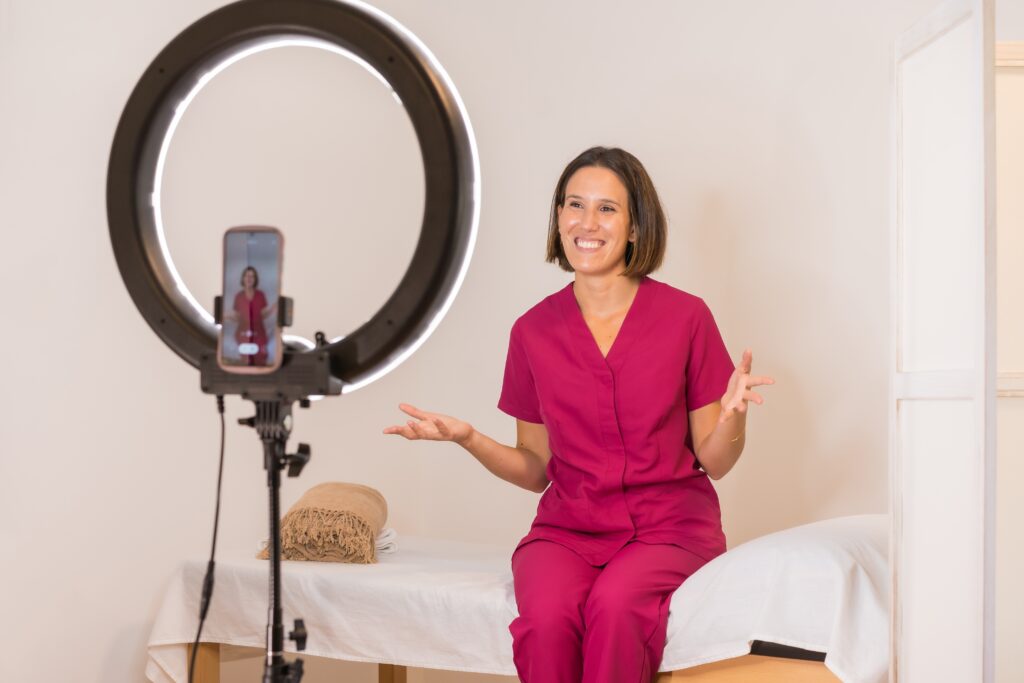
Do you want your published work to reach more people? If so, consider creating a video abstract. This format allows you to present your article in an engaging way that encourages viewers to seek out the full text. People appreciate a good story, and a video enables you to tell the “story” of your work.
Research confirms the value of video abstracts. For example, a study by Bonnevie and colleagues found that video abstracts increased “worthwhile” (change of at least 10%) views of articles. The study also found an increase in citations and social attention, but the authors note that this may be small. Erskine and Hendricks found that video abstracts increase viewership on X.
Check the journal’s author guidelines to see if it accepts video abstracts. Even if it doesn’t, you can still make your own video for posting on social media platforms.
Some publishers offer to make videos for you, but that option can be expensive. Here are a few tips you can use to create your own work.
Craft your message. Distill your work into a concise, clear message. Don’t try to cover too much content. Also, don’t use too much jargon; once posted online, people outside the nursing profession may find the video, watch it, and want to learn more about your work.
Choose a format. Once you have your message, consider the type of abstract you want to create. The most common is the “talking head,” where the author speaks on camera about the article. This can be accompanied by slides with short bullet points or graphics or a slide with an infographic. Another option is narrating a short PowerPoint presentation; however, people usually like to see the speaker so you might consider using a platform such as Zoom to create the video.
Be natural. Don’t read from a script (although do plan what you’re going to say). Practice what you want to say (focusing on the key message) and speak naturally.
Ensure an optimal setting. The setting should have sufficient light, but avoid speaking with a window behind you, which will make it difficult to see you. Avoid distracting background settings and noise. If you’re using your smart phone or tablet, put it in the horizontal position (landscape mode). Use a mount or position the device in some other way so it doesn’t move. Position yourself in the frame so that you’re not too close (for example, you don’t want to cut off part of your head), but not so far away that the viewer is distracted by the background or can’t see your expressions. Put your device in airplane mode so you’re not interrupted by calls or texts.
Keep it short. A common recommendation is 2 to 5 minutes, but some recommend 2 minutes or shorter for clips that will be posted on social media. Remember that you aren’t presenting your entire article; just giving enough information that the viewer’s interest is piqued and they seek out your work.
Edit the video. As needed, you can use software such as Apple’s iMovie or Windows Movie Maker to edit your video. However, since the videos are short, you may be able to skip this step.
Follow the journal’s guidelines. Most journals that accept video abstracts specify technical requirements, such as file format (for example, .mp4, .mpg, .mov).
Stay within copyright. Verify with your publisher that you can use images from your published article. Obtain permission to use previously published graphics from other sources. You also would need to obtain permission to use third-party music.
Test it. Play the video on your cell phone, tablet, and computer to verify it displays properly.
Share
Once you’ve completed the video, it’s time to share. Send it to the journal, which will put it online with the article (as long as the video is submitted within the specified time frame) and may post on its social media platforms and YouTube channel. Don’t forget to post it on your own media outlets.
Although it may be time consuming to create your first video abstract, like anything else, it will become easier with more experience. It’s worth taking the time to learn this skill so that your work can reach the widest possible audience
 Cynthia Saver, MS, RN, is editor of the award-winning book Anatomy of Writing for Publication for Nurses, 5thed. She has more than three decades of publishing experience as a writer, editor, and publishing executive. Cynthia’s work has appeared in many journals, and her past positions include editorial director for American Nurse Journal, which she helped launch. Cynthia is passionate about helping nurses share their expertise by writing for publication and happily shares her knowledge though The Writing Mind blog, articles, short presentations, and workshops.
References
BMJ Author Hub. Video abstracts. authors.bmj.com/writing-and-formatting/video-abstracts/what-is-a-video-abstract
Bonnevie T, Repel A, Gravier F-E, et al. Video abstracts are associated with an increase in research reports citations, views and social attention: A cross-sectional study. Scientometrics. 2023;128(5):3001-15. doi:10.1007/s11192-023-04675-9
Enago Academy. Video abstract formats and journal guidelines. February 4, 2026. enago.com/academy/video-abstract-formats-journal-requirements
Erskine N, Hendricks S. What is the effect of posting video abstracts on journal article impact? J Vis Commun Med. 2024;47(2):47-55. doi:10.1080/17453054.2024.2423087
Landers T, Schulte SJ. Promoting your work. In: Saver C. Anatomy of Writing for Publication for Nurses, 5th ed. Indianapolis, IN: Sigma Theta Tau International; 2024; 171-83.
Wolters Kluwer. Author toolkit: Creating & submitting video abstracts & videos to journals. journals.lww.com/cns-journal/Documents/Video%20Abstracts%20Toolkit%20for%20Authors%20jr2.pdf