
ANA celebrates 130 years of leading and advancing the nursing profession
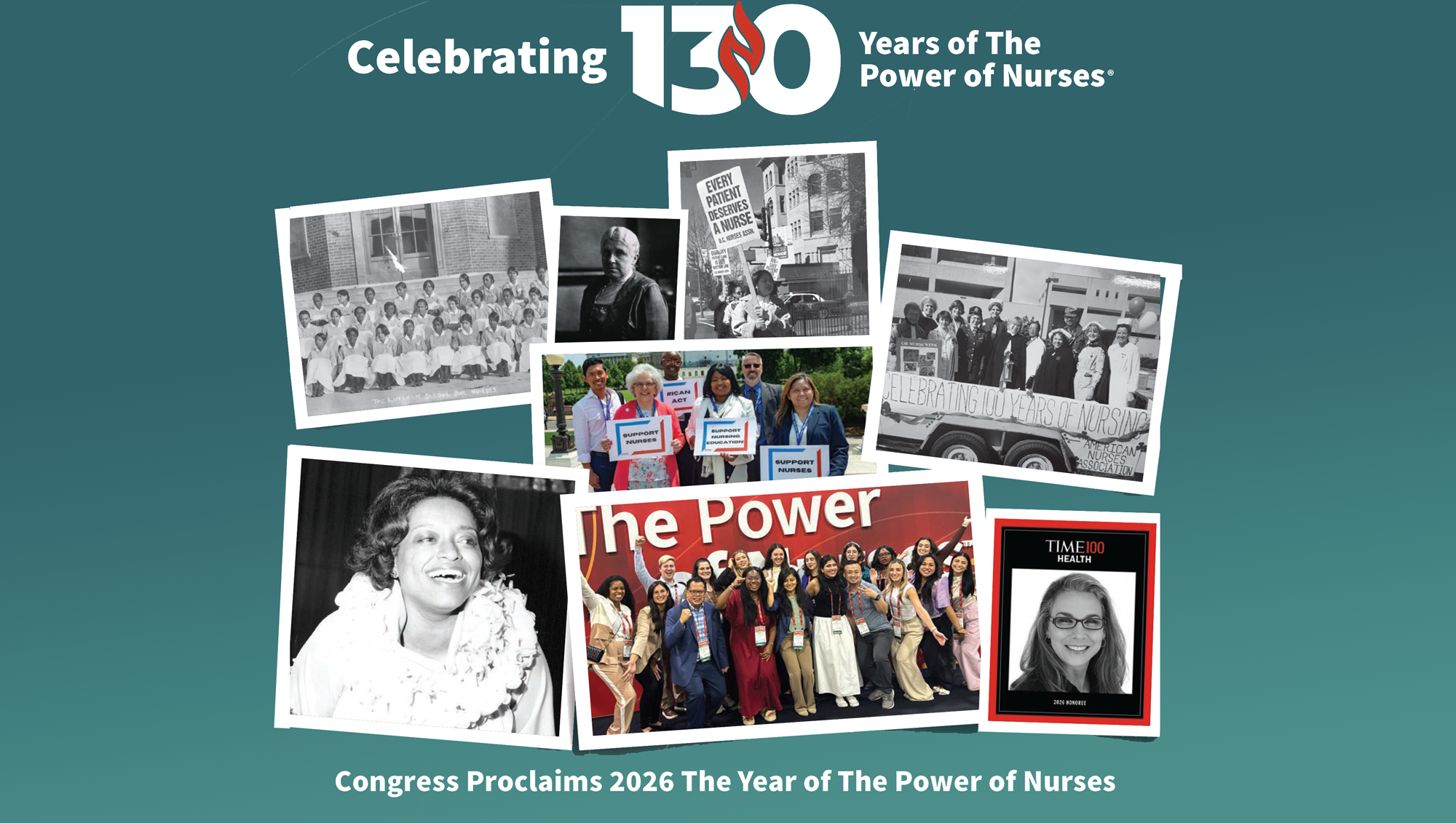
For 130 years, the American Nurses Association (ANA) has empowered nurses through advocacy, education, innovation, and collaboration. Since its founding, ANA has been dedicated to ensuring that nurses’ vital role, voice, and value in healthcare and society are heard and recognized. In this anniversary year, we celebrate the milestones and moments from each generation to create a healthy world through The Power of Nurses®.
Founding a profession
ANA’s journey began in 1896, when a small group of determined nurses gathered with an ambitious goal: to organize their profession, elevate its standards, and speak with one unified voice on behalf of patients across the country. What they founded that year, the Nurses’ Associated Alumnae of the United States and Canada, would become the American Nurses Association and set in motion 130 years of advocacy, innovation, and impact.
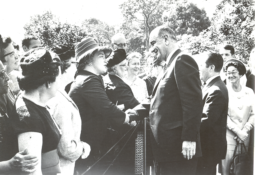
Nursing in the 1890s was largely unregulated. There were no licensing requirements, no standardized training programs, and no professional body to represent nurses’ interests or protect patients from untrained practitioners. Nurses worked long hours in hospitals, private homes, and charitable institutions and had no collective voice.
ANA’s founding members saw this as an opportunity rather than an obstacle. Early state association members began lobbying state legislatures for nurse practice acts, developing the first ethical standards for nursing, and building the infrastructure of a true profession. Within a decade, the first state nurse licensure laws were passed, a direct result of organized nursing advocacy.
Millions of nurses stepped up to address the challenges of their times with dedication, passion, and ingenuity. They understood that a strong nursing profession with standards, education, ethics, and a recognized place in healthcare would lead to safer and healthier patients and communities.
A more inclusive membership
ANA’s founders envisioned a unified profession that has evolved over time. This year, the ANA Membership Assembly enacted a historic bylaws change to include licensed practical nurses (LPN) and licensed vocational nurses (LVN) in ANA membership.
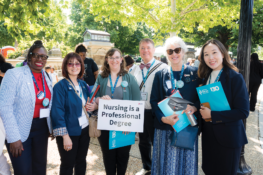
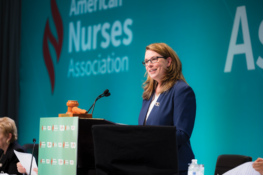
“LPNs and LVNs are essential to patient care and to the strength of our profession,” said Jennifer Mensik Kennedy, PhD, MBA, RN, NEA-BC, FAAN, president of the American Nurses Association. “We’re building a more inclusive ANA that reflects the full nursing team, resulting in improved outcomes for nurses and the patients and communities we serve.”
(LPNs/LVNs are invited to share their interest in receiving information about ANA membership on the ANA website at americannurs.es/lpn-lvn-interest.)
Defining professional nursing
Defining nurses as professionals has long been a core tenet of ANA. In 1946, after concerted effort, the association obtained professional status classification for nurses from what was then the U.S. Civil Service Commission, which played a key role in professionalizing the federal workforce.
A different type of challenge arose when the “One Big, Beautiful Bill Act” (H.R. 1) in 2025 imposed new limits on federal borrowing for graduate students. The Department of Education underwent formal rulemaking to implement provisions related to federal graduate student loan borrowing, severely limiting the definition of “graduate” and “professional” degrees. The narrowed definition omits post-baccalaureate nursing degree programs from the professional degree category in the final rule, jeopardizing the nursing workforce pipeline.
Demonstrating The Power of Nurses, ANA and its partners mounted a multi-faceted campaign to defend the professional status of nurses through legislative, policy, and legal avenues. In a groundswell of support, more than 250,000 individuals signed a petition; nearly 8,000 emails were sent to congressional offices, and more than 140 members of Congress signed a letter to the Department of Education on nurses’ behalf. The campaign garnered over 6 billion media impressions. In legal action, the association and other stakeholders filed suit to challenge the ruling. An early ruling for another case resulted in a stay on the definition from being implemented nationwide. ANA is awaiting a final ruling in its case. Learn more at RNAction.org.
Advocating for health and access to care
ANA strives to ensure that nurses have a voice in the policy decisions that impact the profession and the patients they serve. From its earliest years, the association has advocated for the health of patients and communities. In 1958, the House of Delegates endorsed healthcare as a right of all people, decades before many of today’s access debates took shape. ANA later supported federal health reform efforts and vigorously defended the Affordable Care Act’s coverage protections. That legacy endures as nurses continue to defend Medicaid, workforce development funding, patient safety, workplace protections, and patients’ access to advanced practice RNs.
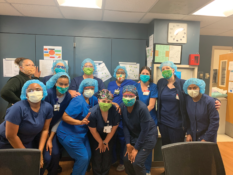
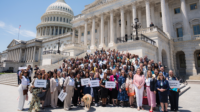
ANA’s nonpartisan advocacy approach and priorities for the administration are outlined in its annual Advocacy Agenda (bit.ly/4dbp9DH). Nurses meet each year with Congressional representatives on Hill Day and during state advocacy events to share their personal stories and messages, demonstrating how policy affects real people because they see those consequences at the bedside, in clinics, in schools, and in communities.
Supporting nurses’ well-being
ANA also has long recognized that the health of the public depends on the health and safety of nurses. In 1946, the ANA House of Delegates endorsed the 8-hour workday and 40-hour work week for all nurses, connecting working conditions with professional sustainability.
More recently, ANA has expanded its commitment to nurses’ well-being through Healthy Nurse, Healthy Nation®, launched in 2017 to improve nurses’ health across domains such as mental health, sleep, nutrition, physical activity, quality of life, and safety (hnhn.org).
ANA’s focus on well-being has deepened in response to burnout, moral distress, workplace violence, staffing challenges, and the lasting effects of the COVID-19 pandemic. During the pandemic, ANA led the charge for frontline protections for nurses, hazard pay, and mental health support. For example, Nurse Well-Being: Building Peer and Leadership Support, designed for nurses by nurses, provides evidence-based tools to improve stress recovery (bit.ly/4eWTEN9).
Leading innovation and AI
Innovation has always been part of nursing’s story. Nurses have redesigned care processes, created new models of education, advanced research, improved safety, and developed practical solutions to complex problems. Today, ANA is helping make nurse-led innovation visible, scalable, and connected through funding opportunities, education, communities of practice, and platforms that invite nurses to share what’s working. Examples include the ANA Innovation Awards, Innovation Accelerator, and Innovation Row at the Magnet & Pathway Conference®. The See You Now podcast, in partnership with Johnson & Johnson, shines a light on the real nurses changing the status quo in healthcare.
To address rapid developments in technology and artificial intelligence (AI), ANA convened a national AI in Nursing Practice Think Tank in April. The aim was to establish nurse-led guardrails as AI tools increasingly shape documentation, decision support, triage, staffing, education, and care delivery. The group came to consensus that AI must support, not replace, professional nursing judgment. Nurses must be part of governance, implementation, education, and evaluation so that technology strengthens safety, reduces burden, and advances equity rather than creating new risks.
Fostering opportunity and flourishing
ANA’s history includes efforts to eliminate discrimination, advance integration, and support leadership pathways for nurses from under-resourced communities. In partnership with leading national nursing organizations, ANA helped launch the National Commission to Address Racism in Nursing in 2021. ANA acknowledged harms of the past with an apology for excluding and segregating Black nurses between 1916 and 1964 and other harms.
In 2025, ANA hosted the inaugural Equity in Nursing Summit (renamed the Opportunity & Impact Summit in 2026), establishing an intentional, proactive framework to eliminate health disparities and professional inequities across the continuum of care. This work connects directly to the Code of Ethics for Nurses, which calls on the profession to strengthen forces that foster health and flourishing and oppose structures that harm. A workforce that reflects the communities it serves is better positioned to deliver compassionate, culturally responsive, and effective care.

Celebrating nursing
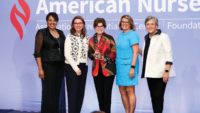
The prestigious ANA Hall of Fame marked its 50th anniversary this year (bit.ly/4wiP82r). The initial cohort in 1976 included 15 charter members. This recognition celebrates the extraordinary visionaries, leaders, and pioneers whose enduring contributions have forever reshaped the landscape of American nursing. On June 25, the association welcomed two distinguished nursing leaders into the Hall of Fame: Barbara Russell, MPH, BSHSA, RN, CIC, FAPIC and Debra Toney, PhD, RN, FADLN, FAAN.
Imagining the future
Today, the association’s impact is bolstered by being a part of the American Nurses Enterprise (ANE), which includes ANA, the American Nurses Credentialing Center, and the American Nurses Foundation. Together, the enterprise organizations are pursuing a singular vision to create a healthy world through The Power of Nurses. This includes the forward-looking 2026–2030 Strategic Plan to build an even stronger, more aligned organization. The plan centers around three priorities: Advocate, Elevate, and Engage.
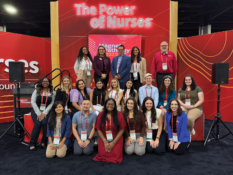
ANE introduced “Integrating Excellence: Imagining ANE into 2040,” an organization-wide initiative to establish a long-term strategic framework to elevate clinical practices, champion frontline workforces, and amplify the voices of professional nurses over the next two decades.
With an eye to the future, the ANA NextGen Ambassadors initiative invites the perspectives of younger-generation nurses to better understand what they want and need from their professional association. By engaging directly, ANA is creating opportunities for emerging nurses to share their views, connect with nurse leaders, and help design the programs that will support the profession in the years ahead.
From the first gathering of our founders in 1896 to this year’s AI think tank, these milestones reflect a thriving profession willing to shape and defend its values and envision a bright future for nurses, patients, and communities. As ANA looks toward the next 130 years, The Power of Nurses remains both a celebration and a charge: to lead with courage, protect the public’s trust, and build a future in which every nurse, and every patient, can flourish.
Thank you to our past, present, and future members for contributing to the tapestry of ANA’s foundation, the strides of today, and the bright future of tomorrow.
American Nurse Journal. 2026; 21(9). Doi: 10.51256/ANJ092652
 American Nurse is the official journal of the American Nurses Association and is a member benefit. Learn more about the association and the many benefits of joining.