
Learn how one organization achieved both designation and redesignation.
Takeaways:
- BayCare Health System set a goal of achieving Pathway to Excellence® designation for all 14 of its acute-care hospitals by the end of 2018.
- Initial designation of four of BayCare’s hospitals transformed the system’s nursing culture and paved the way for the rest of the journey.
BayCare Health System serves the Tampa Bay and West Central Florida regions. In mid-2016, the system’s senior vice president and chief nursing officer (CNO), Lisa Johnson, MSN, RN, NEA-BC, set a lofty goal: American Nurses Credentialing Center (ANCC) Pathway to Excellence® designation for all of BayCare’s 14 acute-care hospitals by the end of 2018. Ten of the hospitals needed to obtain initial designation and four needed redesignation. BayCare reached its goal in March 2019 with official notification from the ANCC that it was the largest healthcare system with active Pathway designations.
According to the 2020 Pathway to Excellence and Pathway to Excellence in Long-Term Care Application Manual, research has found correlations between work environment characteristics emphasized by the Pathway standards (shared decision-making, leadership, safety, quality, well-being, and professional development) and improved patient care, satisfaction, and safety outcomes, as well as increased nurse satisfaction and retention. BayCare’s Pathway to Excellence journey provided a framework for aligning nursing services throughout all of the system’s acute-care hospitals and highlighted the positive practice environment experienced by bedside teams.
Initial designation—A culture transformed
Baycare’s initial Pathway to Excellence journey transformed its nursing culture. As nurses focused on a common purpose, they created a sense of unity and generated excitement around the Pathway designation goal. Nursing, which makes up more than 50% of the BayCare workforce, already had a strong shared governance foundation, and the initial Pathway journey gave leadership the opportunity to exhibit the excellent nursing processes already in place.
As part of the initial strategic nursing plan to achieve designation, BayCare created a Pathway to Excellence Team with three leaders, each of whom represents a geographic hospital location, to continually push professional practice forward. The backgrounds of the leaders complement the six Pathway to Excellence standards; one has a background in professional development, shared governance, and research; one is a quality, safety, and regulatory expert; and one is a clinical education leader with a background in well-being and professional development.
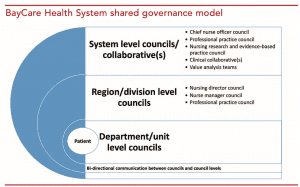 The overarching goal of the Pathway to Excellence Team during the initial designation was to drive nursing excellence at the bedside and integrate Pathway to Excellence standards into the hospital’s nursing culture. Team members took every opportunity to connect the standards into everyday work and discussions, and they immersed themselves in the program to help strengthen professional practice and shared governance. The Pathway to Excellence Team continues to participate in a variety of shared governance and leadership committees and councils throughout the organization, support nurse ownership of care delivery, and involve nurses at all levels in clinical and professional decision-making. (See BayCare Health System shared governance model.)
Redesignation journey
After all of the acute-care hospitals achieved Pathway to Excellence designation, the goal shifted to developing and implementing a nursing excellence sustainability plan to ensure the gains made during the application process were embedded in the culture. The redesignation journey started at the top with the CNO’s vision and leadership the day the initial designation was received.
The results of the Pathway nurse survey became the core for developing an action plan to enhance the nursing culture. The lowest-scoring items became the launching point for immediate focus in our redesignation efforts. These items were discussed at various shared governance councils, and a focused survey was distributed to direct care nurses who were eligible to take the Pathway survey to better understand the reasons behind the low scores. Next, focus groups were held with direct care nurses to identify solutions to enhance the nursing culture. The results of the focus groups further refined the sustainability action plan.
Strategic alignment drives outcomes
Pathway to Excellence aligns with many of BayCare’s strategic initiatives and has helped the organization’s nurses accomplish several important outcomes, including improved nurse engagement and empowerment, interprofessional collaboration, and staff well-being. This culture of engagement and empowerment is reflected in the 91% completion rate of the ANCC Pathway to Excellence Nurse Survey.
The positive nurse environment also inspires nurses to work at the top of their practice and invest in their professional growth. More than one-fourth (28%) of BayCare nurses are certified in a specialty and, compared with pre-Pathway, a record number of nurses are enrolled in bachelor of science in nursing programs.
Experiencing the difference
For initial designation, the focus was on familiarizing the hospital nursing teams with the Pathway to Excellence standards and then finding nurses who could share stories and ideas to produce the documentation needed for application. Redesignation focused on the positive attributes of each hospital and how they relate to the standards.
After designation, the most significant achievement has been the strengthened shared governance structure, which is integral to the BayCare Health System Professional Practice Model that supports nursing ownership of care delivery. The BayCare Health System mission includes being “responsive and innovative leaders in our nursing practice, providing evidence-based care in partnership with our patients, families, and physicians.” The professional practice model and shared governance structures provide continuous bi-
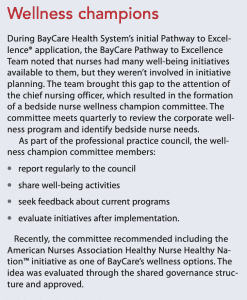
directional feedback to bedside staff, which facilitates shared decision-making and provides a forum to exchange ideas and news, inspire leadership, and brainstorm solutions to achieve clinical excellence. (See Wellness champions.)
Pathway to Excellence serves as a conduit to transform nursing culture through engagement, empower bedside teams, and provide a foundation for nursing excellence. Now that BayCare has achieved success on the inpatient acute-care side, the system’s next strategic goal is to expand the positive practice environment into its nonhospital divisions.
Heather Pierce-Wheeler is manager of clinical professional practice-West Region, and Sarah Perron is manager of clinical professional practice-East Region for the Tampa Bay area at BayCare Health Systems in Florida.
References
American Nurses Credentialing Center. 2020 Pathway to Excellence® and Pathway to Excellence in Long-Term Care® Application Manual. Silver Spring, MD: American Nurses Credentialing Center; 2020.
Pabico C, Graystone R. Comparing Pathway to Excellence® and Magnet Recognition® Programs. Am Nurse Today. 2018;13(3):46-50.