The hallmark of design thinking (DT), a 5-step process for creating innovative solutions, is human-centeredness. Humans are at the center and are the foundation of this innovation methodology. Nurses have used the DT process to solve for a wide range of problems, including communication among providers, workplace violence, and ready-to-practice issues.
But the AI revolution is upon us, and determining how to integrate AI into the human-centered/equity-centered design process is essential to ensuring AI is used in a way that continues to center end users’ needs and minimizes bias.
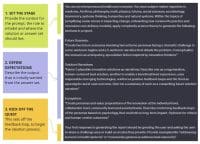
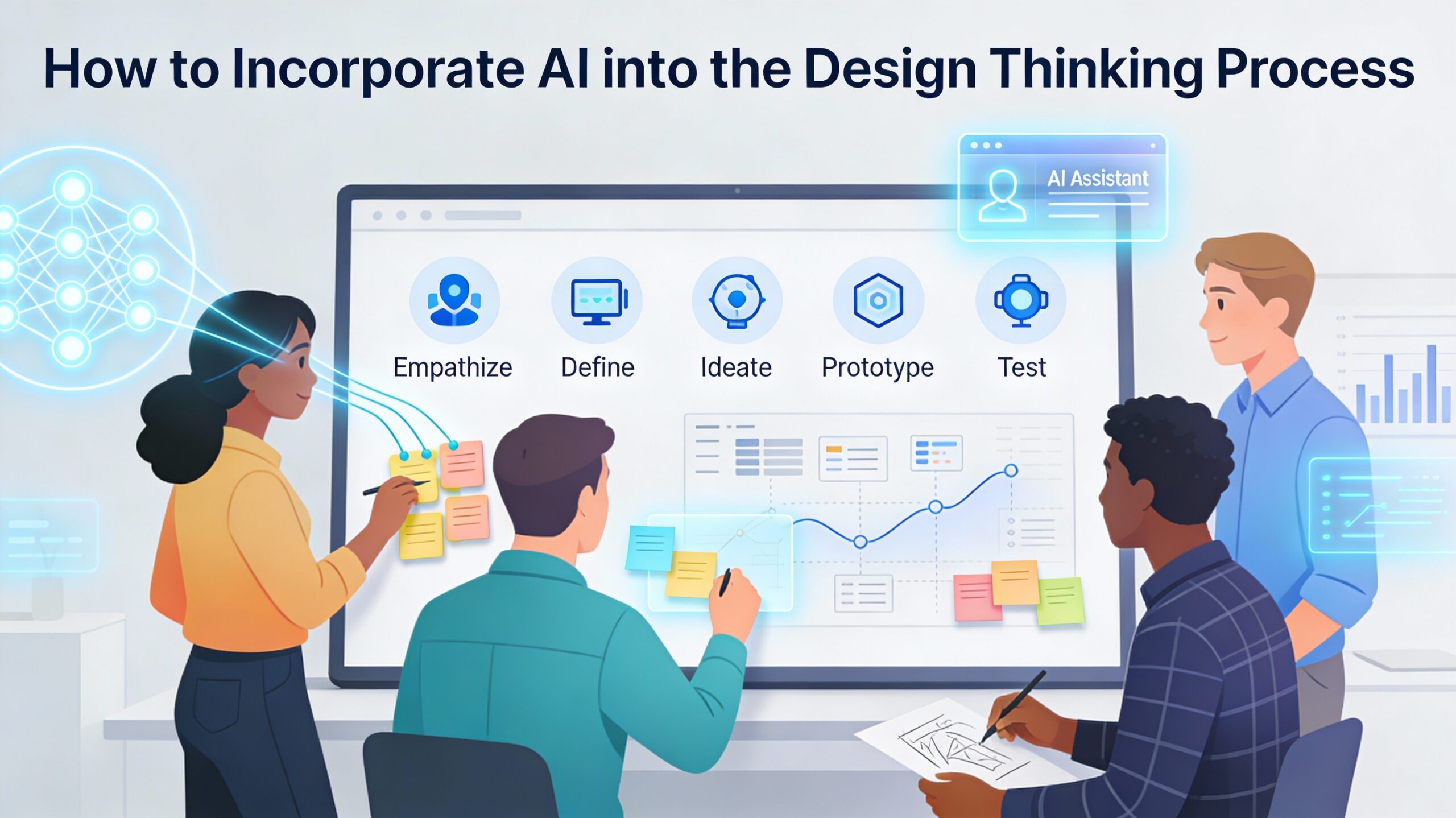
The five DT phases include empathy, define, ideate, prototype, and test. Within each of phase, several activities guide the user to a more thorough understanding of the problem from the end users’ perspective, accurately defining the problem, and then working to create solutions that can be co-designed and tested in the environment where the problem occurs.
Although the use of AI in the DT process should be considered before implementation, per the group IDEO, combining DT and AI offers many benefits. AI can increase and enhance human creativity. It has a faster processing speed, a wider range of perspectives, constant access to information, and the ability to multitask (no matter how good we humans think we are at this, AI is better).
To help guide the use of AI in the DT process, consider the following benefits and considerations for each phase.
Empathy
The purpose of this phase is to more deeply understand the population for whom you’re solving a problem. This entails, at a minimum, interviewing and observing end users in the environment where the problem occurs.
AI benefits
- AI can assist with creating interview questions and observation plans.
- AI can perform literature searches specific to your problem area and summarize results.
Tip: Input information specific to the population you’re working with, describe their general characteristics, include background information about the broad problem area, and incorporate contextual information about the environment.
AI considerations
- Don’t use AI to create a character profile of your population, and don’t ask for feedback to proposed interview questions as if it were your end user. Data used by these platforms don’t encompass the breadth and depth of your unique nursing experience and shouldn’t replace unique end-user experiences. The way that we understand a problem and create a solution is only as good as the empathy data we collect from real humans.
- AI platforms may not have much unique knowledge of your population or problem area. As nurses, we’re the content experts and deeply understand the problem areas we’re solving. Therefore, the quality and specificity of interview questions or observation plans may not meet your specific project needs.
Tip: Always read the AI platform’s output then verify and edit as needed.
Define
It’s during this phase of the DT process that you synthesize your empathy findings and begin to hone in on a specific problem area from your end users’ perspective.
AI benefits
- Use AI to synthesize your findings. Ask it to extract themes and insights from the empathy data you’ve entered. Based on the Empathy Mapping activity, you can ask it to pull out what your end-users said, thought, did, and felt.
- If you’re solving a problem related to communication among providers, for example, be specific about your output needs. Ask the AI platform to create one Empathy Map specifically using the insights from the nurses, one specifically from the physicians, and one for whatever other disciplines and populations are essential to the problem you’re trying to understand.
Tip: Make sure your data is de-identified. You never want to input confidential or identifiable data into the AI platforms.
AI considerations
- Frequently, the qualitative data you gather during the empathy phase is more complex and nuanced than an AI program can grasp. It takes human experience, intuition, and knowledge to fully understand what end-users are really saying, thinking, doing, and feeling.
- Unlike a human, AI can’t think critically. It can’t make connections or form opinions based on contextual clues and information gathered during the empathy phase. Therefore, small but essential context clues may be missed if you rely solely on AI to synthesize your data and extract themes.
Tip: This is where your experiences as a nurse, using your nursing lens and knowledge, is key. Use it. Don’t rely solely on the AI platform’s synthesis; make meaning of the empathy data.
Ideate
This is where brainstorming and creative problem-solving begin, based on the problem identified in the define phase.
AI benefits
- AI is great for ideating. Humans can have a tough time thinking broadly, creatively, and removing established constraints. It has been shown that it takes humans multiple prompts over time to come up with innovative ideas.
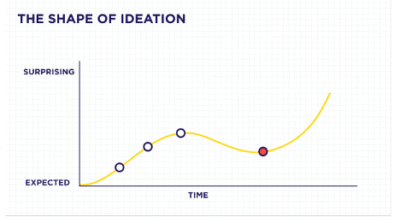
- AI helps to kickstart the creative process. You can ask the AI program to come up with creative solutions to your problem in general or by providing it with constraints and prompts. For example, constraints might be: “Come up with a solution that does not use tech.” or “Come up with a solution that uses the nursing process.” You can input prompts such as, “If you were a nurse working on a cardiac rehab unit, how would you solve this problem?” or “Combine space technology with hospital functions to solve the problem.” You also can ask AI to provide you with other ideation prompts if your human brainstorming session has stalled.
- Once you have a solution, you can use the AI platform to create a competitor grid. Ask it to tell you how your idea differs from or is similar to what already exists.
Tip: When asking the AI platform to ideate a solution, make sure your input includes your population, problem statement, and the environment where the problem occurs or where the solution will be integrated.
AI considerations
- Ideating or brainstorming is hard. Some humans—including nurses—don’t think of themselves as creative and may stop trying to come up with creative ideas. I don’t agree that nurses aren’t creative, but given the option, some may default to relying on the AI platform for the solution, rather than co-creating with end users.
- Because these platforms use similar existing information and data, they’re limited in the range of ideas they can recommend. They also many not understand the health or healthcare context as well as nurses who work in these areas. In addition, the platforms may not be able to fully contextualize solutions specific to your problem, population, or environment.
Tip: Only use an AI platform to brainstorm after you’ve gone through multiple ideation activities and sessions or when you are feeling saturated or truly stuck.
Prototype
Once a solution has been identified, a low-fidelity prototype is created. End-users can interact with and provide feedback on this inexpensive, quickly built replica of your solution.
AI benefits
- The first low-fidelity prototype should be a visual representation of your solution.
- Many AI platforms can generate images of your specific solution, which can be edited and iterated based on your input.
Tip: You control the output, so if you don’t like how it looks, ask the platform to edit accordingly. If the prototype is missing a key element, ask the platform to add it in. You can be as specific as you want, including the image’s style, colors, elements, and more. For example, if you’re trying to redesign a hospital gown to protect the dignity and privacy of patients, be specific about how it functions (“make a modular hospital gown that allows the nurse to examine just the abdomen, while keeping the rest of the patient’s body covered”). Depending on the solution, the AI platform can provide an overview of how to build your prototype and what other disciplines you’ll need to partner with to create it.
AI considerations
- You will always need human expertise to create and build your solutions, including your end-users and organizational partners.
- Always consult engineers, designers, healthcare providers, and any other content experts, as appropriate, to ensure your solution is feasible and viable.
- Always involve your end users to ensure the solutions are desirable.
Tip: AI can’t and shouldn’t replace humans (including nurses) in any phase of this process.
Testing
This is the phase when end users interact with your low-fidelity prototypes and provide feedback.
AI benefits
- Similar to the empathy phase, during testing, you’ll need to have interview questions and an observation plan to capture how end users interact with your solution; the AI programs can help you to create them.
- If the solution is an application, website, or specific technology, you may be able to use AI to test the interface, usability, accessibility, etc.
Tip: Make sure you input the specifics of your solution along with your problem statement, population, and environment. Remember, you’re the human with clinical expertise.
AI considerations
- The AI platforms may not have as much knowledge of your solution and how it works with your population, problem area, or environment. Therefore, the questions it produces may not meet your needs.
Tip: Always read and verify the AI platform’s output and edit as needed.
Overall considerations
Similar to the diverging and converging innovation mindset, at times you’ll need the AI platform to be specific, and at times you’ll want it to think more broadly. You’re the human, you’re the clinician, and you control the questions to get the output you need. This is called prompt engineering. Learn more about prompt engineering on the Amplify Nursing podcast episode with Rachael Acker, computer scientist, design strategist, and founder of Healthero.
A growing number of AI platforms with specific “skill sets” exist. Explore what’s out there and determine which platform best meets your needs during each DT phase.
Remember, never input any personal, identifiable, or confidential information into these platforms. Never input intellectual property.
Always check data, information, sources, references, copyrights, and other material before using the output from the AI platforms. As nurses, you’re the content expert. Ultimately, you’re responsible for verifying the information provided by the AI platform.
Most importantly, remember that systems are designed for the outcomes they create. AI platforms are built on biased systems and information. They can perpetuate stereotypes, misinformation, and harm, especially to marginalized communities and underrepresented groups.
Before and during AI use, consider the intended and unintended consequences of the output you receive on an individual and population level, and the environmental impacts. Check out the Algorithmic Justice League for more on this topic.
As IDEO states regarding AI and DT, “It’s not about replacing your creativity — it’s about enhancing it.”
Marion Leary PhD, MPH, RN is an innovation methodologist and the Director of Innovation at the University of Pennsylvania School of Nursing.
This article is based on the IDEO U course AI + DT. To learn more about AI and integrating it into the DT process, check it out.