Nursing engagement in antibiotic stewardship has gained greater traction since the Joint Commission issued an updated policy in 2023 requiring nursing staff to be involved in their facility’s antibiotic stewardship program. The mission of an antibiotic stewardship program is to decrease the overuse and misuse of antibiotics that lead to antibiotic resistance. According to the World Health Organization (WHO), antibiotic resistance occurs when antibiotics are no longer effective in treating infections in people. Bacterial infections can be resistant to multiple antibiotics, making it difficult to treat patients.
Traditionally, an antibiotic stewardship program has been led by physicians and pharmacists. Over the years, it became apparent that a multidisciplinary approach is needed to combat antibiotic resistance. In 2017, the American Nurses Association (ANA) and the Centers for Disease Control and Prevention (CDC) released a joint statement describing nurses as a unique profession due to their diverse work settings and their relationships with patients and community members. The 2019 edition of the Core Element of Hospital Antibiotic Stewardship Program acknowledges the pivotal role nurses play in reporting antibiotic overuse and misuse, as well as in educating patients about their antibiotic management. Please note that the phrases “antibiotic stewardship” and “antimicrobial stewardship” are used synonymously. The title has shifted to antimicrobial to include antivirals, antifungals, and antiparasitics in addition to antibiotics.
The situation
A systematic analysis by the Antimicrobial Resistance Collaborators estimated that 4.71 million deaths worldwide were attributable to antimicrobial resistance in 2021. From 1990 to 2021, antibiotic-resistant infections increased by over 80% among adults age 70 and older. In addition, the systematic analysis predicts there could be 8.22 million global deaths associated with antimicrobial infections without a meaningful change in antimicrobial clinical practice by 2050.
The CDC’s 2019 Antibiotic Resistance Threats in the United States reported that in the United States, there were 35,000 deaths each year due to antimicrobial-resistant infections, along with 2.8 million antimicrobial-resistant infections recorded. Healthcare settings were found to be the leading locations for antimicrobial infections. The report also stated that antimicrobial-resistant infections impose a $4.6 billion annual financial burden on healthcare costs in the United States.
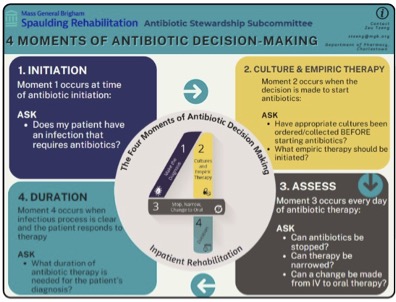
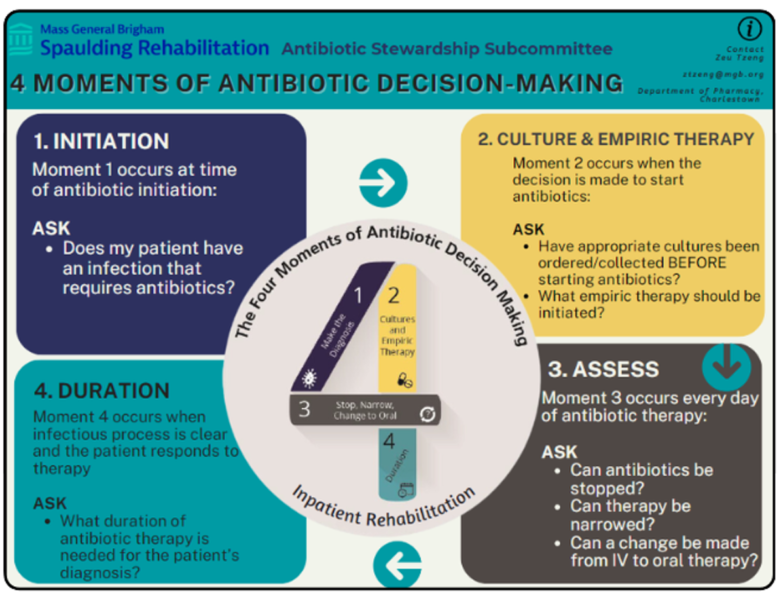
A 2019, Tamma and colleagues suggested that a guideline incorporating a multidisciplinary approach may improve antibiotic prescribing. The Four Moments of Antibiotic Decision-Making, created by researchers from Johns Hopkins and the Agency for Healthcare Research and Quality (AHRQ), accomplished this.
| 4 Moments of Antibiotic Decision-Making guided questions 1. Does this patient have an infection that requires antibiotics? 2. Have I ordered appropriate cultures before starting antibiotics? What empirical antibiotic therapy should I initiate? 3. A day or more has passed. Can I stop antibiotics? Can I narrow therapy? Can I change from I.V. to oral therapy? 4. What duration of antibiotic therapy is needed for this patient’s diagnosis? |
The Four Moments of Antibiotic Decision-Making promoted communication among prescribing providers and other members of the healthcare team, such as nurses, to optimize antibiotic management.
There were no known antibiotic stewardship initiatives in nursing practice prior to the quality improvement (QI) project at the inpatient rehabilitation facility located in Boston, Massachusetts.
The antibiotic stewardship subcommittee approved the principal investigator to educate and train the frontline nurses on antibiotic stewardship and the Four Moments of Antibiotic Decision-Making guideline. The aim was to empower nurses to be knowledgeable and comfortable in engaging in conversation with providers to optimize patient care.
The project
The QI project had two goals. The first goal was to enhance nursing awareness in antibiotic stewardship. The second was to increase nurse engagement in the inpatient rehabilitation facility’s antibiotic stewardship efforts by integrating the AHRQ “Four Moments of Antibiotic Decision-Making” tool into frontline nurses’ workflows.
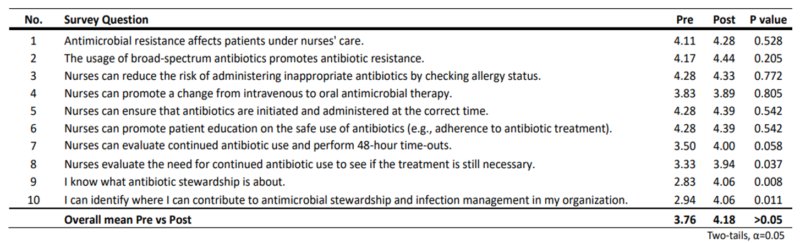
In January of 2024, we sent a pre-test survey to all frontline nurses to measure their baseline awareness of nursing engagement in antibiotic stewardship. Next, during the implementation phase, we educated frontline nurses on antibiotic stewardship. Members of the pharmacy department trained the nurses in the “Four Moments of Antibiotic Decision-Making” from March to July of 2024 through in-person unit-base education, education presentations during nurse team meetings, advertisements in nursing newsletters, educational flyers, distribution of nurse pocket-size guides, and QR-coded posters on nursing units linked to supplementary resources. We also recruited nurse champions on each unit to serve as resources.
 The outcome
 The outcome
After the implementation phase, a post-test survey was sent in August 2024. We instructed all participants to use the last four digits of their mobile phone number or any four digits of their choice as an identifying code to link their pre- and post-test survey responses. The project leader reviewed and used the Excel software program to generate results. Among the 141 frontline nurses at the inpatient rehabilitation facility, only 18 fully completed the pre- and post-test survey. We compared pre- and post-test survey responses using a paired t-test. The results revealed a statistically significant difference in the overall mean scores.
Project outcomes included the following:
- Frontline nurses had increased knowledge of antibiotic stewardship and the Four Moments of Antibiotic Decision-Making tool.
- Frontline nurses were empowered to advocate and participate in optimizing antibiotic therapy.
- The QI project provided a foundation to frontline nurses on the management of antibiotic principles.
- The project helped foster an improved relationship among frontline nurses, providers, and pharmacists.
- The frontline nurses verbalized that the QI project helped contribute to their knowledge, which enhanced their practice in antibiotic management for the best patient care.
- The frontline nurses stated that the Four Moments of Antibiotic Decision-Making tool was easy to use, and it helped organize their approach for antibiotic management.
- Unit-based nursing huddles now include patient-specific antibiotic discussions.
 Challenges and limitations
 Challenges and limitations
One limitation of this QI project was the low response rate. There was a 13% response rate, with only 18 frontline nursing staff completing both the pre- and post-intervention surveys of the 141 selected. This may affect the generalizability of the findings. Future efforts should include survey engagement strategies, including incentives or survey completion integration into scheduled staff meetings.
It was challenging to get nurses to buy into participating in the QI project. The nurses expressed their uncertainty about their role in antibiotic stewardship and, at times, hesitated to engage in interdisciplinary conversations with prescribers. We attempted to mitigate this response by recruiting nursing champions to serve as peer models and resources, helping to normalize stewardship discussions and reinforcing the Four Moments of Antibiotic Decision-Making tool within the interdisciplinary team.
Additionally, during busy shifts, some nurses had difficulty attending educational sessions. To ensure accessibility and flexibility, maintain momentum, and broaden participation despite time constraints, we offered an expanded training repertoire in many formats, including brief in-unit sessions, newsletter articles, and pocket guides.
Return on investment
We designed the project to be a low-cost, highly resource-efficient approach to enhancing nursing interdisciplinary involvement with pharmacy and prescribers. The pharmacy department developed education materials in-house, integrated training sessions into routine staffing sessions, and distributed the information and materials through existing communication channels. No external funding was required for this project, and despite a minimal financial burden, it yielded meaningful improvements in nurses’ knowledge, interdisciplinary collaboration, and the integration of antibiotic stewardship across disciplines.
We found a positive return on investment in enhanced engagement of frontline nurses in antibiotic management to improve outcomes with judicious use of antibiotics over time. Leveraging existing infrastructure and personnel demonstrated meaningful changes in stewardship culture to be achievable with modest resources.
Implication for practice
Antibiotic stewardship education with implementation of the Four Moments of Antibiotic Decision-Making tool increased nursing awareness in antibiotic stewardship. Antibiotic stewardship discussion became a part of nursing huddles. Other healthcare organizations can use this QI project as a resource to help engage their frontline nurses in antibiotic stewardship initiatives.
References
Agency for Healthcare Research and Quality. Four moments of antibiotic decision making. 2021. ahrq.gov/antibiotic-use/long-term-care/four-moments/index.html
American Nurses Association and Centers for Disease Control and Prevention. Redefining the antibiotic stewardship team: Recommendations from the American Nurses Association/Centers for Disease Control and Prevention workgroup on the role of registered nurses in hospital antibiotic stewardship practice. 2017. cdc.gov/antibiotic-use/media/pdfs/ANA-CDC-whitepaper-508.pdf.
Centers for Disease Control and Prevention. CDC partners estimate healthcare cost of antimicrobial-resistant infections. February 4, 2024. cdc.gov/antimicrobial-resistance/stories/partner-estimates.html#:~:text=Key%20points%20*%20CDC%20worked%20with%20experts,make%20informed%20choices%20that%20improve%20patient%20safety
Centers for Disease Control and Prevention. Core elements of hospital antibiotic stewardship programs. 2025. cdc.gov/antibiotic-use/hcp/core-elements/hospital.html?CDC_AAref_Val=https://cdc.gov/antibiotic-use/core-elements/hospital.html
Joint Commission. What are the expectations for a hospital’s antibiotic stewardship program? July 9, 2024. jointcommission.org/en-us/knowledge-library/support-center/standards-interpretation/standards-faqs/000002449
Murray CJ, Ikuta KS, Sharara F, et al. Global burden of bacterial antimicrobial resistance in 2019: A systematic analysis. Lancet. 2022;399(10325):629-55. doi:10.1016/s0140-6736(21)02724-0
Tamma PD, Miller MA, Cosgrove SE. Rethinking how antibiotics are prescribed: Incorporating the 4 moments of antibiotic decision making into clinical practice. JAMA. 2019;321(2):139-40. doi:10.1001/jama.2018.19509
World Health Organization. Antimicrobial resistance. 2023. who.int/news-room/fact-sheets/detail/antimicrobial-resistance#:~:text=Antimicrobial%20resistance%20(AMR)%20is%20a%20global%20public,disease%20spread%2C%20severe%20illness%2C%20disability%2C%20and%20death