

Grants fuel nursing workforce and equity strategies.
A group of 22 organizations nationwide have made tangible strides in their efforts to strengthen the nursing workforce and address barriers that limit growth and representation. Grants in 2024 from the American Nurses Association (ANA) and the National Commission to Address Racism in Nursing (Commission) facilitated the development and implementation of these initiatives.
ANA and the Commission made the grants to engage the nursing profession in creating a more equitable and just healthcare environment and to empower nurses to advocate for change. With funds provided by ANA, the Commission awarded $200,000 to 10 organizations; ANA subsequently awarded $100,000 to 12 of its constituent and state nurses associations (C/SNAs).
The grantees used the funds in a variety of ways—for education and training, advocacy and legislation, opportunity and engagement initiatives, and reviews of and changes in response to harmful organizational practices.
Five experiences are highlighted below.
Igniting educators’ ideas
What began as a simple grocery run in early 2024 sparked a transformative idea for Kenya Beard, EdD, AGACNP-BC, ANEF, FAAN, FADLN—one that has grown into several groundbreaking initiatives that are accelerating health equity. As inaugural dean of Mercy University School of Nursing, Beard thinks a lot about how to improve care access and outcomes and how to deepen the experiences of student nurses. Her brainstorm at the grocery store happened when she saw a group of Girl Scouts selling cookies. “I thought, ‘If they can sell cookies here, why can’t student nurses come and use their influence to make a difference in the community?’,” she recalled.

This reflection led to four Health Equity Influencers Programs (HEIP) that empower high school students, nursing students, and nurse educators, respectively, to act as catalysts for change. In what became HEIP in the Community, Beard and her colleague Sindy Louisma, MPA, sent student nurses into community sites to engage and educate individuals about their health.
The success of this initiative inspired Beard to apply for a grant from the Commission to develop a HEIP for nurse educators. This competitive nationwide program selects a cohort of nurse educators interested in creating inclusive and innovative learning environments, embracing artificial intelligence-driven tools, and preparing students to deliver equitable, data-informed care.
During the 40-hour 6-month residency, participants in HEIP-Nurse Educators join virtual sessions and two in-person meetings led by Danica Sumpter, PhD, RN, CNE, FADLN, and Sally Carlisle, DNP, MSN, RN, CNE, to broaden their insights about bolstering the quality of nursing education and to create equity-minded solutions that influence health outcomes. They also meet with highly esteemed nursing leaders who share their knowledge and expertise. Mercy has hosted two cohorts of up to 20 educators. Examples of educators’ projects include developing implicit bias training, developing a course to advance health equity through nursing history and theory, and creating a toolkit for virtual simulation in clinical teaching.
“We’re giving HEIP-Nurse Educators the tools to leverage their influence,” said Beard. “They already have the projects. We give them the confidence and connect them to people so they can use their influence to make a difference.”
Improving patient outcomes
Norton Sound Health Corporation (NSHC) used its grant from the Commission to enhance health-seeking behaviors, especially around vaccination, among its remote, widely dispersed patient populations. NSHC is a tribally owned and operated, independent, nonprofit organization that serves communities in the Bering Strait region, a 23,000 square-mile swath of northwestern Alaska. In addition to Norton Sound Regional Hospital in Nome, NSHC operates clinics in 15 villages scattered along the coast and islands in the region.
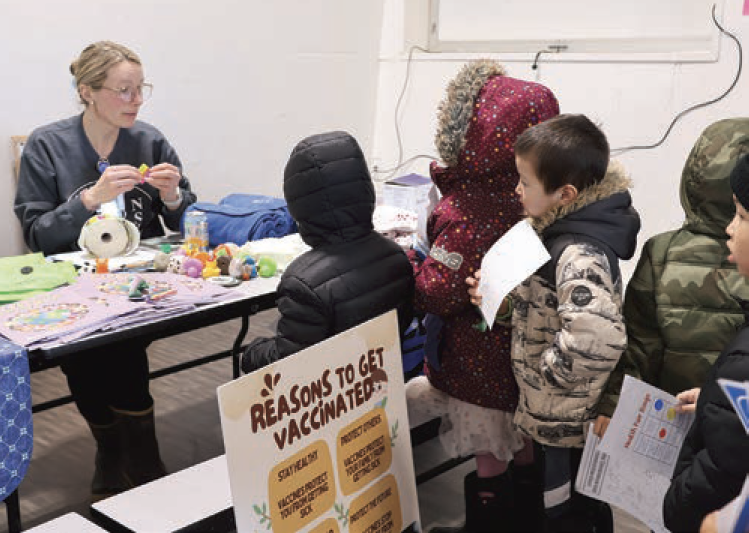
NSHC applied for a Commission grant in the category of belonging, innovation, and growth ideas—broad, bold, and innovative strategies that deploy novel concepts and approaches to improve nursing and patient-specific outcomes in healthcare. With the aim of increasing pediatric vaccination rates, NSHC deployed community education, nursing and medical staff training, and targeted interventions to improve patient outcomes.
The 2024–2025 vaccine theme, “Norton Sound Strong,” recognized the centennial of the 1925 Serum Run, also known as the Great Race of Mercy. This event, which made headlines worldwide, involved a nearly 700-mile dog sled relay to deliver life-saving diphtheria antitoxin to Nome, which was at risk of an epidemic after several patients died of the infection.
The message “Protected by vaccines for 100 years” harkened back to the 1925 Serum Run and reinforced the value of vaccinations at events in five communities, a health fair in Nome, and other educational events, one of which reunited descendants of the original mushers with one of the children saved by the serum, who had matured into a community elder. (Jirdes Winther Baxter, the last known survivor of the outbreak, died on January 5, 2026, at age 101.)
The Commission funding “has been a net positive for our community and our clinical team,” said Candice Whitely-Shukla, MPH, MSN, FNP-C, HRSA coordinator at NSHC. “Our comprehensive approach… has been vital in overcoming traditional obstacles to pediatric vaccination in remote Alaska Native villages. We will continue to prioritize education for clinical staff on historical trauma, vaccine hesitancy, and barriers to care, as these are essential to delivering equitable care to our Indigenous patient population.”
Enhancing career development
Widening economic opportunities for nurses and aspiring nurses was the impetus behind the grant the Tennessee Nurses Association (TNA) received from ANA. The Volunteer State is home to sharp urban-rural divides, where large, well-resourced metropolitan areas contrast with less populated and resource-limited counties. Bridging these differences and opening learning and career advancement pathways remain top priorities for TNA, according to past president Ray Coe, PhD, MBA, MHA, RN-BC, NEA-BC, who led the grant initiative along with TNA Board of Directors members Marilyn Smith, DNP, MSN, RN; Courtney Nyange, DNP, MSN, RN, CNE; and District 3 President Ashley Carter, MSN, RN, AMB-BC, CNEcl, CPhT. “We want people to see that they’re not limited, that they’re capable of advancing, and that opportunities abound for everyone,” Coe said.
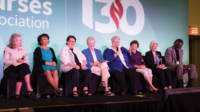
TNA used the grant funds for two initiatives. The first was to screen the documentary, Everybody’s Work: Healing What Hurts Us All, at the 2024 TNA annual conference, followed by a panel discussion with Nyange; Carter; Tena Job, MSN, ACM-RN; Daphny Peneza, MSN, RN, CNOR, CSSM, FAORN; and past ANA President Ernest Grant, PhD, RN, FAAN.
Through the lens of fearless nurses, Everybody’s Work not only exposes the biases that result in worse healthcare outcomes for patients from under-resourced communities but also captures the painful impact these inequities have—both on recipients of care and nurses.
Everybody’s Work and the accompanying discussion proved revelatory and inspiring, said Coe. “This helped people realize that they’re not alone. And they heard others discussing how they overcame the challenges they faced,” he recalled.
TNA also published volume 2 of A History of The Tennessee Nurses Association, covering the 2 decades since publication of the first volume and reflecting the range of experience among nurses in Tennessee, from across practice settings and sites, roles, and educational backgrounds. “We need a workforce that looks like the state of Tennessee, and we need patients to know that they can trust their caregiver because that caregiver has been in their shoes,” Coe said. “We want people to look at this book and see what others have done and know they can make a career out of this.”
TNA shared its efforts with the broader nursing community, presenting at the 2024 ANA Leadership Summit, a professional development gathering of leaders from C/SNAs. Coe also spoke at the 2025 Equity in Nursing Summit, describing Tennessee’s apprenticeship program for nursing assistants, which enables them to work and earn money while attending school, and the state’s tuition-free community and technical colleges, which enable students to advance through nursing education while not incurring debt.
Coming together through focused training
The Maryland Nurses Association (MNA) used its grant from ANA to develop language for and obtain passage of a law that requires one-time structural racism training for all licensed healthcare professionals in the state to be taken at the time of their initial licensure or renewal after April 1, 2026. With the law enacted, MNA also deployed the funds to contract with the University of Maryland to develop a 1-hour training program that meets the new requirement.
The law, passed on May 13, 2025, defines structural racism as “the totality of ways in which societies foster racial discrimination by mutually reinforcing systems of housing, education, employment, earnings, benefits, credit, media, health care, and criminal justice.”
The new law builds on an earlier one that required all health professionals to complete implicit bias training at their first license renewal after April 1, 2022.

MNA sought the structural racism law “because people often confuse implicit bias and racism and think of them as one and the same,” according to Lou Bartolo, DNP, MSN, RN, president of MNA. “We wanted to raise awareness about the differences between these two issues and ultimately for healthcare professionals in the state of Maryland to be better healthcare providers.”
Bartolo stressed the vital contribution of Yvette Conyers, DNP, RN, FNP-C, CTN-B, CFCN, CFCS, CNE, FADLN, CWCN-AP, in developing the training materials. As associate dean for strategic engagement and impact at the University of Maryland School of Nursing, she also collaborated in developing the law’s language. “She’s very well versed in these issues, but she also kept an open mind because we wanted to make sure both the language and the training worked for all healthcare professions,” he explained.
While this bill was in process, other ANA C/SNA leaders approached Bartolo about MNA’s strategy for achieving its passage. He cited the importance of engaging a lobbyist to guide the process and partnering with a state university and other state agencies about the need for such a requirement and the process for developing associated training materials. “The biggest thing is to make sure you’re working with all healthcare professional organizations. We really had to come together as one,” he stressed.
Fostering inclusive communication
ANA-New York (ANA-NY) saw its grant from ANA as an opportunity to educate, motivate, and empower nurses to implement strategies that remove barriers and support health equity. “As the state with the third largest number of nurses, and the largest professional nursing organization in the state, we felt that this was part of our responsibility,” said Marilyn Dollinger, DNS, FNP, RN, former ANA-NY president and chair of the ANA-NY health equity task force that sought the grant and oversaw how the funds were deployed. “We were already doing things in bits and pieces, but this grant enabled us to be on the record with a more focused initiative.”
The seven-member task force that Dollinger led, with representatives from across the state and practice settings, investigated training programs and resources for improving health equity and strengthening the nursing workforce. Ultimately, they collaborated with Northwell Health to develop “Strategies and Skills to Broaden Inclusive Communication in Healthcare,” a customized four-part, 8-hour program that covers topics such as unconscious bias, moving from safe to brave, impact versus intent, and allyship. The training series was offered virtually to ANA-NY members in the spring and summer of 2025.
The training modules will be offered in the future, possibly in person at regional meetings throughout New York state, according to Dollinger. Task force members Teddi Levine, DNP, MEd, RN, NEA-BC, and Kim Velez, MSN, RN, presented the group’s output in November 2025 at the Sigma Theta Tau Biennial Convention.
Like TNA, ANA-NY also screened Everybody’s Work; Mercy University’s Beard joined an accompanying discussion panel along with Grant and Deborah Stamps, EdD, MBA, MS, RN, GNP, NE-BC, an expert in workforce development and founder and CEO of Deborah Stamps Consulting. Additionally, ANA-NY held a joint program with the Genesee Valley Nurses Association (at which Beard spoke), sponsored a task force member to attend the Equity in Nursing Summit, and held a virtual discussion about The Black Angels, a book about the unheralded Black nurses at Sea View Hospital in Staten Island who treated thousands of patients with tuberculosis and participated in drug trials that eventually led to treatments for the disease.
The task force’s work will live on through standing ANA-New York committees, as these initiatives also are part of the association’s strategic plan, according to Dollinger. “Our goal was to start with a small group, have them investigate training programs, and gradually increase the concentric circles of influence,” she said. “We felt that was the fastest route to mainstreaming and increasing our impact.”
ANA remains committed to driving equity and engaging in solutions-oriented efforts to structurally and systematically create healing environments in nursing and beyond. Our equity vision for the nursing profession guides our work. (See ANA Equity Vision for the Nursing Profession.) To learn more about these efforts, visit https://www.nursingworld.org/practice-policy/workforce/racism-in-nursing/
ANA Equity Vision for the Nursing Profession
A nursing profession where every nurse has the equal opportunity to excel, and every patient receives the highest standard of equitable care. We will not rest until health equity is a reality embedded in the heart and hands of every nurse and reflected in everyday practice.
Together, we will lead the charge to transform healthcare into a system that is just, inclusive, and truly equitable for all.
—Genna Rollins is a writer/editor at ANA.
 American Nurse is the official journal of the American Nurses Association and is a member benefit. Learn more about the association and the many benefits of joining.