This 2018 update to the sepsis bundle focuses on beginning treatment immediately.
Takeaways:
- Sepsis bundles are designed for bedside application of key elements of the Surviving Sepsis Campaing guidelines.
- The focus of the hour-1 sepsis bundle is to begin resuscitation and management immediately.
- Nurses are critical to improving outcomes for patients with sepsis.
Editor’s note: September is Sepsis Awareness Month. Learn more.
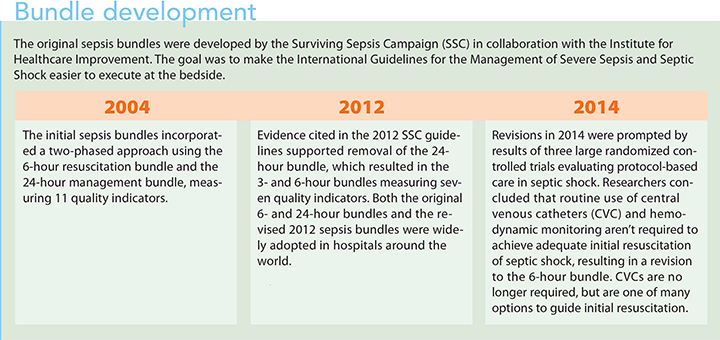
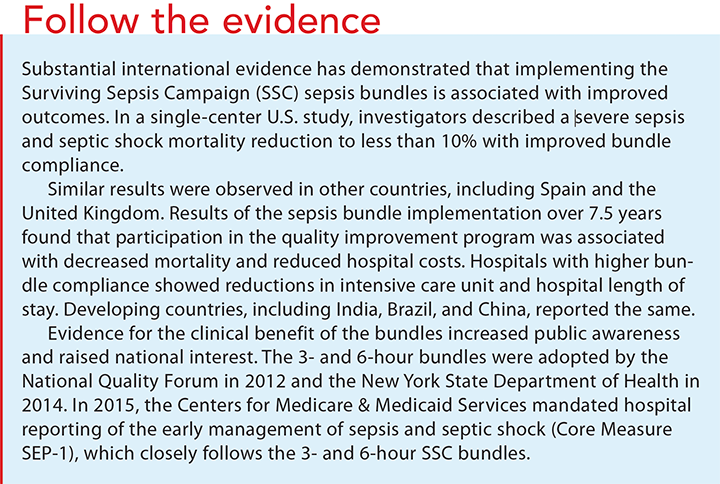
Sepsis is recognized as a leading cause of death around the world, with more than 1 million patients affected each year in the United States. In 2002, as part of international efforts to improve care for patients with sepsis, the Surviving Sepsis Campaign (SSC) was created to spread sepsis awareness, improve diagnosis and recognition, increase use of appropriate and timely care, educate healthcare providers, develop guidelines, and implement performance improvement programs. After publication of the SSC Guideline for the Management of Severe Sepsis and Septic Shock in 2004, the first sepsis bundles were presented. They were created to bring key elements of the guidelines to bedside clinicians. (See Bundle development.) Over the years, the bundles have been revised to reflect the best available evidence; the most recent revision was published in June 2018. (See Follow the evidence.)
This article will review the new hour-1 sepsis bundle and outline the implications for nursing practice.
The hour-1 bundle
The most recent SSC International Guidelines for Management of Sepsis and Septic Shock: 2016 were published in March 2017, with detailed definitions of sepsis and septic shock and associated interventions. Updated evidence led to revisions of the 3- and 6-hour bundles, resulting in a single combined bundle. The June 2018 update is identified as the hour-1 bundle.
The objective of this bundle is to begin resuscitation and management immediately, even though some of the resuscitation measures may require more than an hour to complete.
Rationale and supporting evidence
The hour-1 bundle includes five key elements. (See SSC hour-1 bundle.)
surviving-sepsis-campaing-hour-1-bundle-ssc- Measure lactate level (remeasure if initially > 2 mmol/L). Rationale: Although serum lactate isn’t a direct measure of tissue perfusion, it can serve as a surrogate for worse outcomes. Lactate-guided resuscitation has been associated with mortality reduction. This is a weak recommendation with low quality of evidence.
- Obtain blood cultures prior to administration of antibiotics, but don’t delay appropriate antibiotic therapy if obtaining blood cultures is difficult. Rationale: Blood cultures are important for pathogen identification. Obtaining them before administering antibiotics is listed as a best practice statement, which is an ungraded strong recommendation used when the benefit or harm is certain but the evidence is difficult to summarize.
- Administer broad-spectrum antibiotics. Rationale: Adherence to early antibiotics and antibiotic stewardship are important to provide high-quality care. Administering broad-spectrum antibiotics with one or more I.V. antimicrobials is a strong recommendation with moderate quality of evidence. Administer narrow-spectrum antimicrobial therapy after the pathogen and sensitivity are acquired; discontinue antimicrobials if no infection exists.
- Begin rapid administration of 30 mL/kg crystalloid fluids for hypotension or lactate ≥4mmol/L. Rationale: Sepsis patients with tissue hypoperfusion or septic shock require early fluid resuscitation. Administration of 30 mL/kg of crystalloid for hypotension or lactate ≥4 mmol/L is graded as a strong recommendation with low quality of evidence. Despite the lack of controlled studies to support the 30 mL/kg fluid dose, several interventional and observational studies provide support. Evaluate and assess fluid responsiveness before administering additional fluid beyond the 30 mL/kg dose.
- Apply vasopressors if the patient is hypotensive during or after fluidresuscitation to maintain mean arterial pressure (MAP)≥ 65 mm Hg. Rationale: Restoring perfusion pressure to vital organs is essential. Vasopressor administration in a hypotensive patient is graded as a strong recommendation with moderate quality evidence.
 Nursing implications
 Nursing implications
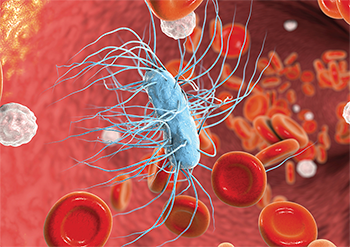
Nurses are instrumental to improving outcomes for patients with sepsis or septic shock. They can pro- vide early recognition of signs and symptoms, implement treatment, help remove barriers to care, and promote education.
Recognizing signs andsymptoms
As nurses interact with patients in a wide variety of settings—emergency departments, intensive care units, medical/surgical units, skilled nursing facilities, the community, homes, and medical offices—they’re likely to encounter patients with signsand symptomsofsepsis.Promptrecognition is an important step in sepsismanagement, and some organizations have shown that specialty trained sepsis rapid response teams lead to improved patient outcomes.
Implementing treatment
After confirming a sepsis diagnosis with the provider, the nurse should collaborate with others to initiate guideline-recommended treatment. Sepsis bundle interventions are implemented in the form of an order-set, protocol, pathway, or care plan. Screening and monitoring patients with sepsis may differ from hospital to hospital and even from unit to unit because of the nature of the patient population. Follow your organization’s protocol, and review protocols and care plans to see if updates based on the new hour-1 bundle are indicated.
Several studies have demonstrated that nurse-driven protocols are effective in improving adherence to SSC guideline recommendations; implement protocols that align with your state’s practice acts. Whether you work in the acute or post-acute care setting, it’s essential to be aware of the hour-1 bundle elements and to promote prompt implementation.
Removing barriers
In addition to delayed recognition of sepsis, barriers to sepsis bundle implementation include lack of knowledge, resources, staff, and informatics support. The organizations most successful at managing sepsis are those with senior leadership backing, physician and nursing staff engagement, and informatics support.
Promoting education
A sepsis education program that includes guidance for sepsis screening, a process to communicate findings, and knowledge of the hour-1 bundle components will keep nurses up-to-date. Staff should know what to do and why; understanding why provides motivation for timely appropriate treatment to patients with sepsis. Educational resources and tools are available. (See Educational resources.)
Educational resources
| Use these resources to promote education about the Surviving Sepsis Campaign (SSC) hour-1 bundle. Intensive Care Medicine: The Surviving Sepsis Campaign Bundle: 2018 Update This video provides an overview of the new hour-1 bundle. SSC Hour-1 Bundle infographic Download this infographic to share with colleagues and your organization’s leadership. SSC hour-1 bundle pocket card Download and print this pocket card to keep with you as a reminder of the five elements of the new hour-1 bundle. |
Quality, timely treatment
Sepsis bundles are designed for bedside application of key elements of the SSC guidelines and promote the importance of appropriate and timely treatment. The 2018 hour-1 bundle update focuses on five elements within a single sepsis bundle. Nurses are instrumental in early sepsis identification and patient management. Adhering to their role in providing quality timely treatment will result in better patient outcomes.
Christa Schorr is an associate professor of medicine at Cooper Medical School of Rowan University and a clinical nurse scientist—critical care at Cooper University Hospital in Camden, NewJersey.
Selected references
De Backer D, Dorman T. Surviving sepsis guidelines: A continuous move toward better care of patients with sepsis. JAMA. 2017;317(8):807-8.
Ferrer R, Artigas A, Levy MM, et al; Edusepsis Study Group. Improvement in process of care and outcome after a multicenter severe sepsis educational program in Spain. JAMA. 2008;299(19):2294-303.
Gao F, Melody T, Daniels DF, Giles S, Fox S. The impact of compliance with 6-hour and 24-hour sepsis bundles on hospital mortality in patients with severe sepsis: A prospective observational study. Crit Care. 2005;9(6):R764-70.
Ju T, Al-Mashat M, Rivas L, Sarani B. Sepsis rapid response teams. Crit Care Clin. 2018;34(2);253-8.
Kleinpell R. Promoting early identification of sepsis in hospitalized patients with nurse-led protocols. Crit Care. 2017;21(1):10.
Kleinpell R, Schorr CA. Targeting sepsis as a performance improvement metric: Role of the nurse. AACN Adv Crit Care. 2014;25(2):179-86.
Levy MM, Rhodes A, Phillips GS, et al. Surviving Sepsis Campaign: Association between performance metrics and outcomes in a 7.5-year study. Intensive Care Med. 2014;40(11):1623-33.
Levy MM, Evans LE, Rhodes A. The Surviving Sepsis Campaign bundle: 2018 update. Crit Care Med. 2018;46(6):997-1000.
Miller RR 3rd, Dong L, Nelson NC, et al; Intermountain Healthcare Intensive Medicine Clinical Program. Multicenter implementation of a severe sepsis and septic shock treatment bundle. Am J Respir Crit Care Med. 2013;188(1):77-82.
Mukherjee V, Evans L. Implementation of the Surviving Sepsis Campaign guidelines. Curr Opin Crit Care. 2017;23(5):412-6.
Rhodes A, Evans LE, Alhazzani W, et al. Surviving Sepsis Campaign: International guidelines for management of sepsis and septic shock: 2016. Crit Care Med. 2017;45(3):486-552.
Schorr C, Odden A, Evans L, et al. Implementation of a multicenter performance improvement program for early detection and treatment of severe sepsis in general medical-surgical wards. J Hosp Med. 2016;11(suppl 1):S32-9.
ant9-Sepsis-822a