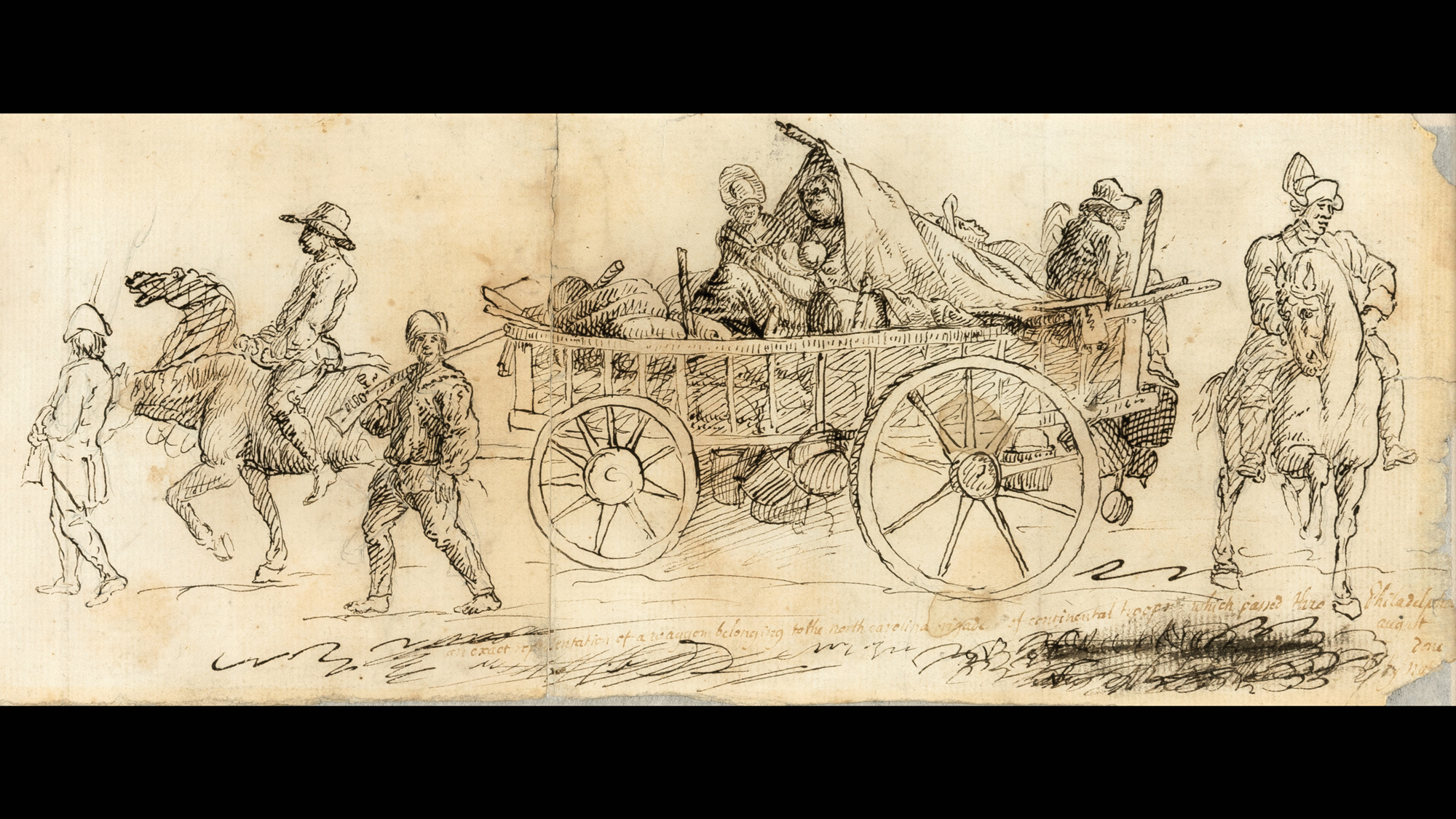
Photo Credit: Museum of the American Revolution, Gift of Judith Hernstadt, 2023.16.01
- Nursing has evolved since the founding of the United States in 1776, but some commonalities remain, including undervaluation of nursing labor and reliance on nurses in times of crisis.
- After the Civil War, in response to lack of recognition and fair pay, Union Army nurses organized and advocated for themselves.
- In the 20th century, scientific and healthcare advances and nurse shortages led to changes in nursing education.
The history of an evolving profession
HUMAN SURVIVAL, particularly during times of crisis, has always hinged on our ability to provide care for our sick and vulnerable. The story of American nursing, then, is at least as old as the story of the nation itself. In our exhibit, Nursing the Revolution, on display at the Barbara Bates Center for the Study of the History of Nursing at the University of Pennsylvania School of Nursing, we explore these beginnings through groundbreaking research that’s uncovered materials rarely, if ever, displayed before.
This occasion of America’s semiquincentennial offers a unique chance to reflect on the contributions of nursing, not just during the Revolutionary War, but over these past 250 years. Much has changed between 1776 and 2026, but common threads have endured. From the persistent under-valuation of nursing labor during the Revolutionary War to the moments of national crisis that always seem to bring the critical importance of nursing back into focus, the story of nursing in America includes its struggle and setbacks as much as its success and progress. The longstanding association between the assumption of women’s unpaid domestic work and the labor of nursing (whether paid, donated, or even enslaved) is another thread that weaves its way through this history.
Looking back to American nursing’s roots, we also see a story about the denigration of nursing as mere “women’s work,” something elite physicians saw as separate from the more serious business of “medicine”. Subjugated and embedded within the hierarchical power dynamics of America’s growing hospital system, nurses from the beginning have fought and defied the underestimation of their labor and expertise through campaigning, professionalization, and dedication to patients. Although the effects of these efforts remain complicated, the story of nursing is inseparable from the story of healthcare in America.
1776
Before the Revolutionary War, as described by Brandt, nursing served as one of many sources of healing labor. Caring for the sick and injured was a family and community affair. The work of tending the sick—washing, warming, feeding, monitoring, changing soiled linens, emptying chamber pots—usually fell to those closest to the patient.
In most Anglo-American households, girls were raised with these foundational healing skills, expected to care for their families and neighbors. Enslaved, indentured, and hired domestic servants acquired these caregiving skills by necessity, sometimes incorporating traditional knowledge from their own communities. If they developed a particular aptitude or interest in healing and nursing, free women with local connections could offer caregiving services alongside other lay healers, physicians, and apothecaries.
In this era, nursing and doctoring were distinct but overlapping practices. Doctoring implied acute medical intervention: diagnosing illness, prescribing and administering medicines, performing surgeries. As it does now, nursing related to attending to the patient’s immediate and ongoing needs—encompassing everything required to keep a patient alive and as comfortable as possible. Most women healers at this time performed a seamless combination of both doctoring and nursing labor. Philadelphia druggist Elizabeth Paschall, for instance, combined her medical practice and trade with hands-on patient care, which she recorded in her journal.
Freelance healers, midwives, and nurses built their reputations and skills over many years in a community, giving their work a social legitimacy. Without this accompanying reputation for medical expertise, nursing for pay carried stigma, especially for lower class women. The bodily intimacy of the work and its cultural association with poverty and contagious illness made many women reluctant to advertise themselves as nurses. However, nursing work, when combined with other forms of skilled domestic labor like laundering, wet-nursing, or cooking, offered significant opportunities for women to earn income.
By 1776, however, the healthcare landscape was entering a period of rapid change. Elite, university-trained male physicians worked to distinguish their knowledge and abilities from lay healers. Unlike women providers, these male physicians generally offered only medical treatment and left nursing care in the hands of women of the household or a hired nurse. Although they depended on the caregiving expertise of women, many physicians considered nursing an extension of women’s domestic responsibilities.
Early forms of institutional healthcare began to draw a clear distinction between doctoring and nursing as separate occupations with strictly gendered boundaries. The Pennsylvania Hospital in Philadelphia was the only civilian hospital in the American colonies before the 1770s. Its founders followed precedents set by British charitable hospitals, employing women only as matrons, nurses, or cooks, all of whom worked under the authority of the physicians and hospital managers. The matron, essentially the hospital’s housekeeper, ensured that the nurses kept the wards clean, the linens washed, and attended patients with efficiency and obedience to physicians.
When the Revolutionary War broke out in 1775, physicians organized the Continental Army’s Hospital Department. Much like they did in their regular practices, these medical men relied on the healing and nursing expertise of American women to care for sick and wounded soldiers. Yet rather than acknowledge the essential value of nursing work, the Continental Army’s hospitals followed the hierarchical systems established in British military hospitals and implemented at Pennsylvania Hospital.
Nurses in this system occupied the lowest rung in the military hospital hierarchy and earned such low wages that army leaders consistently struggled with recruitment. In 1777, former Surgeon General Dr. John Morgan accused Congress of fixing nurses’ pay “so low [that] we shall never be able to furnish good nurses, or in short any nurses, in proportion to the number wanted for the sick.”
Even when sympathy for the sick and wounded soldiers convinced women to work in army hospitals, they couldn’t rely on regular wages or even adequate supplies. In 1780, in the Yellow Springs Hospital in Pennsylvania, Dr. Bodo Otto reported that hospital staff hadn’t received wages or clean clothes for 7 months. To make matters worse, the hospital had exhausted its food rations, firewood, and straw (for patients’ beds). The nurses and orderlies refused to continue any longer, knowing that any care they provided couldn’t save the soldiers without basic resources for sustenance, hygiene, and warmth.
The women who nursed soldiers faced dangerous and life-threatening working conditions as diseases like small-pox and dysentery swept through the troops. After the war, despite the dedication of nurses and the demonstrated need for them, the new U.S. pension system offered no route for nurses to receive any compensation or recognition. Most records of their service fell into obscurity, if they were documented at all. Today we have only a few scraps of paper, saved in the collections of archives and private collectors, to offer insight into their existence.
Although the professionalization of nursing was still 100 years away, Revolutionary War hospitals and their colonial antecedents laid the long-lasting organizational groundwork for the nursing profession and the healthcare system. Before the United States of America had even won its war for independence, many of the themes of the next 250 years of nursing were already established.
1876
Over the course of its first century, the nation weathered numerous epidemics, from yellow fever to cholera, and multiple wars. The most notable of these, of course, was the Civil War, during which both Union and Confederate leaders turned to nurses to keep soldiers alive and well.
In May 1861, just one month after President Lincoln’s call for 75,000 soldiers to defend the Union, the Woman’s Central Association of Relief had selected 100 women to train as nurses in the city’s hospitals for wartime service. Recognizing the need for a widespread organization to oversee such a large nursing force, as noted by Oates, the government appointed Dorothea Dix in June of that year.
Well-known in Washington, D.C. for her advocacy work to improve conditions in the country’s asylums, Dix became the Superintendent of Army Nurses for the Union Army. Despite having never worked as a nurse herself, her social status alongside her acumen for organization and leadership helped her build and oversee a formidable nursing force.
She established strict standards for nurses, requiring them to be between ages 35 and 50, physically capable, well-educated, and of impeccable character and moral standing (bit.ly/4uXF5Qa).
Many women found other ways to serve as nurses. Some worked for private relief agencies, such as the U. S. Sanitary Commission, or were hired directly by military hospitals.
The indispensable labor of the more than 18,000 women who ultimately served as Union nurses helped demonstrate, once again, the critical link between a well-trained and organized nursing force and the country’s victory. However, many of the same issues of stigma, waged labor, respect, and hierarchy their predecessors confronted continued to characterize the experience of Civil War nurses.
The Union did pay its nurses around $0.40/day, on par with what soldiers received. Many wealthier women, who didn’t require payment, offered their service as an act of Christian charity. According to Schultz, this created a nurse hierarchy, with the wealthier women gaining prestige, autonomy, and respect in the hospital for their “superior motives,” relegating many lower-class and Black women to the least-desirable hospital work of laundry and cooking.
After the war, women who had served as Union nurses learned that they wouldn’t receive recognition as veterans, nor would they have access to Federal pensions. They also weren’t welcomed as members by veterans’ organizations.
In response, Union nurses organized and advocated for recognition and adequate compensation. In 1881, Dix founded what would become known as the National Association of Army Nurses of the Civil War (NAAN). By the mid-1880s, through hard work and lobbying, nurses convinced Congress to begin issuing pensions to those who had been injured during the war. However, it wouldn’t be until 1892 that Congress finally passed the Army Nurses Pension Act, which granted a federal pension of $12/month to women who could demonstrate they had worked as Union Army nurses for at least 6 months.
By 1894, about 400 veteran nurses were drawing pensions, but obtaining them was administratively and logistically complex and fickle. Still, as Schultz notes, the symbolism of the act can’t be overstated. For the first time, the government acknowledged that wartime nursing deserved recognition and compensation on par with that of male soldiers.
According to Whelan and Buhler-Wilkerson, before the war’s end, in 1863, the country’s first-known chartered school for nurses was founded at the Woman’s Hospital of Philadelphia. Just 10 years later, three new nurse education programs, modelled after Florence Nightingale’s training school in London, opened their doors—New York Training School at Bellevue Hospital, the Connecticut Training School at the State Hospital (New Haven Hospital), and the Boston Training School at Massachusetts General. These “Nightingale schools” became the standard for nursing education around the world; at the same time, hospitals were expanding as sites of healthcare and scientific innovation.
These programs generally required 2 to 3 years of classroom and bedside training. In 1876, these young schools were just beginning to graduate some of their first classes. Over the next century, this model of nurse education would become the basis for the professionalization of nursing.
In 1896, a small group of nurses founded the Nurses’ Associated Alumnae of the United States and Canada, with the goal of establishing professional nursing standards. That organization became the American Nurses Association (ANA), setting in motion 130 years of advocacy and innovation.
1976
By 1976, nursing was once again in flux. This time, the issue wasn’t whether nurses needed a formal education, but what type of institution was best equipped to deliver it. After World War II, Congress enacted the Hill-Burton Act, which funded the expansion of hospitals in communities around the country, creating a surge in the demand for nurses.
Between World War II and 1970, dramatic innovations added scientific and technological complexity to healthcare, demanding more of nurses. In addition, most experienced nurses who had served during World War II left the workforce to pursue marriage and childrearing.
Just as the factors contributing to the nursing shortage were numerous, so too were the suggestions for how to fix it. Many nursing leaders and organizations, including ANA and the National League for Nursing, argued that nursing growth and survival as a profession in this new landscape required enhanced educational standards. These organizations advocated for the expansion of baccalaureate in nursing (BSN) programs and looked to them as the future of the field. In response, by the 1960s, more college-based nursing programs launched to provide nurses with a strong academic foundation.
Nurses with BSNs became more common by the mid-1970s, but the cost and time to acquire these degrees posed significant hurdles for many, limiting the number of BSN graduates entering the field in any given year. Exploration into alternative pathways to nursing led to the expansion of licensed practical nurse (LPN) programs, as well as the development of the associates degree in nursing (ADN).
While pursuing her EdD in nursing education at Columbia University’s Teachers College, Mildred Montag proposed a 2-year nursing curriculum through the emerging network of community colleges. According to Orsolini-Hain and Waters, Montag believed these “nursing technicians” could, in theory, help fulfill less-skilled nursing roles in hospitals, thus freeing nurses with advanced educations to perform more complex and technical duties. The proliferation of BSN and community college nursing programs largely replaced the older “Nightingale” model of hospital-based nurse training by the end of the 1970s.
The parallel development of multiple nurse education tracks offered a possible solution to the problems that plagued the healthcare system after the war, but it also built on longstanding divisions that had characterized the field. ADNs and BSNs could both become RNs, making their different educational backgrounds invisible once they entered practice.
However, because the LPN and ADN took less time and money to complete than the BSN, it appealed to those with fewer resources. Thus, as shown by Mann and colleagues, many LPNs and ADNs came from working-class, Black, and immigrant communities. According to Matthais, the problem of differentiation of practice among these educational paths continues to cause debate today. At the same time, as described by Tobbell and D’Antonio, institutionalizing a hierarchy with multiple “levels” of nursing perpetuates the story of the LPN/ADN/BSN divide, which reflects the country’s longstanding patterns of exclusion based on racial and class divisions—with roots that trace back to previous eras.
By the bicentenary of American independence in 1976, the United States was still reeling from the Vietnam War. As noted by Dixon Vuic, approximately 10,000 women had served in Vietnam, 90% of them as nurses. Many had enlisted through the Army Student Nurse Program, organized by the U.S. Army Nurse Corps (under a recruitment effort titled “Operation Nightingale”), which offered trainee nurses tuition support in exchange for their service in Vietnam. Although the U.S. Army struggled with nursing shortages, the dedication and skill of those who served contributed to a 98% survival rate among treated casualties.
After the war, however, recognition of nurses’ contribution to the war was, once again, slow and contested, due to outdated assumptions about women’s role in warfare and the political unpopularity of the war itself. Post-Civil War campaigning had established nurses’ entitlement to veteran pensions, but many nurses who served in Vietnam found veterans’ services difficult to access.
Many nurses suffered long-term health consequences from Agent Orange exposure and post-traumatic stress disorder, but, according to Cassie, the Department of Veterans Affairs (VA) was ill-equipped, and sometimes unwilling, to address the health needs of women veterans until the mid-1980s. In response, nurses who served during the war became instrumental in pushing the VA to better support women veterans, leading to the establishment of the Center for Women Veterans in 1994.
According to Singleton, nurses challenged the erasure of women from the cultural memory of the Vietnam War. After a decade of campaigning, the Vietnam Women’s Memorial was formally dedicated in 1993. Again, through determined organizing in addition to their nursing work itself, nurses achieved the recognition they deserved.
2026
Over the past 50 years, the nursing profession has made many gains. However, struggles continue, including the fight for adequate pay and recognition as well as safe and sustainable working conditions. The 2020s witnessed what may become known as one of the worst pandemics in global history—COVID-19. Again, as described by Mohammed and colleagues, nurses received accolades for their critical work and heroism, but they also paid significant costs, many with their lives.
Despite significant advancements in the educational opportunities available to nurses, many of those gains are under active threat. Between 1976 and 2026, according to Tobbell, the effort to firmly establish PhD nurse scientists and DNP clinical practitioners helped solidify nursing’s position as a unique knowledge-making field with specific clinical expertise and a respected role to play in healthcare. But that status is once again being challenged. The U.S. Department of Education issued a new rule, set to take effect July 1, 2026, that prevents designating nursing as a professional degree and reduces the cap on funding available in the form of student loans.
This latest chapter in nursing’s story resonates with the struggle that nursing has faced since our country’s birth—a struggle rooted in a fight for recognition and respect for performing crucial, life-sustaining, necessary labor. Future historians will analyze the full impact of this current policy, but nurse leaders already fear the chilling effect it will have on graduate nursing programs.
In reaction to this rule change, however, nurses have once again organized, rallied, and pushed back. Over 245,000 nurses participated in signing a petition, led by ANA, in protest of this rule change. ANA has vociferously opposed the change, stating that it “will result in a negative impact on patient care as advanced practice registered nurses are increasingly relied on to provide crucial primary care and other specialty healthcare services.”
Consider your own story
It’s impossible to capture a full history of 250 years of nursing in one article, not just because of the complexity and depth to the story, but also because so much of it has been overlooked, forgotten, or ignored. The organization of professional nursing in the 20th century means that nurses have left more of a paper trail than their 18th century forebearers. However, because even nursing’s recent past hasn’t always been properly documented, stewarded, or shared, nursing organizations, healthcare institutions, and nurses themselves have a role to play in preserving their stories so they’re not lost to history.
Our research for Nursing the Revolution turned up much evidence of what nursing looked like 250 years ago, but it can provide only a glimpse into the countless lives devoted to caring for the sick and wounded, whether in their homes and communities or in a damp, frigid army encampment. The story of nursing is the story of American healthcare. On this occasion of the semiquincentennial, take a moment to reflect on this long tradition and consider your stories and how they’ll appear in the archival record in another 100 years.
Meg Roberts is the Fennell Career Development Fellow in the History of the Americas at the University of Edinburgh. Jessica Martucci is curator at The Barbara Bates Center for the Study of the History of Nursing at the University of Pennsylvania School of Nursing in Philadelphia.
American Nurse Journal. 2026; 21(7). Doi: 10.51256/ANJ072612
References
American Nurses Association. “American Nurses Association’s statement on the Department of Education’s finalized graduate student loan rulemaking. 2026. nursingworld.org/news/news-releases/2026-news-releases/american-nurses-associations-statement-on-the-department-of-educations-finalized-graduate-student-loan-rulemaking
Brandt SH. Women Healers: Gender, Authority, and Medicine in Early Philadelphia. Philadelphia, PA: University of Pennsylvania Press; 2022.
Cassie N. ‘There were no women in Vietnam’: Remembering the combat nurses who served during the Vietnam War. Paper presented at Researching Women and the Military; March 9, 2018. London UK. eprints.gla.ac.uk/363727/
Dixon Vuic K. Officer, Nurse, Woman: The Army Nurse Corps in the Vietnam War. Baltimore, MD: Johns Hopkins University Press; 2011.
Dr. Bodo Otto to the Continental Congress. 19 May 1780 (no. 14). Otto Family Documents (DLAR 1704p). Philadelphia, PA: American Philosophical Society.
Gardner Holland MA. Our Army Nurses: Interesting Sketches, Addresses, and Photographs of Nearly One Hundred of the Noble Women Who Served in Hospitals and on Battlefields during our Civil War. Boston, MA: B. Wilkins & Co; 1895.
Green FH. Memoirs of Elleanor Eldridge. 2nd ed. Providence, RI: B.T. Albro; 1843.
Mann Wall B, Cessato WA, Tucker V. The ‘right kinds of nurses’: Centering LPNs in the nursing labor force. Policy Polit Nurs Pract. 2025;26(1):24-39. doi:10.1177/15271544241278626
Matthias AD. The Intersection of the history of associate degree nursing and ‘BSN in 10’: Three visible paths. Teach Learn Nurs. 2010;5(1):39-43. doi:10.1016/j.teln.2009.08.006
Mohammed S, Peter E, Killackey T, Maciver J. The “nurse as hero” discourse in the COVID-19 pandemic: A poststructural discourse analysis. Int J Nurs Stud. 2021;117:103887. doi:10.1016/j.ijnurstu.2021.103887
Morgan J. A Vindication of His Public Character in the Station of Director-General of the Military hospitals, and Physician in Chief to the American Army. Philadelphia: 1777.
Oates L. Civil War nurses. Am J Nurs. 1928;28(3):207-12. doi: https://doi.org/10.2307/3408924
Orsolini-Hain L, Waters V. Education evolution: A historical perspective of associate degree nursing. J Nurs Educ. 2009;48(5):266-71. doi:10.3928/01484834-20090416-05
Paschall EC. Manuscript Recipe Book. ca. 1745-67. College of Physicians of Philadelphia.
Schultz JE. Race, gender, and bureaucracy: Civil War army nurses and the pension bureau. J Women’s History. 1994;6(2):45-69. doi:10.1353/jowh.2010.0384
Singleton M. Flashback Friday—After Vietnam, the ten-year battle to honor women veterans. November 11, 2024. UVA School of Nursing. nursing.virginia.edu/news/flashback-vietnam-women-veterans/
Tobbell DA. Dr. Nurse: Science, Politics, and the Transformation of American Nursing Chicago, IL: University of Chicago Press; 2022.
Tobbell DA, D’Antonio P. The history of racism in nursing: A review of the existing scholarship,” National Commission to Address Racism in Nursing. May 1, 2022. nursingworld.org/globalassets/practiceandpolicy/workforce/commission-to-address-racism/1thehistoryofracisminnursing.pdf
Whelan JC, Buhler-Wilkerson K. Nursing, history, and health care. University of Pennsylvania School of Nursing. 2011. nursing.upenn.edu/nhhc.
Key words: American nursing, Revolutionary War nursing, Union Army nurses, 20th century nursing

















1 Comment. Leave new
A riveting story and an important reminder of nursing’s enduring impact. I would gently suggest that America’s nursing story reaches back even further. Pennsylvania Hospital, founded in 1751 by Benjamin Franklin and Dr. Thomas Bond, was the nation’s first hospital and laid the foundation for organized nursing care in America. This year, our alumni all-class reunion at Pennsylvania Hospital on October 3rd will celebrate Philadelphia’s newest museum at this historic landmark, a fitting tribute to where so much of our profession’s legacy began.