
Use responses to behavioral interview questions to highlight your skills and knowledge.
By Deborah Lindell, DNP, MSN, RN, CNE, ANEF, and Debra Hagler, PhD, RN, ACNS-BC, CNE, CHSE, ANEF, FAAN
Communicating effectively in an interview is key to getting the professional nursing job you want. Prospective employers ask different types of interview questions to learn about your knowledge and skills. Behavioral questions are often probing and specific, so they require careful preparation. Read on to learn how to succeed in a behavioral interview.
What is a behavioral interview?
Structured behavioral interviews are used by all types of businesses to assess whether a candidate has the characteristics and competencies required for the position. In health care, structured interviews are used for employment, volunteer positions, and educational programs.
Both situational and behavioral questions may be part of a structured interview. Situational questions are future oriented; candidates are asked to describe how they would respond to standardized scenarios. Behavioral questions begin with a prompt and the candidate is asked to describe an example of a past response.
Why are behavioral interviews used?
The rationale behind behavioral interviews is that a candidate’s past actions in a particular situation may indicate how that person will respond in a similar future situation. For the candidate, a behavioral interview provides opportunities to highlight skills and competencies.
How do I recognize a behavioral interview question?
 Behavioral interview questions focus on qualities needed to carry out the roles and responsibilities of the position and will cover general and specific topics. General questions are relevant to all types of positions and transferrable skills, such as teamwork and collaboration; problem solving; initiative; leadership; motivation; interpersonal skills; time management; communication; and response to challenge, stress, or pressure.
Specific questions are tailored to skills and competencies needed for a particular position or field. For nursing and health care, interviewers may ask about topics such as ethics, customer service, clinical skills, conflict resolution, flexibility, future orientation, ability to manage frustration, and a specific work setting or client population. Examples of setting-specific topics include the candidate’s experience in caring for patients with a critical illness, dementia, psychiatric and behavioral health illnesses, or end-of-life concerns.
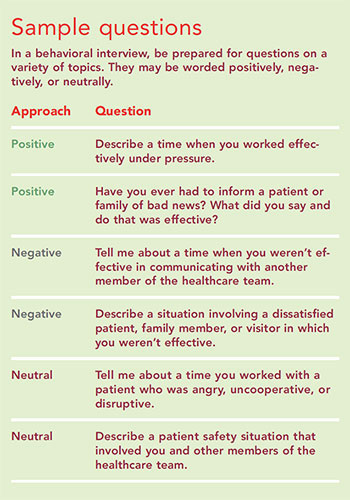
The questions may be worded positively (“Can you tell me about a time you were successful at doing [specific behavior]?”), negatively (“Can you tell me about a time in which you weren’t successful at doing [specific behavior]?”), or neutrally (“How did you handle [specific situation]?”). (See Sample questions.)
How do I prepare for behavioral questions?
Assume you’ll be asked behavioral questions in a job interview, and use these tips to prepare.
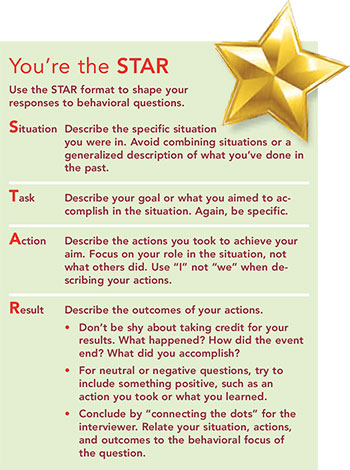
 Use the STAR (Situation, Task, Action, Result) format to practice for behavioral questions. (See You’re the STAR.) If the question is worded in a positive or neutral manner, use the STAR format to describe a situation you handled successfully, emphasizing your contributions and the positive outcomes. If the interviewer asks for an example of a situation that didn’t go well, use the STAR format to illustrate how you made the best of a difficult situation, to emphasize positive outcomes, and to demonstrate what you learned.
- Don’t be surprised if the interviewer asks a question that doesn’t seem to relate directly to the position; he or she will have a reason. For example, an interviewer who asks, “What do you do for recreation or hobbies?” is trying to learn more about you as a person and determine whether you lead a balanced life. Respond with some outside interests but not so many that might indicate you’re overcommitted.
- After you respond to a question, the interviewer may ask follow-up questions. Of course, if the interviewer asks a question about your personal life that’s illegal or inappropriate, such as your marital status, you may decline to answer.
- Anticipate possible topics by learning about the organization’s culture, priorities, and the populations or communities it serves. Study the organization’s website; the “About” section will include information about the leadership, history, and value statements (vision or mission). Also read sections about the nursing division or department and the organization’s activities to promote quality and safety.
- Learn about the roles and responsibilities of the position, including necessary skills, what makes a successful candidate, and what makes an unsuccessful candidate. Also try to find out why the position is vacant and what is the most difficult part of the job.
- Identify situations in which you engaged in positive behaviors. When possible, draw from experiences in health care. If you’re a student who doesn’t have professional experience in health care, identify a situation in which you had a role or responsibility that illustrates skills in customer service (such as a server in a restaurant) or demonstrates your ability to protect child safety (such as a nanny).
- Identify several real-life situations in which you played a key role. Don’t invent or modify stories, take your time to respond thoughtfully, and avoid using the same situation in response to more than one question.
- Like any story, be sure your description of the situation has a beginning, middle, and end. Practice telling your stories before the interview.
- Be clear as to how the situation and your actions relate to the focus of the question. When concluding, connect the dots. For example, when a potential employer whose facility serves a largely Spanish-speaking population asks you to provide an example of leadership, you could share a situation in which you arranged for interpreter and translation services or used your fluency in Spanish. Then explain how you might use your past success with these skills in future situations with the employer’s organization.
- If you have little time to prepare, think of situations for the most common topics in behavioral interview questions—teamwork, leadership, handling conflict, problem solving, biggest failure, work ethic, and greatest accomplishment. Reviewing your resume may help you identify examples.
 Use the STAR (Situation, Task, Action, Result) format to practice for behavioral questions. (See You’re the STAR.) If the question is worded in a positive or neutral manner, use the STAR format to describe a situation you handled successfully, emphasizing your contributions and the positive outcomes. If the interviewer asks for an example of a situation that didn’t go well, use the STAR format to illustrate how you made the best of a difficult situation, to emphasize positive outcomes, and to demonstrate what you learned.
What should I do during the interview?
 Behavioral questions are most typically used during second or later interviews, which are usually more in-depth and place the individual candidate with one interviewer or a panel of interviewers. The setting may be an office or conference room and the format may be in-person or by video conference. The hiring process may include a tour of the potential unit or division, and additional interview questions may be asked by the nurse manager at that time.
Follow general recommendations for interviews, such as directing your attention to the interviewer and listening carefully to, and following, instructions and questions. Remember that the interviewer is assessing your behavior as well as the content of your responses. Show the interviewer a confident, genuine candidate who’s relaxed, engaged, and enthusiastic about the position. Always thank the interviewer and send a written thank-you note or email message the next day.
Ready for success
Behavioral questions are a great opportunity to show the value you can bring to an organization. When the interviewer asks a behavioral question, take a moment to recognize the intended behavior and identify a specific situation. Then use the STAR format to provide a thoughtful and organized response that emphasizes your actions in a realistically positive light. Now you’re ready for a successful behavioral interview.
Deborah Lindell is an associate professor at Frances Payne Bolton School of Nursing, Case Western Reserve University in Cleveland, Ohio. Debra Hagler is a clinical professor at the College of Nursing & Health Innovation, Arizona State University in Phoenix.
Selected references
Bika N. Structured interview questions: Tips and examples for hiring. Workable.com.
Brandon Communications. The complete hiring & interviewing guide 2009. Behavioral interviewing.
CareerGuru99. Top 40 behavioral interview questions with answers.
Career Services. Behavioral interview techniques—The STAR approach. Wayne State University.
Doyle A. Top 10 behavioral interview questions and answers. The Balance.com. July 2, 2017.
Harrington C. 15 helpful behavioral interview questions for nurses. Relode.com. March 10, 2016.
Simpson M. Behavioral interview questions and answers 101. The Interview Guys.com.
Skillings P. Behavioral interview questions. BigInterview.com.
Virginia Education Wizard. The STAR method. VAWizard.com.
CW2018_BehavioralInterview
















4 Comments.
Thank you for sharing. I am so happy to hear that you have found this excellent blog.
Amazing information you have shared really apprciated
good
Thanks for sharing great Behavioral interview tips..This site is very helpful for me and other students who are fresher and preparing for an interview.this is Very impressive and insightful article. You’re doing great job to help people to crack interview. Usually i won’t greet anyone. But For your this great helping article i don’t have words to express.Thank you so much for sharing great content. Keep writing!