

Evidence, expertise, and engagement guide revision of Nursing: Scope and Standards of Practice



The American Nurses Association’s (ANA) Nursing: Scope and Standards of Practice (NSSP) informs clinical expectations, influences organizational policies, and helps nurses understand their role across settings. As nursing evolves, this foundational document must evolve as well. To undertake an essential update, ANA convened a national workgroup to create the 5th edition of the NSSP. Guided by emerging evidence, contemporary practice realities, and a commitment to usability, the workgroup aimed to create a clear, relevant, and actionable guide for nurses across all roles and settings.
Grounding the work in a shared purpose, the revision began with three key inputs:
- A research study examining dissemination and adoption of prior NSSP editions
- Review of previous NSSP editions, including the 4th edition
- Alignment with the updated Code of Ethics for Nurses
For readers who develop, implement, teach, or use professional standards, this revision process offers a practical example that can serve as a model for other professional initiatives.
Maintaining relevance
A question surfaced during the review of the NSSP 4th edition: Do nurses use the NSSP? This question led to a mixed-methods research study to examine how the document is disseminated and adopted. Findings from the study provided an evidence base for this revision. ANA invited two of the study investigators to serve as co-chairs for the 5th edition revision workgroup, creating a direct connection between research findings, document development and the voice of nurses. The revision workgroup represented a broad range of contemporary nursing practice and included clinicians, educators, researchers, policy experts, informatics specialists, nurse leaders, and ANA staff. This diversity ensured that varied perspectives informed content decisions while maintaining focus on the needs of nurses.
Building the foundation for success
The workgroup used a set of content guidelines derived directly from the co-chairs’ research findings as an important decision tool. The guidelines operationalized the voice of nurses and encouraged plain language, concise wording, real-world applicability, and clear organization of information. Importantly, the content guidelines were intentionally broad enough to guide consistent decision-making.
The workgroup adopted the Kano Model as a prioritization and decision framework. By categorizing content as “must-have,” “more-is-better,” or “delighter,” the workgroup identified essential content. This framework helped maintain focus on content that directly contributed to the document’s purpose while supporting the overarching goal of simplicity.
Throughout the process, several guardrails shaped decisions and ensured consistency, compliance, and alignment with professional standards. The motto, “Keep it Simple” served as the grounding principle. The content included in the scope and standards section reflects the areas for which nurses could be held accountable. ANA’s artificial intelligence (AI) guideline supported responsible use of AI by keeping content drafts within ANA’s approved AI platform and reinforcing a human-in-the-loop approach to review, judgment, and accountability.
Content strategy
The workgroup established a clear content strategy and organizational framework to make the NSSP easier to navigate and apply. The four categories for content development were scope of practice, standards of practice with competency statements, context of nursing, and appendices. The document needed to be applicable and relevant to nurses entering practice while remaining meaningful to experienced nurses. In addition to content guidelines, the workgroup established parameters in the development of competency statements to promote clarity and usability. (See Checklist for developing competency statements.)
Checklist for developing competency statements
- Clear and concise
- Evidence-informed
- Observable and measurable
- Applicable to all nurses (roles and settings)
- Action-oriented language
- Inclusive and equitable
- Supportive of lifelong learning
- Reflective of contemporary practice
Experts in areas including competency development, innovation, professional identity, nurses’ mental health, and health justice provided subject matter expertise to inform the workgroup’s decisions. This iterative approach strengthened the evidence base and practical relevance of the document while allowing emerging issues to be considered throughout development.
What is nursing?
Nursing is a person-centered, evidence-informed profession that integrates the art and science of caring, critical thinking and judg-ment, promotion of health and wellness, disease and injury prevention, and alleviation of suffering to support healing through com-passionate presence across the lifespan. Registered nurses assess, diagnose, plan, implement, and evaluate care in partnership with recipients of care (including individuals, families, communities, and populations) and the interprofessional team, within diverse set-tings. Grounded in ethical practice and cultural humility, nursing advocates for equity, safety, and dignity in every interaction and upholds the integrity of the profession itself. Nursing practice is informed by ongoing education, research, and interprofessional col-laboration. As a vital and evolving profession, nursing protects and advances the health of people and populations, with a deep ap-preciation for the interrelatedness of life circumstances, experiences, and connections with one another.
Source: Nursing Scope and Standards of Practice, 5th Edition
External drivers
Professional standards don’t exist independently of the settings in which nurses practice. Throughout development, the workgroup considered the legal, professional, ethical, regulatory, organizational, and societal factors that influence how standards may be interpreted and applied. Language was carefully reviewed to confirm it accurately conveyed the intended meaning while supporting inclusivity and reinforcing professional accountability.
Consensus building
The workgroup brought perspectives from different roles, specialties, practice settings, and years of nursing experience. Consensus helped create a unified voice across the document. The final content emerged through repeated discussion, revision, and shared agreement to represent nursing practice broadly and consistently.
Achieving a usable and adaptable document
After completion of content drafts, a cohesive document was ready for external review through a 30-day public comment period. A total of 1,247 participants from across the United States and internationally provided feedback on the draft. These comments informed subsequent revisions by the workgroup, resulting in a stronger final manuscript that ultimately received approval by the ANA Board of Directors.
Feedback from the public comment period helped validate the document’s direction and identify areas where wording, organization, and application needed refinement. This step ensured that the final manuscript reflected not only expert consensus but also the perspectives of nurses and stakeholders who would use the standards in practice, education, leadership, and policy contexts.
As a result, the Nursing: Scope and Standards of Practice, 5th Edition represents a modernized foundational document crafted to make it easier to read, understand, and apply, while preserving the adaptability needed to support all nurses.
From listening to action
Revising a national standards document requires more than content expertise: it begins with listening and requires shared purpose, strategy, and collaboration. By combining evidence, structured processes, broad engagement, and attention to usability, ANA created an updated document designed to ensure that professional standards remain relevant, credible, and grounded in the realities of nursing practice.
—The authors are co-chairs of the ANA Nursing Scope and Standards Workgroup.
ANA publications
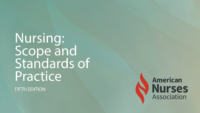
Nursing: Scope and Standards of Practice, 5th Edition is an essential professional resource that informs and guides nurses in their vital work providing safe, quality, and competent care. This publication and the Code of Ethics for Nurses are considered foundational resources for all nurses in every environment.
The NSSP 5th Edition is designed to be more actionable and aims to strengthen how nurses can do the following:
- Advocate for recipients of care.
- Advance quality, safety, and equitable care.
- Lead and implement evidence-informed improvements.
- Educate and mentor across the career continuum.
Nurses will find a more relevant foundational document for nursing practice that includes:
- A simpler, more intuitive structure.
- Inclusive, contemporary language.
- Streamlined competencies.
- Emphasis on today’s practice reality.
- In addition to the NSSP, ANA has published scope and standards of practice with more than 20 nursing specialties, frequently co-publishing them with the relevant specialty nursing organization.
To obtain a copy of ANA’s Nursing: Scope and Standards of Practice, 5th Edition, visit nursingworld.org/nurses-books
American Nurse Journal. 2026; 21(10). Doi: 10.51256/ANJ102632
References
American Nurses Association (ANA). (2026). Addressing nurse fatigue to promote health, safety, and well-being for all. [Position Statement]. https://www.nursingworld.org/practice-policy/nursing-excellence/official-position-statements/id/addressing-nurse-fatigue-to-promote-safety-and-health/
American Nurses Association. Code of Ethics for Nurses. 2025. nursingworld.org/coe-view-only
American Nurses Association. Healthy Nurse, Healthy Nation: The first 5 years. Am Nurse J. 18(4):33-41. https://www.myamericannurse.com/healthy-nurse-healthy-nation-the-first-5-years
American Public University System. What is nurse burnout and how can it be prevented in healthcare? 2024. apu.apus.edu/area-of-study/nursing-and-health-sciences/resources/what-is-nurse-burnout-and-how-can-it-be-prevented-in-healthcare/
Bell T, Sprajcer M, Flenady T, Sahay A. Fatigue in nurses and medication administration errors: A scoping review. J Clin Nurs. 2023;32(17–18), 5445-60. doi:10.1111/jocn.16620
Caldwell JA, Caldwell JL, Thompson LA, Lieberman HR. Fatigue and its management in the workplace. Neurosci Biobehav Rev. 2019;96:272-89. doi:10.1016/j.neubiorev.2018.10.024
Cho H, Steege LM. Nurse fatigue and nurse, patient safety, and organizational outcomes: A systematic review. West J Nurs Res. 2021;43(12)1157-68. doi:10.1177/0193945921990892
Chu B, Marwaha K, Sanvictores T, Awosika AO, Ayers D. Physiology, stress reaction. In: StatPearls. May 7, 2024. ncbi.nlm.nih.gov/books/NBK541120
Nguyen N, Spooner E, O’Balle P, et al. The relationship between depression, burnout, and suicide among healthcare professionals: A scoping review. Worldviews Evid Based Nurs. 2025;22(3):e70037. doi:10.1111/wvn.70037
 American Nurse is the official journal of the American Nurses Association and is a member benefit. Learn more about the association and the many benefits of joining.