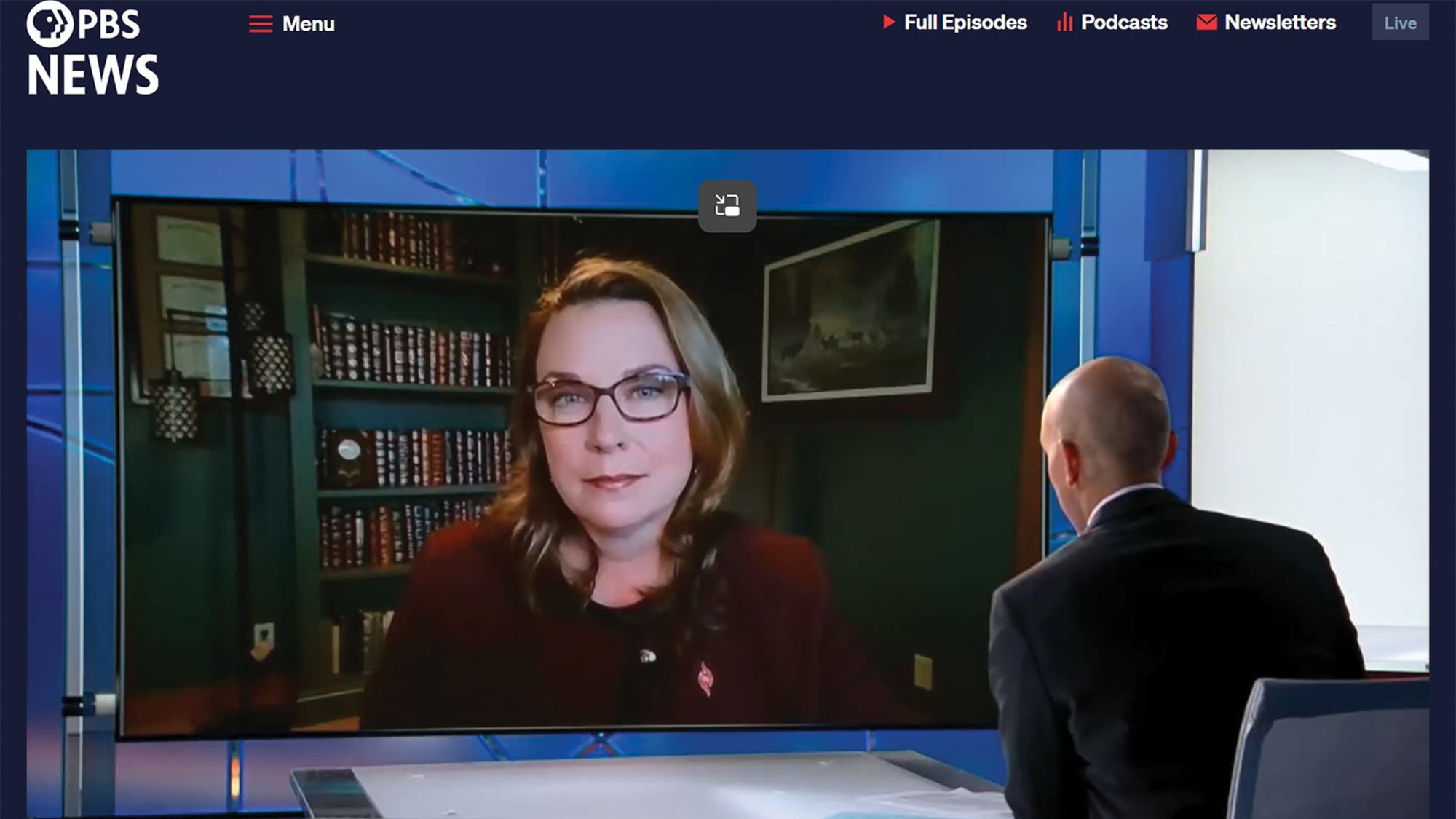

[Pictured Above: ANA President Jennifer Mensik Kennedy on PBS News Hour]
ANA activates multi-pronged campaign to protect access to advanced nursing education.
When faced with an unprecedented challenge to the profession, nurses rallied in a wave of advocacy that fully demonstrated The Power of Nurses™. The spark was passage of the One Big, Beautiful Bill Act (H.R. 1) last year, which eliminated the Graduate PLUS loan program and imposed new limits on federal borrowing for graduate students, jeopardizing the nursing workforce pipeline. Specifically, it established caps of $20,500 annually and $100,000 in aggregate for graduate degree programs, and $50,000 annually and $200,000 in aggregate for professional degree programs. Starting with the provisions and statutory definitions in the law that distinguished between “graduate” and “professional” degrees, the Department of Education (ED) subsequently initiated a negotiated rulemaking process to implement and operationalize these borrowing limits.
Recognizing nurses as the heartbeat of healthcare in the United States, and amid ongoing nursing and faculty shortages, the American Nurses Association (ANA) and its partners sprang into action. The omission of post-baccalaureate nursing degree programs from the professional degree category clearly fails to recognize the clinical training and expertise of these trusted clinicians so needed for our healthcare delivery system. Additionally, post-baccalaureate nursing programs meet the definition defined by H.R. 1 and the purpose of “professional” degree programs—to prepare students with the education necessary for professional practice.
Nursing excluded from deliberations
Through the negotiated rulemaking process, ED convened a committee—the Reimagining and Improving Student Education (RISE) Committee—tasked with determining how to structure the regulations for these new loan limits. At the outset, ANA pushed for nursing representation on the RISE Committee and collaborated with partners on strong coalition letters when our calls went unheeded.
Despite these efforts, the RISE committee failed to recognize the strength and rigor of post-baccalaureate nursing programs, excluding them from the definition of professional degree programs. As a result, as proposed, post-baccalaureate nursing students would only be eligible for HALF the amount of federal loans as students in “professional” degree programs. Moreover, the recommendations limited the professional degrees only to programs in pharmacy, dentistry, veterinary medicine, chiropractic, law, clinical psychology, medicine, optometry, osteopathic medicine, podiatry, and theology. These recommendations were carried through to the proposed rule ED released in January.
A groundswell of grassroots advocacy
Once we saw the recommendations issued by the RISE Committee, we knew that mobilizing nurses to make their voices heard was vital. Before the proposed rule was even published, the response sparked the strongest wave of grassroots advocacy from nurses that we have seen since the personal protective equipment shortages of the COVID-19 pandemic. In a matter of weeks, the efforts gathered over 245,000 petition signatures and sent nearly 18,000 emails to congressional offices through ANA’s grassroots platform alone. Social media was ablaze with nurses and others sharing the importance and technical expertise of their work.
This groundswell garnered national media attention, with nearly 6 billion media impressions and enough engagement that the ED issued a fact sheet in response to the backlash. Congress even got involved, with members of Congress highlighting nurses’ voices on the House Floor, posting on social media, and over 140 members signing onto a ‘Dear Colleague’ letter sent to ED urging for the inclusion of post-baccalaureate nursing degree programs in the proposed rule.
The momentum didn’t stop there. When ED issued its proposed rule in January, which opened a 30-day public comment period, the renewed media attention gave opportunities for ANA President Jennifer Mensik Kennedy, PhD, MBA, RN, NEA-BC, FAAN, to continue to highlight the devastating impact of the proposed rule for the future of post-baccalaureate nursing students and programs across the country. Nurses were ready to advocate for the profession once again by submitting personalized comment letters. ANA provided template language and grassroots campaigns for individual nurses, our constituent and state nurses associations, and organizational affiliates, giving them the opportunity to share how the proposed changes to federal graduate student loan borrowing would impact them and their ability to further their clinical education. Thousands of nurses used that template to make their voices heard.
Nursing IS a professional degree
ANA’s formal comment letter was detailed, first and foremost calling for ED to include post-baccalaureate nursing programs as professional degrees. Our comments focused on how these degrees meet the statutory definition of “professional” degrees in H.R. 1 and how ED’s rulemaking must reflect that. That definition recognizes a degree program as professional if it is needed for entry into a profession, it is generally more than what a student would know at the baccalaureate level, and generally requires professional licensure. Advanced nursing programs clearly meet this definition. We highlighted the critical need for advanced practice registered nurses (APRNs) and nurse faculty and how these degree programs are paramount to meeting that need and worth the federal investment. ANA also argued that provisions in the proposed rule run counter to other priorities within the current administration, where we have seen health agencies take action to recognize and advance APRNs in approaches to overcome challenges in our nation’s healthcare delivery system.
The ED point of view
Of note, ED included some rationale for why they excluded nursing from the professional degree designation. Focusing primarily on nurse practitioners, ED raised that since there is state variance in full practice authority, supervision requirements, and other limitations to practice, these factors warrant the exclusion of nursing degrees from the professional degree category.
ANA strongly pushed back on these assertions, noting that limitations to practice vary across states due to political considerations and decisions, not a reflection of the clinical expertise and training of trusted nurse clinicians. ED also raised the fact that licensure as a registered nurse (RN) was required for post-baccalaureate nursing programs, signifying that the post-baccalaureate degrees were not needed for entry into the profession—one part of the statutory and regulatory definition of professional degrees. ANA detailed how RN licensure was simply a foundational prerequisite to pursue APRN and other post-baccalaureate nursing programs and licensure. The association’s comments provided more context, further highlighting why and how these programs meet the definition of professional degrees.
ANA submitted its formal comment letter before the public comment period closed on March 2, issuing a press statement on our submission (bit.ly/3OyFvNp).
A final rule
BY THE NUMBERS
245,000+
petition signatures
Nearly 8,000
emails to congressional offices
140+
members of Congress sign a letter to the Department of Education
75,000+
comments to the Department of Education overall
Nearly 6 billion
media impressions
ED reviewed and considered the over 75,000 comments submitted and published the final rule on May 1. ED finalized the provisions related to the graduate and professional degree definitions as proposed—meaning students pursuing post-baccalaureate nursing programs will be limited to the lower borrowing amounts. The final rule addresses comments received on why post-baccalaureate nursing programs should be included, with ED standing firm that supervision and other restrictions to advanced nursing practice prevent post-baccalaureate nursing degree programs from meeting their definition of professional degree programs for purposes of determining loan limit eligibility.
ANA expressed its profound dismay in the ruling. “This final rule will limit baccalaureate-prepared nurses’ ability to pursue advanced degrees, including the Master of Science in Nursing, Doctor of Nursing Practice, Doctor of Nurse Anesthesia Practice, and Doctor of Philosophy in Nursing, the very degrees that produce the advanced practice nurses and educators our country so desperately needs,” said Dr. Mensik Kennedy. “Make no mistake, this is not a technicality or a footnote. This rule will be felt in real communities, for example, in rural areas where nurse practitioners, midwives, and nurse anesthesiologists are often the only providers of core care services.”
The new limits go into effect beginning July 1, 2026. ANA is assessing which advocacy approach to pursue now that the rule is finalized. ANA stands ready to keep this issue at the forefront until post-baccalaureate nursing programs are rightly seen as professional degree programs.
—Zina Gontscharow is director of policy & regulatory advocacy at ANA.
American Nurse Journal. 2026; 21(6). Doi: 10.51256/ANJ0626334
 American Nurse is the official journal of the American Nurses Association and is a member benefit. Learn more about the association and the many benefits of joining.